

Key Takeaways
- Convenience meals typically cost two to four times more per serving than comparable scratch-cooked meals.
- The time cost of cooking from scratch is often lower than people assume, especially with meal planning.
- Convenience food can be a practical tool but shouldn't be the default for budget-conscious households.
- Stocking pantry staples significantly narrows the time gap between convenience and scratch cooking.
- Sodium, added sugars, and portion distortion are common nutritional trade-offs in convenience products.
Option A
Convenience Food
The time-saving, grab-and-go option.
Best for: People with very limited time who need ready-to-eat or minimal-prep meals on demand.
Option B
Cooking from Scratch
The affordable, ingredient-first approach.
Best for: Budget-conscious households who want more control over ingredients, portions, and overall spending.
If you're on a tight household budget
Cooking from Scratch
Scratch cooking consistently delivers more servings per dollar. Planning ahead removes most of the time barrier.
If you have genuinely chaotic weeks with no prep time
Convenience Food
Used selectively, convenience meals prevent costly takeout and food waste. Choose lower-sodium options where possible.
If you want better nutrition on a budget
Cooking from Scratch
Scratch cooking gives you full control over ingredients, making it easier to reduce sodium, sugar, and additives.
If you're new to cooking and building confidence
Cooking from Scratch
Simple pantry-based recipes can be made in 20–30 minutes and cost a fraction of packaged alternatives.
What Are We Actually Comparing?
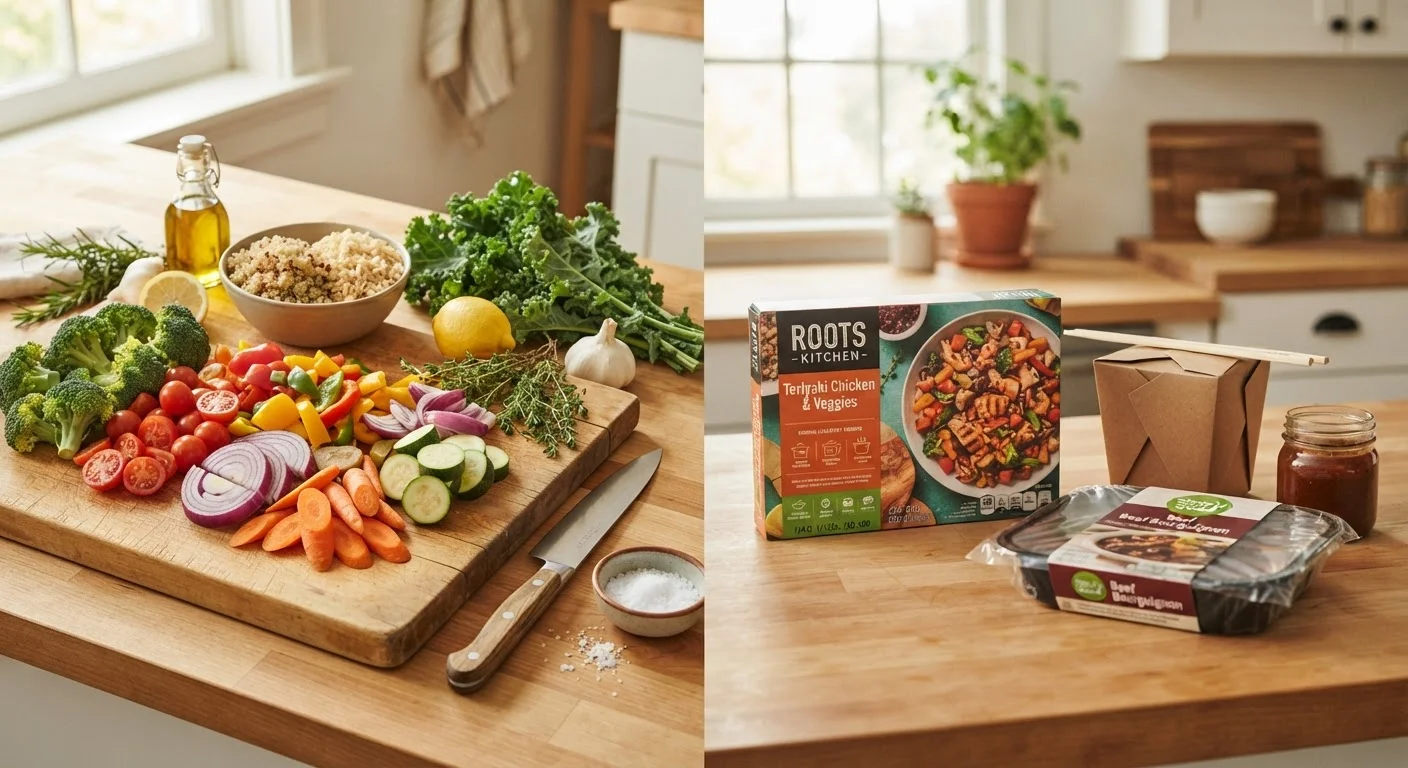
"Convenience food" covers a wide spectrum: frozen dinners, pre-marinated proteins, meal kits, canned soups, rotisserie chicken, and fast-casual takeout. What they share is that someone else has done some or all of the preparation — and priced that labor into the product.
"Cooking from scratch" means starting with raw or minimally processed ingredients — dried beans, whole grains, fresh or frozen vegetables, basic proteins — and doing the assembly yourself. It doesn't require culinary school. Most scratch meals that fit a budget take 20 to 45 minutes to prepare.
The comparison that matters isn't just sticker price. It's cost per serving, time actually spent, nutritional value, and how much food ends up wasted. When you account for all four, the picture shifts considerably. For a deeper look at how marketing can distort your food spending, see common budget-eating myths that quietly inflate your grocery bill.
The Real Price Per Serving
This is where the numbers get clarifying. A frozen mac and cheese dinner serving might cost $3.50 to $5.00 at retail. A batch of homemade mac and cheese made with pasta, cheddar, milk, and butter can produce four to six servings for roughly the same total price — putting cost per serving closer to $0.75 to $1.25.
The same pattern holds for soups, stir-fries, grain bowls, and casseroles. Meal kits, while convenient, typically run $10 to $12 per serving — well above what those same ingredients would cost bought separately.
| Criterion | Convenience Food | Cooking from Scratch |
|---|---|---|
| Average cost per serving | $3.50–$12.00 | $0.75–$2.50 |
| Active prep time | 4–10 minutes | 15–45 minutes |
| Sodium control | Often high, limited control | Full control |
| Ingredient transparency | Moderate — label required | Complete — you choose everything |
| Servings per purchase | Typically 1–2 | Often 4–8 or more |
| Food waste risk | Lower (single portions) | Lower with planning |
| Skill required | Minimal | Basic to moderate |
The gap widens further when you factor in portion sizes. Many convenience products list servings that are smaller than what most adults actually eat, meaning the real per-meal cost is higher than the label implies.
The Time Equation — Reconsidered
Convenience food's strongest argument is time. But this argument deserves scrutiny. A frozen meal takes 4–8 minutes to heat. A simple stir-fry with pre-washed frozen vegetables and cooked grains takes about 15–20 minutes. The time difference is real — but smaller than it feels, especially when you're already tired.
Strategies like batch cooking shrink the daily cooking burden dramatically. Cooking a large pot of beans or grains once covers several meals throughout the week. If you haven't explored this approach, batch cooking vs. meal prepping explains which method suits different schedules best.
A well-stocked pantry also changes the math. When your shelves hold canned tomatoes, lentils, pasta, and spices, a meal is rarely more than 20 minutes away. Stocking a pantry that makes meals almost cook themselves is one of the highest-return habits a budget-focused cook can develop.
3–4x
Cost multiplier for convenience vs. scratch meals
Analysis of comparable meal types consistently shows convenience products costing several times more per serving than home-cooked equivalents made from basic ingredients.
~1,000 mg
Sodium in a typical frozen entrée
Many frozen single-serve meals contain between 700 and 1,200 mg of sodium, according to general nutrition label data from common product categories.
20 min
Median scratch meal prep time with pantry staples
Home cooks with a stocked pantry can typically prepare a complete simple meal in roughly 20 minutes, significantly narrowing the time advantage of convenience products.
Nutrition Trade-Offs Worth Knowing
Beyond cost, convenience foods often carry nutritional trade-offs. High sodium content is the most consistent issue — many frozen meals contain 700–1,200 mg of sodium per serving, which is a significant portion of the daily amount most health guidelines suggest as a general ceiling. Added sugars and refined starches also appear frequently in processed convenience products.
Scratch cooking doesn't automatically mean healthy — it depends on what you're making — but it does put you in control of what goes in. That control matters, particularly for households managing blood pressure, blood sugar, or other diet-sensitive concerns. As always, anyone managing a specific health condition should consult a qualified healthcare professional about their individual dietary needs.
For practical strategies on getting solid nutrition without overspending, eating well on a tight budget offers grounded, everyday guidance. And if you're weighing ingredient choices within scratch cooking, frozen vs. fresh produce breaks down what the price difference actually means for nutrition.
This article is for general informational purposes only and is not a substitute for advice from a qualified healthcare or nutrition professional.