

Key Takeaways
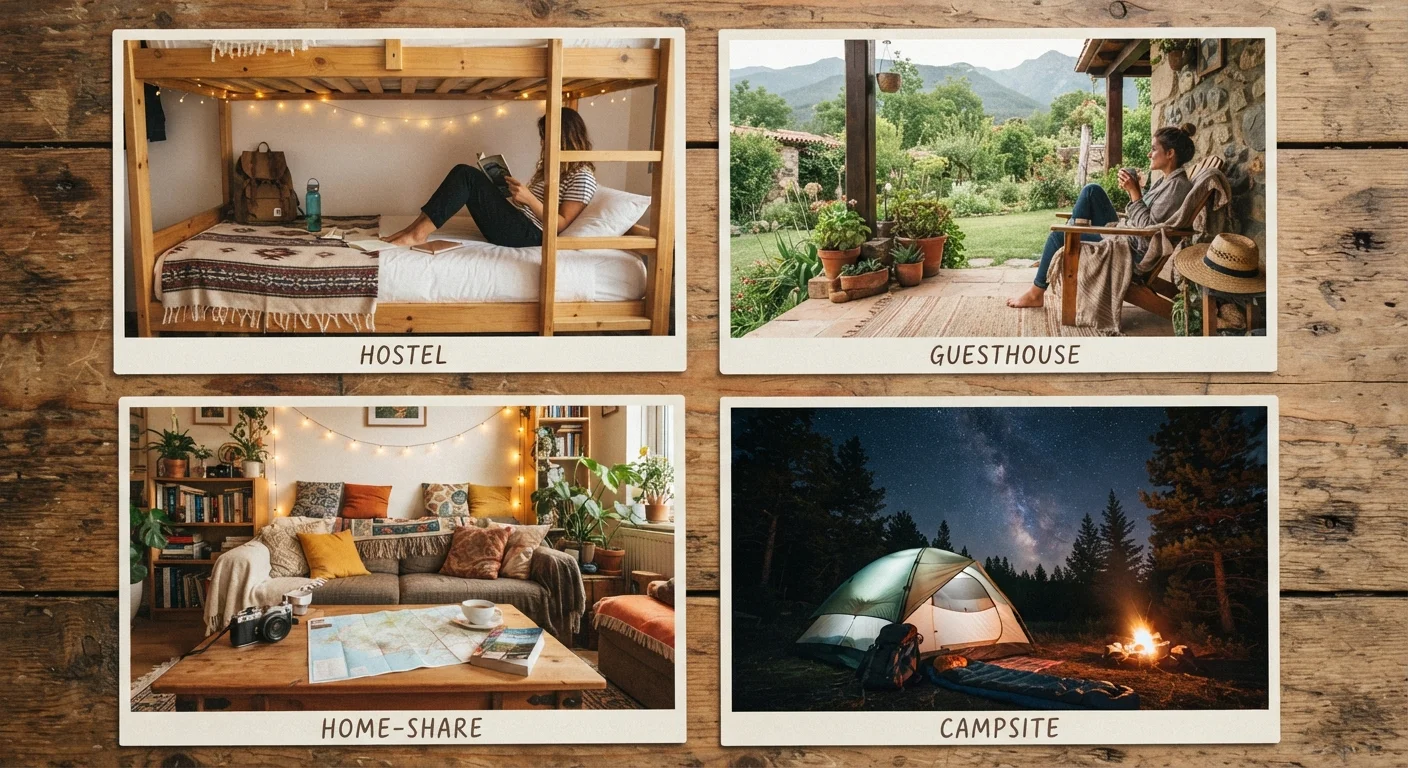
- Hostels offer the lowest nightly cost but require comfort with shared spaces and variable privacy.
- Guesthouses balance affordability with local character, often including breakfast and personal service.
- Home-shares work best for longer stays or families needing kitchen access and extra space.
- Camping delivers unmatched immersion in nature at low cost, with the trade-off of physical effort and gear.
Our Verdict
No single lodging type wins across the board — each genuinely suits a different traveler profile and trip goal. Hostels shine for social solo adventurers watching every dollar; guesthouses reward cultural curious travelers who want local warmth without roughing it; home-shares make sense for groups or extended stays; and camping delivers the deepest outdoor connection at the lowest daily cost when you own the gear.
| Best for | Recommended |
|---|---|
| Solo travelers and social budget-seekers | Hostel |
| Culture-curious travelers wanting personal service | Guesthouse |
| Families, groups, or week-plus stays | Home-share |
| Outdoor enthusiasts prioritizing immersion over comfort | Camping |
Why Your Lodging Choice Matters More Than You Think
Hotels are the default — familiar, predictable, and priced accordingly. But once you step outside that comfort zone, you discover that where you sleep fundamentally shapes how you experience a place. Your lodging determines your neighbors, your morning routine, your food options, and often your nightly spend. For budget-conscious travelers, it's one of the highest-leverage decisions on any trip.
This breakdown covers four practical alternatives — hostels, guesthouses, home-shares, and camping — with honest tradeoffs on cost, privacy, social opportunity, and logistics. Whether you're planning a solo adventure or a group trip or figuring out the right base for a self-guided itinerary, this comparison gives you a clear framework to decide.
Hostels: Maximum Social Energy, Minimum Spend
Hostels remain the go-to for travelers who want to stretch their budget as far as possible. Dormitory beds in the United States typically run between $25–$60 per night depending on the city, while private rooms in hostels often undercut comparable hotel rates by 30–50%. The tradeoff is real, though: shared bathrooms, bunk configurations, and communal noise are standard features, not bugs.
What hostels offer beyond savings is harder to quantify: common rooms that become impromptu meet-ups, staff who genuinely know the local scene, and a built-in community of like-minded travelers. For solo travelers in particular, hostels can eliminate the isolation that sometimes shadows independent trips.
Getting the Most From a Hostel Stay
If noise and light sensitivity are concerns, look for hostels that offer 4- or 6-bed dorms rather than 12+, and request a lower bunk when booking. Many hostels now use app-based check-in and offer private lockers for valuables — features worth confirming before you arrive. Reading recent reviews specifically about cleanliness and noise levels gives you a much more accurate picture than star ratings alone.
If noise and light sensitivity are concerns, look for hostels that offer 4- or 6-bed dorms rather than 12+, and request a lower bunk when booking. Many hostels now use app-based check-in and offer private lockers for valuables — features worth confirming before you arrive.
Guesthouses: Local Character Without Roughing It
A guesthouse sits comfortably between a hostel and a boutique hotel — typically a family-run property with private rooms, often including breakfast, and a distinctly personal atmosphere that chain hotels simply can't replicate. Pricing varies widely by region, but guesthouses frequently land 20–40% below equivalent hotel rates in the same area.
The host relationship is guesthouses' real differentiator. Owners often provide restaurant tips, transport advice, and cultural context that no app algorithm surfaces. For travelers whose priorities lean toward experiencing a place authentically, this insider access can be genuinely trip-defining. The limitation: availability in rural or off-the-beaten-path areas can be inconsistent, and quality control varies more than with branded hotels.
| Hostel | Guesthouse | Home-Share | Camping | |
|---|---|---|---|---|
| Typical nightly cost (US) | $25–$60 dorm | $60–$130 private room | $70–$200+ (varies by size) | $0–$35 per site |
| Privacy level | Low (shared dorm) | Moderate (private room) | High (full unit available) | Variable (site spacing) |
| Kitchen access | Communal kitchen | Rarely included | Usually included | Portable stove only |
| Social opportunity | Very high | Moderate | Low to moderate | Low to moderate |
| Best stay length | 1–5 nights | 1–7 nights | 5+ nights | 2–10+ nights |
| Gear or setup required | None | None | None | Significant |
| Local character | Moderate | High | Moderate | High (nature-based) |
Home-Shares: Space, Flexibility, and Kitchen Privileges
Home-share platforms have made renting an apartment, cottage, or private room in someone's home a mainstream option. The value proposition is strongest for groups of three or more, longer stays of five-plus nights, and anyone who wants a kitchen — which alone can meaningfully reduce food costs on extended trips.
Families traveling with children often find home-shares the most practical choice: more square footage, separate sleeping areas, laundry access, and the ability to maintain some semblance of a routine. The adjustment required when sharing someone's active home isn't trivial, though — navigating shared living spaces takes communication and flexibility. Cleaning fees and service charges can also erode the apparent cost advantage on shorter stays, so always calculate the full nightly rate before comparing.
Camping: The Deepest Immersion at the Lowest Cost
When gear is already owned or rented, camping consistently delivers the lowest nightly accommodation cost of any option. Public campsite fees across US national forests and state parks commonly range from free dispersed camping to $10–$35 per night for developed sites. That math is hard to argue with on longer outdoor trips.
The real investment is upfront — quality sleep gear, a reliable shelter system, and food prep equipment — plus the physical commitment that comes with backcountry travel. For travelers still figuring out which outdoor format fits them, the car camping vs. backpacking comparison lays out exactly how those two approaches diverge. Pairing smart camping decisions with well-chosen ground transportation can make an entire multi-destination trip remarkably affordable.
One honest caveat: weather dependency, permit requirements in high-demand areas, and the physical demands of camp life mean camping isn't universally accessible. Verify reservation windows and site conditions through official land management agency sources before finalizing any plans.