

Key Takeaways
- Simple tasks like air filter swaps and wiper replacements are safe and cost-effective for most drivers to handle themselves.
- Work involving brakes, suspension, or safety systems generally warrants a qualified mechanic's attention.
- DIY maintenance can save money but requires the right tools, time, and an honest assessment of your skill level.
- Poorly executed DIY repairs can void warranties or create larger, costlier problems down the road.
- Keeping a maintenance log — whether you DIY or use a garage — helps protect your car's reliability and resale value.
Significant cost savings on parts and labor
Mechanics charge both for parts and labor time, which can double or triple the cost of a straightforward job. Doing it yourself means paying only for parts and any consumables.
You work on your own schedule
No booking appointments, no waiting for a loaner car, no surprise delays. For simple tasks, you can complete them in an afternoon when it suits you.
Builds genuine familiarity with your vehicle
Regularly working on your own car means you notice changes in condition earlier, which can catch small problems before they escalate into costly repairs.
Eliminates upsell pressure
Some service centers recommend additional work during routine visits. Handling maintenance yourself removes that dynamic entirely for jobs within your capability.
Mistakes can create expensive secondary problems
An over-torqued drain plug can strip an oil pan thread. A disconnected sensor can trigger cascading warning lights. Simple errors have a way of compounding quickly.
Upfront tool investment can offset savings
Some jobs require specific tools — torque wrenches, filter removal tools, jack stands — that cost money to acquire. Infrequent DIYers may not recoup that investment easily.
Safety systems should not be experimented on
Brakes, steering, and suspension work require precision that goes beyond general mechanical aptitude. Errors in these areas can cause accidents, not just mechanical failures.
May affect warranty coverage
On newer vehicles, DIY repairs performed without proper documentation can complicate warranty claims if something goes wrong in a related system afterward.
Modern vehicles are increasingly complex
Many repairs that were once accessible now involve electronic control modules, specialized calibration steps, or require a dealer-level scan tool to complete properly.
Our Verdict
DIY maintenance makes clear financial sense for basic, low-risk tasks where the margin for error is small. But for anything involving your vehicle's safety systems, emissions controls, or complex diagnostics, the cost of getting it wrong outweighs the savings. Most drivers benefit from a mixed approach — handling what they confidently can while relying on a professional for anything that puts safety or reliability at real risk.
Drivers with some mechanical curiosity, basic tools, and the patience to research before turning a wrench — especially those focused on keeping long-term ownership costs down.
What DIY Car Maintenance Actually Covers
"DIY car maintenance" covers a wide spectrum — from checking your tire pressure to replacing brake calipers. Not all of it is equally accessible. For most drivers without a lift, specialty tools, or formal training, the realistic DIY zone is narrower than YouTube tutorials might suggest.
Tasks that are genuinely approachable for a careful, research-minded driver include: engine air filter replacement, cabin air filter swaps, windshield wiper replacement, battery swaps on most vehicles, topping up fluids (washer fluid, coolant reservoir, power steering fluid), and basic bulb replacements where access allows. These jobs share a few things in common — they involve minimal disassembly, pose little risk if done incorrectly in minor ways, and require tools most people already own.
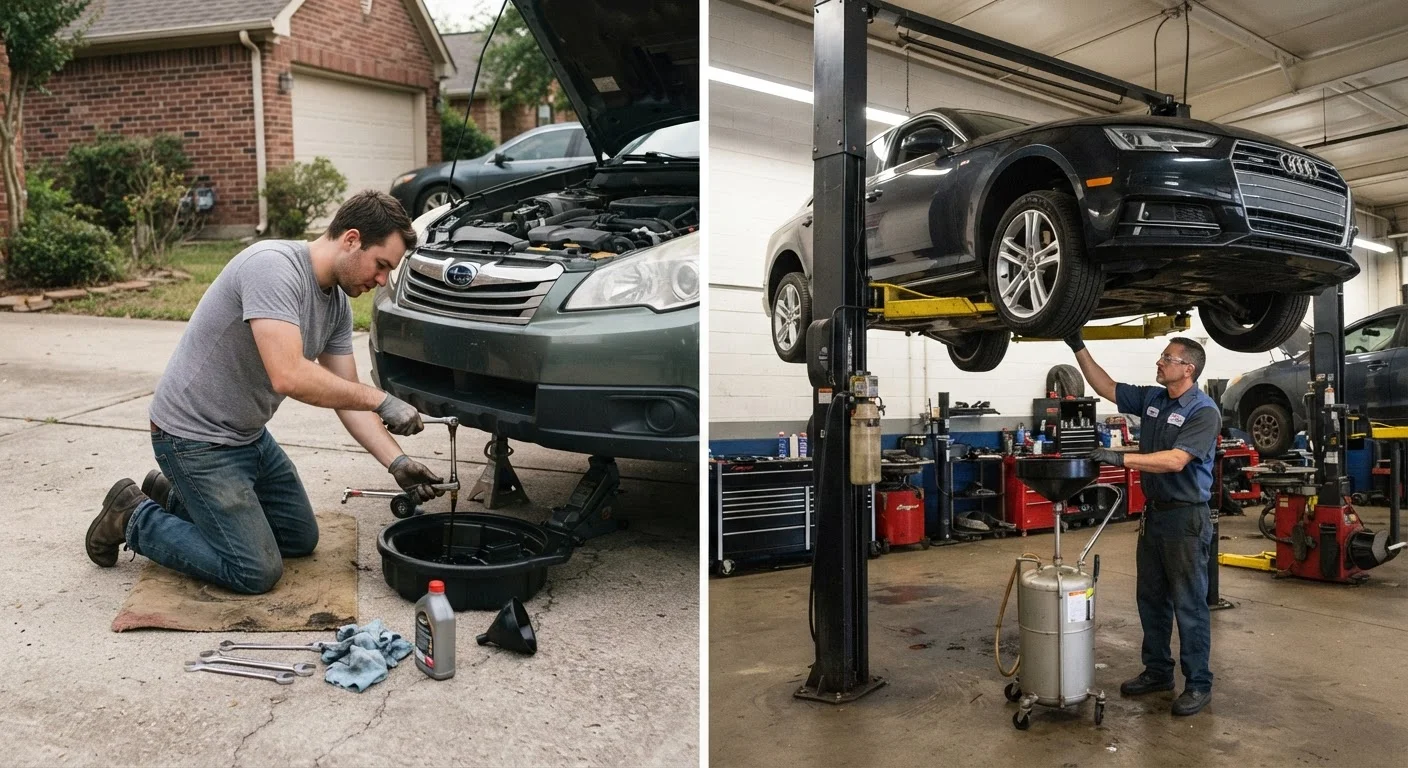
Oil changes fall in a middle zone. They're technically simple, but they require safely lifting and supporting the vehicle, properly torquing a drain plug, and disposing of used oil responsibly. For drivers with the right setup, it's manageable. For those without jack stands and a flat, stable surface, it's not worth the risk.
Before diving into any task, check your owner's manual. It tells you what your specific vehicle needs, and it's the most overlooked resource in most garages. You can also track what you've done yourself using a vehicle maintenance log — useful for spotting patterns and staying on schedule.
The Honest Pros of Doing It Yourself
The financial argument for DIY is real, but it comes with conditions. Here's where it genuinely pays off:
Significant cost savings on parts and labor
Mechanics charge both for parts and labor time, which can double or triple the cost of a straightforward job. Doing it yourself means paying only for parts and any consumables.
You work on your own schedule
No booking appointments, no waiting for a loaner car, no surprise delays. For simple tasks, you can complete them in an afternoon when it suits you.
Builds genuine familiarity with your vehicle
Regularly working on your own car means you notice changes in condition earlier, which can catch small problems before they escalate into costly repairs.
Eliminates upsell pressure
Some service centers recommend additional work during routine visits. Handling maintenance yourself removes that dynamic entirely for jobs within your capability.
Beyond cost, there's also the benefit of understanding your car better. Drivers who handle their own maintenance tend to notice problems earlier — an unusual smell when changing the oil, a worn belt spotted while replacing an air filter. That kind of familiarity has practical value.
Where DIY Creates More Problems Than It Solves
Honest DIY advice has to include the failure modes. These are the situations where going it alone tends to backfire:
Mistakes can create expensive secondary problems
An over-torqued drain plug can strip an oil pan thread. A disconnected sensor can trigger cascading warning lights. Simple errors have a way of compounding quickly.
Upfront tool investment can offset savings
Some jobs require specific tools — torque wrenches, filter removal tools, jack stands — that cost money to acquire. Infrequent DIYers may not recoup that investment easily.
Safety systems should not be experimented on
Brakes, steering, and suspension work require precision that goes beyond general mechanical aptitude. Errors in these areas can cause accidents, not just mechanical failures.
May affect warranty coverage
On newer vehicles, DIY repairs performed without proper documentation can complicate warranty claims if something goes wrong in a related system afterward.
Modern vehicles are increasingly complex
Many repairs that were once accessible now involve electronic control modules, specialized calibration steps, or require a dealer-level scan tool to complete properly.
Brake work deserves special mention. Improperly installed brake components are a direct safety hazard — not just for you, but for everyone on the road. The same goes for suspension components, wheel bearings, and anything involving the steering system. These aren't areas to practice on.
If you're unsure what a mechanic's invoice is actually telling you, our guide on reading a mechanic's quote breaks down the line items so you can follow along and ask better questions.
Tasks That Belong in a Garage
Some jobs require professional attention — not because drivers aren't capable of learning, but because the tools, safety considerations, or diagnostic complexity place them outside reasonable DIY territory.
- Brake pad and rotor replacement — involves precision torque specs, bleeding brake lines, and direct impact on stopping distance.
- Timing belt or chain service — a misalignment here can destroy an engine. Labor-intensive and unforgiving of error.
- Transmission service — fluid changes are sometimes DIY-able, but internal transmission work is not.
- Wheel alignment — requires calibrated equipment. No amount of careful eyeballing substitutes for a proper alignment rack. See our breakdown of tire rotation, alignment, and balancing for more context.
- Emissions or check-engine diagnostics — reading a code with a cheap OBD-II scanner gives you a starting point, but accurate diagnosis usually requires professional equipment and interpretation.
For high-mileage vehicles especially, the complexity of what needs attention increases. Our overview of keeping a car past 100,000 miles outlines which components tend to need professional-level attention as vehicles age.
~35–50%
Typical labor share of a mechanic's total bill
Industry estimates consistently place labor at roughly a third to half of most repair invoices, which is the core of DIY's savings potential.
1 in 3
US drivers who report doing some of their own maintenance
Consumer surveys suggest a significant portion of drivers handle at least basic tasks like fluid top-ups, wiper swaps, or battery replacements themselves.
Building a Practical Mixed Approach
The most cost-effective strategy for most drivers isn't fully DIY or fully professional — it's knowing where the line is for your own situation. A few principles help draw that line clearly:
- Assess the consequences of getting it wrong. If a mistake costs you $20 and a re-do, that's acceptable. If it could compromise stopping power or cause engine damage, it isn't.
- Be honest about your tools and workspace. A driveway and a basic socket set support a certain range of tasks. Don't try to extend beyond what your setup safely allows.
- Research before you start, not halfway through. Stopping mid-job because you hit an unexpected complication is how easy tasks become expensive ones.
- Use seasonal prep as a planning opportunity. The seasonal maintenance checklist covers items you can assess yourself — and helps you identify what needs a professional look before weather extremes arrive.
Small deferred maintenance items — low brake fluid, a slow coolant leak, worn wiper blades heading into winter — have a way of becoming much bigger problems. Understanding that pattern is part of smart ownership. Our article on why skipping small repairs leads to bigger bills explains the mechanics of how that happens.
When you do use a garage, knowing how to read the invoice matters. And if you're weighing which type of garage to use, the comparison between dealership vs. independent garage servicing lays out the trade-offs clearly.