

Key Takeaways
- Tyre rotation moves tyres between positions to even out wear; it doesn't fix shimmy or pulling.
- Wheel alignment corrects the angles your wheels sit at, preventing uneven wear and drifting.
- Balancing eliminates vibration caused by uneven weight distribution around the wheel.
- All three are distinct jobs with different intervals — confusing them leads to missed maintenance.
- Getting all three done on schedule extends tyre life and can improve fuel economy.
Our Verdict
Rotation, alignment, and balancing each solve a different problem. Rotation is the most frequent and cheapest task, alignment matters most when you notice pulling or uneven wear, and balancing is the fix when you feel vibration through the steering wheel or seat. Doing all three on their appropriate schedules is the most cost-effective way to get the full life out of a set of tyres.
| Best for | Recommended |
|---|---|
| Drivers looking to extend tyre lifespan on a budget | Regular tyre rotation |
| Anyone whose car drifts to one side or shows uneven tread wear | Wheel alignment |
| Drivers feeling vibration at highway speeds | Wheel balancing |
Why These Three Jobs Get Mixed Up
Walk into any tyre shop and the service board lists rotation, alignment, and balancing in close proximity. Many drivers assume these are interchangeable terms for the same general job — tweaking the tyres. They aren't. Each addresses a completely different mechanical issue, uses different equipment, and needs to happen on a different schedule. Mixing them up either means paying for work that won't fix your actual problem, or skipping something that's quietly wearing out your tyres ahead of time.
The confusion is understandable. All three involve your wheels and tyres, and shops sometimes bundle them together in service packages. But understanding what each one does takes only a few minutes and can save you real money over the life of your vehicle. For a broader look at which tyre-related checks you can do yourself versus which need a professional, see our guide on DIY maintenance vs. garage work.
Tyre Rotation: Moving Tyres to Even Out Wear
Rotation means physically swapping your tyres between wheel positions — for example, moving the front tyres to the rear and vice versa, sometimes crossing left to right depending on your vehicle's drivetrain. The goal is simple: front tyres on a front-wheel-drive car handle steering and most of the braking force, so they wear faster than the rears. Without rotation, you'd replace two tyres long before the other two need changing.
Most manufacturers recommend rotation every 5,000 to 7,500 miles, though your owner's manual is the definitive source. It's typically the least expensive of the three jobs and the one done most frequently. Rotation won't stop your car from pulling to one side, and it won't cure vibration — those are alignment and balancing problems respectively.
Check Your Owner's Manual First
Manufacturer-recommended intervals for rotation vary by drivetrain and tyre type. All-wheel-drive vehicles often need more frequent rotation than two-wheel-drive models because all four tyres share propulsion load differently. Your manual will give the most accurate interval for your specific vehicle — it takes precedence over any general rule of thumb.
Keeping tabs on tyre pressure regularly complements rotation. Correctly inflated tyres wear more predictably and make the benefits of rotation last longer. Our article on tyre pressure and safety covers what numbers to look for and where to find them.
Wheel Alignment: Correcting the Angles
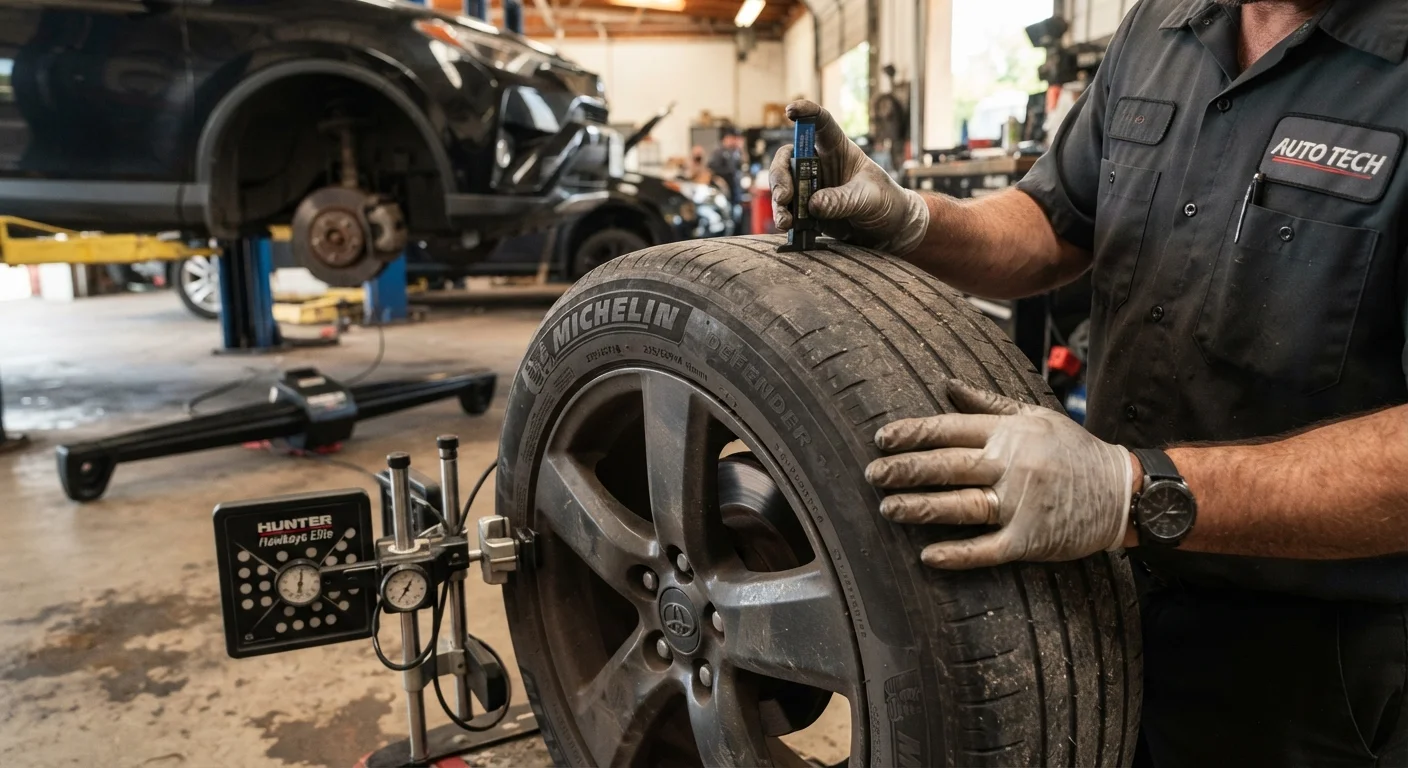
Alignment is about geometry, not physical tyre position. A mechanic places your car on a specialized rack and measures the angles at which your wheels sit relative to each other and the road surface — camber (tilt in or out), toe (pointing in or out), and caster (forward or backward lean of the steering axis). When these angles drift out of spec — from hitting a pothole, a curb strike, or normal wear on suspension components — your tyres scrub against the road at a slight angle instead of rolling cleanly.
The symptoms of misalignment include the car pulling to one side, the steering wheel sitting off-center on a straight road, and uneven tread wear — one edge of a tyre wearing faster than the other. If you notice any of these, alignment is the right fix. Most shops recommend checking alignment once a year or after any significant impact. It won't fix vibration caused by an imbalanced wheel, and it won't equalize tread depth the way rotation does.
| Tyre Rotation | Wheel Alignment | Wheel Balancing | |
|---|---|---|---|
| What it fixes | Uneven tread wear between positions | Incorrect wheel angle causing pull or edge wear | Vibration from uneven weight distribution |
| Typical symptom | Faster wear on drive axle tyres | Car pulls to one side; uneven shoulder wear | Steering wheel or seat vibrates at speed |
| Recommended interval | Every 5,000–7,500 miles | Annually or after significant impact | With new tyres; every 10,000–12,000 miles |
| Equipment used | Standard lift and hand tools | Alignment rack with sensors | Wheel balancer with counterweights |
| DIY feasibility | Possible if you can lift the car safely | Requires specialized equipment — shop job | Requires balancer machine — shop job |
| Relative cost (general) | Lowest of the three | Moderate | Low to moderate |
Understanding your tyre's sidewall markings can also clue you in to wear patterns that signal alignment issues. See what the markings on your tyres actually mean for a plain-language breakdown.
Wheel Balancing: Smoothing Out the Spin
Every tyre and wheel assembly has slight variations in weight distribution around its circumference. When those imperfections are significant enough, the wheel wobbles slightly as it spins, creating vibration you feel through the steering wheel or floorboard — typically at speeds above 50–60 mph. Balancing fixes this by attaching small counterweights to the wheel rim at precisely calculated points.
Balancing is typically recommended when you mount new tyres, and many shops suggest rechecking it every 10,000 to 12,000 miles or whenever you feel that characteristic highway vibration. It won't correct the directional pull of misalignment, and it won't redistribute tread depth — that's rotation's job. Unresolved vibration isn't just annoying; over time it stresses suspension and steering components. If vibration is left long enough, the resulting handling instability becomes a safety concern — something covered in depth in our article on handling tyre blowouts and other emergencies.
How to Decide Which Service You Actually Need
Matching symptoms to the right service saves time and avoids paying for work that won't help. Use this as a rough guide:
- Vibration at highway speed: Balancing first. If that doesn't fully resolve it, alignment may also be a factor.
- Car drifts or pulls to one side: Alignment. Check tyre pressures first — unequal inflation between sides can mimic this symptom.
- Uneven tread wear across the tyre width: Alignment. Wear on one shoulder only is a classic sign of a camber or toe problem.
- Tyres wearing faster on front than rear (or vice versa): Rotation is overdue, or the interval needs shortening.
- New tyres just installed: Always balance; alignment check is smart too, especially if the old tyres showed uneven wear.
For a full picture of the small checks that keep running costs down alongside these services, see our piece on tyre pressure, air filters, and cost-cutting checks.