
Servicing at a Dealership vs. an Independent Garage: What the Difference Costs You

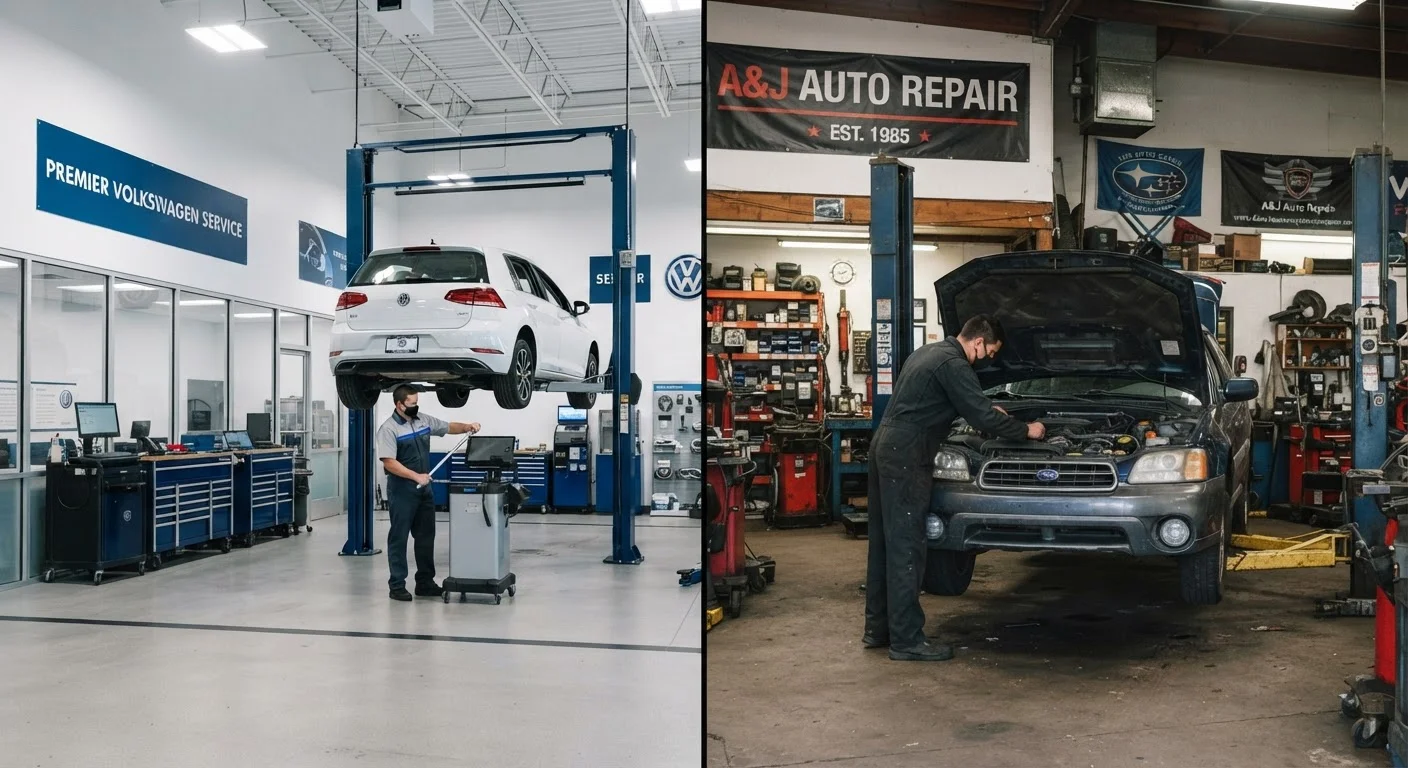
Key Takeaways
- Dealerships typically charge higher labor rates but offer manufacturer-trained technicians and OEM parts.
- Independent garages often cost 20–40% less for the same service, but quality varies widely.
- Using an independent garage during the warranty period is legal and won't void your warranty if documented correctly.
- For complex, model-specific diagnostics, a dealership's specialized tools can be worth the extra cost.
- Getting a written estimate and asking about parts sourcing applies whether you choose a dealer or an independent shop.
Factory-trained technicians for your specific make
Dealer technicians complete manufacturer certification programs and often receive model-specific training updates. This matters most for complex electronic systems on newer vehicles.
Proprietary diagnostic tools and software access
Some manufacturers restrict certain diagnostic and reprogramming functions to dealer-level tools. For software-related faults, this access can be the difference between a proper fix and a workaround.
Genuine OEM parts as standard
Dealerships use factory-specification parts by default, which maintains the original engineering tolerances and can matter for longevity on key components.
Handles warranty and recall work directly
Any open recalls or warranty repairs are processed through the dealer at no cost to you. Independent garages cannot perform manufacturer warranty repairs on your behalf.
Significantly higher labor rates
Dealership hourly labor rates can run 30–50% above comparable independent shops in the same area, adding up quickly on jobs that involve several hours of work.
Tendency to recommend beyond what's necessary
Service advisors at dealerships are often compensated partly on upsells. Some recommended services are mileage-triggered rather than condition-based, meaning you may pay for work your car doesn't yet need.
Less flexibility on parts sourcing
Dealerships typically won't fit customer-supplied parts and default to OEM pricing. Independent shops can often source equivalent parts at lower cost, especially for older models.
Longer wait times and less personal service
High-volume dealer service departments often operate with service advisors acting as intermediaries, making it harder to speak directly with the technician or get detailed explanations of the work.
Our Verdict
Neither option is universally better — the right choice hinges on your car's age, complexity, and what the job actually involves. For routine maintenance on older vehicles, a reputable independent garage almost always delivers comparable work at a lower price. For warranty work, recalls, or complex electronic diagnostics on newer models, a dealership's specialized access is often worth the premium.
Budget-conscious drivers with vehicles more than three years old will typically get the most value from a trusted independent garage, while owners of newer or more complex vehicles may find the dealership's expertise and tooling worth the cost difference for specific jobs.
Where the Price Gap Actually Comes From
The cost difference between a dealership and an independent garage isn't arbitrary — it reflects real structural differences in how each business operates. Dealerships carry higher overhead: manufacturer certification requirements, purpose-built facilities, factory diagnostic equipment, and brand-mandated service procedures all add cost. That overhead gets passed to you through higher labor rates, which can run $130–$180 per hour at a franchised dealer versus $80–$130 at a typical independent shop.
Parts pricing is another factor. Dealerships use Original Equipment Manufacturer (OEM) parts — components made to the same spec as what came in your car. Independent garages often use OEM-equivalent aftermarket parts, which are generally reliable but sometimes cheaper. The gap in parts cost can be significant on certain repairs, though independent shops may also source genuine OEM parts if you ask.
For a clear breakdown of what you're actually paying for on any invoice, see our guide to understanding every line on a service invoice.
Dealership Servicing: Pros and Cons
The case for the dealership comes down to specialization. Technicians are factory-trained on your specific make and model, and the shop has access to proprietary diagnostic software that independent garages often cannot obtain. On modern vehicles — where software and sensors drive more systems than mechanical parts — that access matters.
Factory-trained technicians for your specific make
Dealer technicians complete manufacturer certification programs and often receive model-specific training updates. This matters most for complex electronic systems on newer vehicles.
Proprietary diagnostic tools and software access
Some manufacturers restrict certain diagnostic and reprogramming functions to dealer-level tools. For software-related faults, this access can be the difference between a proper fix and a workaround.
Genuine OEM parts as standard
Dealerships use factory-specification parts by default, which maintains the original engineering tolerances and can matter for longevity on key components.
Handles warranty and recall work directly
Any open recalls or warranty repairs are processed through the dealer at no cost to you. Independent garages cannot perform manufacturer warranty repairs on your behalf.
On the downside, the premium is real and not always justified. A routine oil change or brake pad replacement doesn't require model-specific expertise. Dealerships also have a reputation for upselling services based on mileage schedules that may exceed what your owner's manual actually requires. Always cross-reference any recommended service against your manufacturer's schedule — understanding your car's service schedule explains what interim, full, and manufacturer services genuinely include.
Significantly higher labor rates
Dealership hourly labor rates can run 30–50% above comparable independent shops in the same area, adding up quickly on jobs that involve several hours of work.
Tendency to recommend beyond what's necessary
Service advisors at dealerships are often compensated partly on upsells. Some recommended services are mileage-triggered rather than condition-based, meaning you may pay for work your car doesn't yet need.
Less flexibility on parts sourcing
Dealerships typically won't fit customer-supplied parts and default to OEM pricing. Independent shops can often source equivalent parts at lower cost, especially for older models.
Longer wait times and less personal service
High-volume dealer service departments often operate with service advisors acting as intermediaries, making it harder to speak directly with the technician or get detailed explanations of the work.
Independent Garages: Where the Value Case Holds Up
A well-established independent garage run by qualified mechanics can handle the vast majority of maintenance and repair work on most vehicles. For routine jobs — oil and filter changes, brake work, tyres, coolant flushes — the mechanical task is identical regardless of where you have it done. The savings on those jobs are straightforward.
20–40%
Typical labor cost savings at independent garages
Consumer automotive surveys consistently show independent garages charge meaningfully less per hour for equivalent maintenance tasks compared to franchised dealers.
77%
Drivers who use independent shops post-warranty
According to research by the Auto Care Association, the majority of US vehicle owners shift to independent garages once their manufacturer warranty expires.
Independent shops also tend to offer more personalized service. You're more likely to speak directly with the person who worked on your car, which makes it easier to ask follow-up questions. That said, quality varies considerably between shops. A good independent mechanic with the right equipment is an asset; a poorly equipped shop taking on work beyond its capability is a liability. Ask about certifications (ASE certification in the US is a credible benchmark), check reviews, and don't hesitate to ask how familiar the shop is with your specific vehicle.
If you're weighing how much you can reasonably handle yourself versus when to bring in a pro, this breakdown of DIY vs. garage maintenance covers the trade-offs honestly.
The Warranty Question — Cleared Up
One of the most persistent myths in car ownership is that using an independent garage voids your manufacturer's warranty. In the United States, the Magnuson-Moss Warranty Act generally prohibits manufacturers from voiding a warranty simply because you used a third-party service provider — provided the work was done correctly and with appropriate-quality parts.
Your Warranty Rights Under Federal Law
The Magnuson-Moss Warranty Act (15 U.S.C. § 2302) generally prevents a manufacturer from voiding your warranty solely because you used an independent garage for routine maintenance. The key requirements are that the work is performed competently and that parts and fluids meet manufacturer specifications. Keep all receipts as documentation. If you believe a dealer is incorrectly voiding your warranty, the Federal Trade Commission provides guidance on your rights.
What this means practically: you can take your two-year-old car to a reputable independent garage for an oil change without losing your powertrain warranty. Keep all receipts and service records, note the parts and fluids used, and make sure they meet the manufacturer's specifications listed in your owner's manual. Where dealerships do have a genuine advantage is for warranty repair work itself — if a component fails under warranty, the dealer handles the claim directly with the manufacturer at no cost to you.
Understanding exactly what any service entails before you authorize it — at either type of shop — is essential. Reading a mechanic's quote walks through the terminology so you can have an informed conversation before work begins.
How to Decide for Your Situation
The practical decision framework is simpler than the marketing from both sides suggests. Consider the dealership for: recall work (which is always free at the dealer), warranty repairs, complex software or electrical diagnostics on newer vehicles, and any job where model-specific tooling is genuinely required. Consider an independent garage for: routine maintenance, brake jobs, tyre replacement, general repairs on vehicles older than three to five years, and any situation where the dealership quote seems disproportionate to the complexity of the task.
Get a written estimate from both before committing on larger jobs. Ask each shop whether they're using OEM or aftermarket parts, and check that any fluids meet your manufacturer's spec. The car maintenance hub has additional guidance on keeping your vehicle reliable without overspending across its entire service life.
Price alone shouldn't drive the decision — but paying more should always come with a clear reason.