

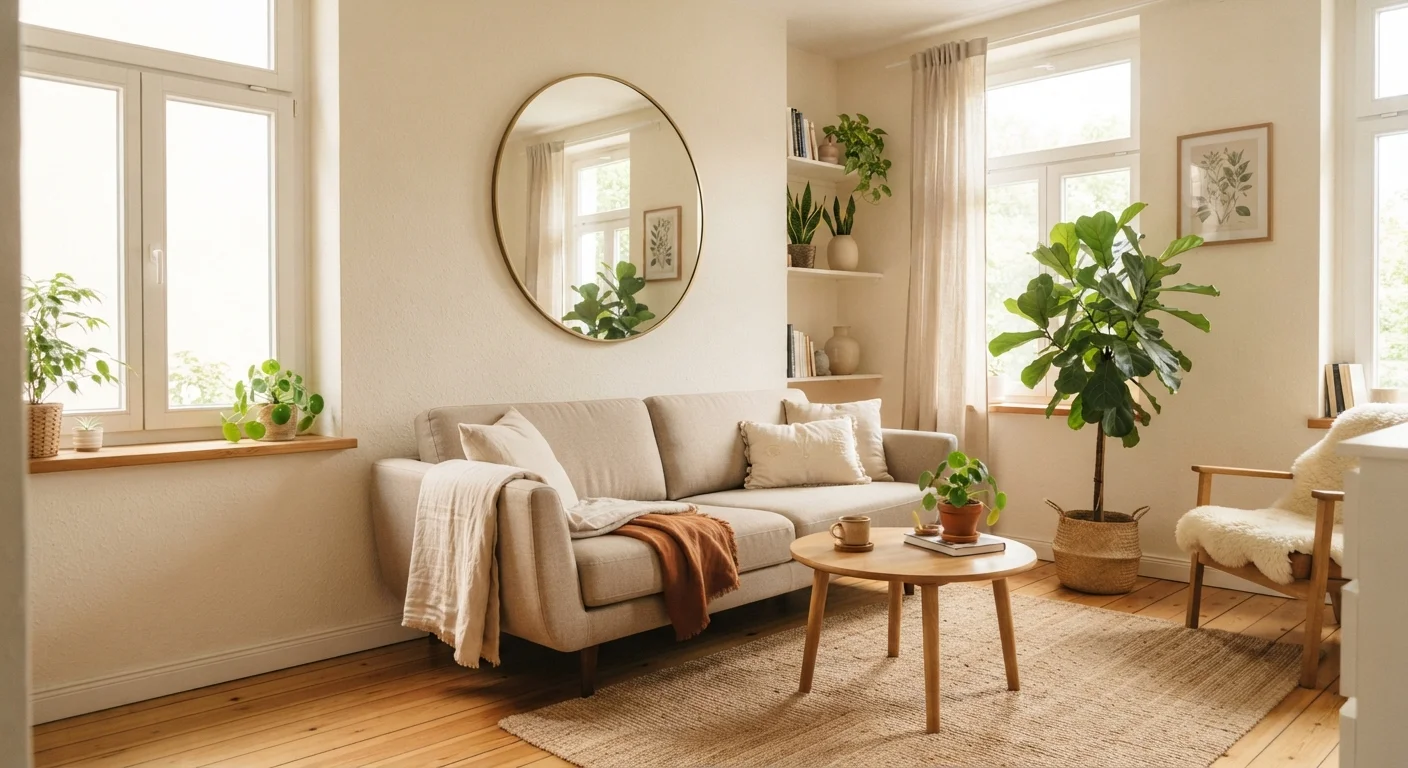
Key Takeaways
- Clutter is one of the biggest contributors to a room feeling cramped — it crowds the visual field.
- Dark walls absorb light and pull surfaces closer, making rooms feel smaller than they are.
- Furniture scale matters: oversized pieces in a small room shrink perceived open space.
- Strategic use of mirrors, lighting, and vertical lines can meaningfully shift how spacious a room feels.
- Most fixes that improve perceived space cost little or nothing to implement.
Perceived Room Size
Perceived room size is how large or small a space feels to the people using it — which often has little to do with the room's actual square footage. Visual cues like color, lighting, clutter, and furniture placement send signals to the brain that either open up or compress a room's apparent volume. A small room can feel surprisingly airy with the right choices, while a larger room can feel cramped with the wrong ones.
This phenomenon is rooted in visual psychology — specifically, how the brain processes contrast, depth cues, and peripheral boundaries to estimate the size of a space.
It's Not Just the Square Footage
When a room feels cramped, most people assume the fix involves knocking down a wall or moving to a bigger place. In reality, square footage is only part of the story. The brain uses a range of visual shortcuts to estimate space — and those shortcuts are surprisingly easy to influence without a renovation budget.
Understanding why a room feels small is the first step to doing something practical about it. The culprits are almost always the same: too much visual noise, wrong-scaled furniture, light that doesn't reach the edges of the room, or color choices that pull the walls inward.
How the Brain Reads Space
Your brain estimates room size by scanning for boundaries — where walls, floors, and ceilings begin and end. When those boundaries are obscured or visually cluttered, the brain registers less space. When they're clear and well-lit, the room reads as larger.
A few key principles drive this:
- Contrast and shadow: Dark surfaces absorb light and reduce the perception of depth. Pale, reflective surfaces push boundaries outward.
- Sightlines: The eye needs a clear path to travel across a room. Furniture or objects that interrupt that path make a room feel denser.
- Vertical cues: Tall elements — bookshelves that reach the ceiling, long curtains hung high — draw the eye upward and signal height, which expands the perceived volume of a room.
~33%
Of perceived room size attributed to lighting quality
Interior design research consistently finds that light distribution — not just the amount of light — is one of the largest single factors in how spacious a room appears.
2x
Visual depth added by a well-placed mirror
Mirrors positioned opposite windows or across a room's longest axis can effectively double the perceived depth of a small space by reflecting sightlines and natural light.
~60%
Of US renters living in spaces under 1,000 sq ft
U.S. Census data indicates that a large share of renters occupy relatively compact homes, making space perception a practical concern for millions of households.
These aren't design tricks for the sake of aesthetics. They're how human vision works — and knowing that gives you real leverage over how your home feels, even on a tight budget.
The Usual Suspects: What's Actually Making Your Room Feel Cramped
Most small rooms have at least one of these issues working against them:
Clutter and visual noise
Clutter doesn't just take up floor space — it taxes the eye. A room full of items competing for attention feels busier and smaller than its dimensions suggest. Even reducing visible items on surfaces can shift the feeling of a space. If you want a structured way to tackle this, the room-by-room decluttering audit is a practical place to start.
Furniture that's the wrong scale
A sectional sofa that works perfectly in an open-plan living room can overwhelm a modest apartment lounge. When furniture takes up too much of the floor plan — especially when it's pushed flush against every wall — the remaining open space shrinks below what it needs to be to feel comfortable.
Poor or dim lighting
Shadows gather in the corners of rooms and make them feel like they're closing in. A single overhead fixture in the center of a ceiling creates a bright middle and dark edges, which visually compresses the room. Understanding how natural and artificial light affect perception can help you make smarter lighting decisions.
Low curtain placement
Curtains hung at window height — rather than near the ceiling — cut the wall into two visually shorter sections and reduce the sense of height in the room.
Simple Shifts That Actually Help
The good news: most of the fixes here cost little to nothing. Paint, repositioning furniture, adjusting window treatments, and adding a well-placed mirror are among the most effective tools available — and they're the same ones interior designers rely on. Paint, lighting, and mirrors form a low-cost trio that can genuinely shift how a room feels.
One often-overlooked approach: think vertically. Using wall height for storage and display — rather than spreading everything across the floor — keeps floor space open and draws the eye upward. Vertical space is one of the most underused dimensions in most homes, and it costs almost nothing to start using it better.
Start With What You Already Have
Before buying anything new, try rearranging furniture to open up sightlines and clear floor space near the room's entry point. Move pieces away from the walls by a few inches, remove items from at least one surface, and see how the room reads differently. Many people find this alone changes how a space feels.
Even in a very small space — like a studio apartment or a compact shared home — the same principles apply. If you share your space with others, you may also find that organising a shared living space thoughtfully goes hand-in-hand with making it feel larger for everyone.