

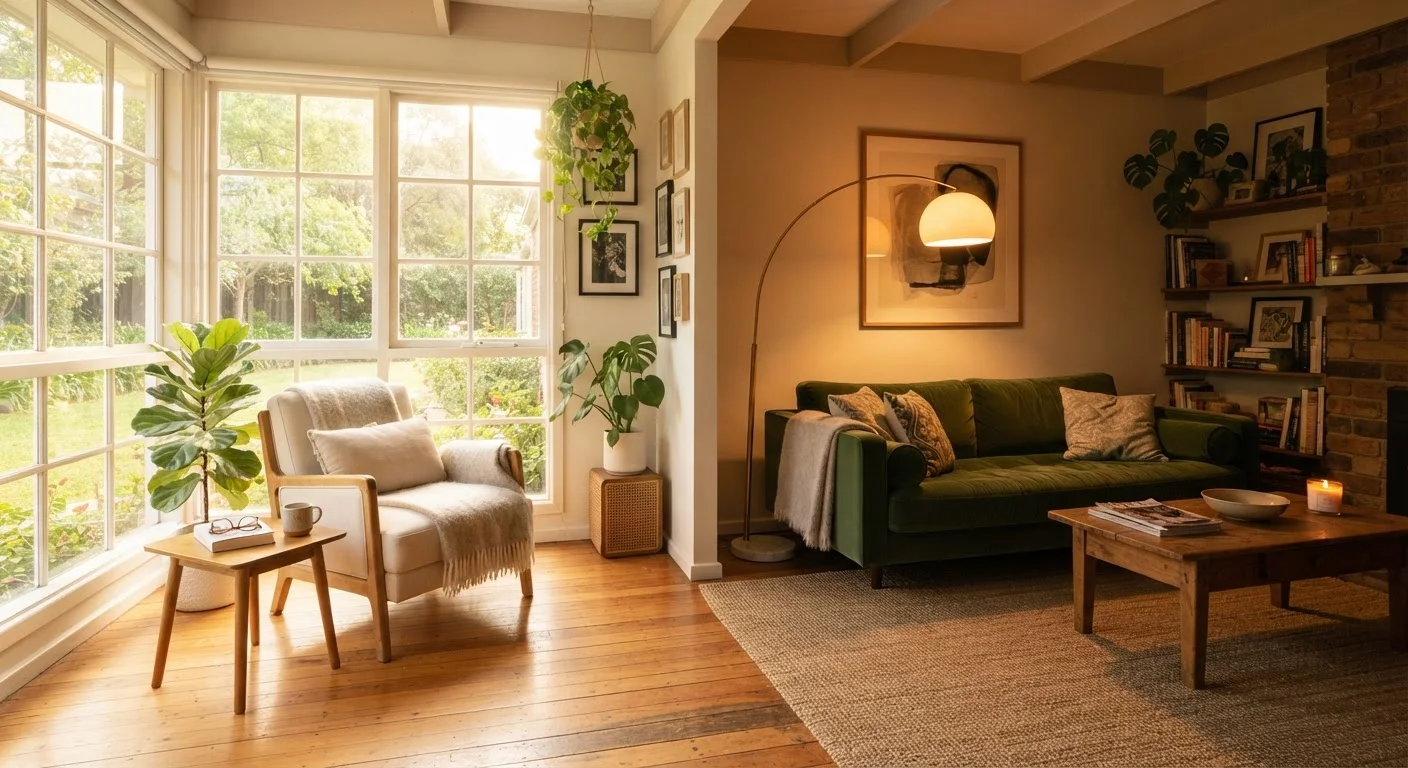
Key Takeaways
- Natural light improves mood and colour accuracy but depends entirely on your home's orientation and layout.
- Artificial light gives you full control over timing, direction, and intensity regardless of weather or season.
- Mixing both strategically — rather than choosing one — delivers the best comfort and energy efficiency.
- Warm-toned bulbs (2700–3000K) mimic natural light most closely in the evening hours.
- Maximising daylight through placement and reflection can meaningfully reduce electricity costs.
Our Verdict
Neither natural nor artificial light wins outright — they serve different purposes and work best in combination. Natural light is unbeatable for daytime wellbeing and colour accuracy, while artificial light fills in the gaps with precision and consistency. A thoughtful layered approach gives budget-conscious households both comfort and control.
| Best for | Recommended |
|---|---|
| Households prioritising daytime energy savings and mood | Natural light maximisation |
| Evening tasks requiring reliable, adjustable illumination | Artificial light (warm LED) |
| Rooms with limited window access or north-facing orientation | Layered artificial lighting |
| Budget-conscious renters who cannot alter windows or structure | Reflective surfaces plus warm-tone artificial light |
How Each Type of Light Actually Works in a Home
Natural light comes from the sun and changes constantly — shifting in colour temperature from cool blue-white at midday to warm amber at dusk. Artificial light, by contrast, stays fixed at whatever colour temperature and brightness you set. That stability is both its strength and its limitation.
Natural light enters a room through windows, skylights, and glass doors, bouncing off walls and ceilings before it reaches your eyes. How much you get depends on your home's orientation, window size, and any obstructions outside. Rooms facing south typically receive the most consistent daylight in the Northern Hemisphere; north-facing rooms tend to stay dimmer throughout the day.
Artificial light sources — mainly LED, incandescent, and fluorescent bulbs — are measured by colour temperature in Kelvin (K). Lower values (2700–3000K) produce warm, yellowish tones similar to evening sunlight. Higher values (5000–6500K) produce a cooler, bluer light closer to midday sun. Understanding this scale helps you choose bulbs that feel intentional rather than harsh. See our guide to using lighting as a low-cost interior tool for practical application tips.
Mood, Wellbeing, and the Light You Live In
Light exposure affects the body's circadian rhythm — the internal clock that regulates sleep, alertness, and mood. Research broadly supports that morning exposure to natural or bright cool-toned light helps people feel more alert and supports better sleep later. Dim or warm light in the evening signals the body to wind down.
Artificial light can interfere with this rhythm if used carelessly. Bright, blue-toned overhead lights late at night can suppress melatonin production, making it harder to fall asleep. Switching to warmer, lower-intensity sources in the evening is a simple, cost-free adjustment that many households overlook.
Natural light also affects how spacious a room feels. A well-lit room with good daylight tends to read as larger and more welcoming. If your space feels cramped, lighting may be a contributing factor — our article on why small rooms feel smaller than they are explores this in more depth. For a broader look at how light fits into daily mood regulation, see how daily habits shape your baseline mood.
Evening Light Swap Worth Trying
About an hour before bed, switch off overhead lights and rely on table lamps or floor lamps with warm bulbs (2700K or lower). This simple habit costs nothing and may help your body wind down more naturally. Dimmers, if you have them, work well for this too.
Colour Perception and Practical Trade-Offs
| Natural Light | Artificial Light | |
|---|---|---|
| Cost to operate | Free | Ongoing electricity cost |
| Colour rendering | Excellent (full spectrum) | Varies by bulb CRI rating |
| Controllability | Limited (weather/season dependent) | Full control (timing, direction, intensity) |
| Mood/wellbeing effect | Strong positive, supports circadian rhythm | Can disrupt sleep if poorly timed |
| Availability | Daylight hours only | 24/7 availability |
| Room size perception | Makes spaces feel larger and open | Depends heavily on placement and type |
| Energy efficiency | Completely energy-free | LED is highly efficient; incandescent wasteful |
Colour rendering is one area where natural light has a clear edge. Paint colours, textiles, and artwork all look truest in natural daylight because sunlight contains the full visible spectrum. This matters when you're choosing paint, decorating, or checking if clothing colours match. Artificial light, depending on its colour rendering index (CRI — a measure of how accurately a light source shows colour), can make the same wall paint look muddy or overly warm.
For most practical home tasks, LEDs with a CRI of 90 or above perform well. Standard budget bulbs often fall in the 80–85 range, which is acceptable for general use but noticeable when colour matters. Colour accuracy aside, artificial light wins on reliability — it works at 2 a.m. during a storm just as well as on a sunny afternoon.
Energy Costs and Smart Layering
From a cost standpoint, daylight is free. Every hour you use it instead of an electric light is money saved on your electricity bill. Simple moves — keeping window areas clear of heavy furniture, using light-coloured curtains, and placing mirrors to bounce light deeper into a room — can meaningfully extend your usable daylight hours without any renovation.
When daylight runs out, LEDs are by far the most energy-efficient artificial option, using roughly 75% less energy than traditional incandescent bulbs for the same light output. The upfront cost is slightly higher, but the savings over the bulb's lifespan are well-documented.
The practical approach for most households is layering: maximise natural light during the day, then use artificial light strategically — task lighting where you need focus, ambient lighting to set the mood, and dimmers wherever possible. This approach also reduces the sense of overwhelm that comes with trying to light a room with one ceiling fixture. If indoor air quality is also a concern in your space, see our low-cost ways to improve indoor air quality for related practical tips.