

Key Takeaways
- Nutritious eating is achievable on a limited budget when you focus on whole, minimally processed staples.
- A small set of pantry ingredients — beans, grains, eggs, and frozen vegetables — forms the backbone of affordable meals.
- Meal planning, even informally, significantly reduces food waste and impulse spending.
- Shopping with a list and cooking at home more often are two of the highest-impact habits for budget eaters.
- Basic cooking skills unlock far more variety and savings than convenience or takeout food ever can.
Start here
Why Budget Eating and Good Nutrition Aren't at Odds
Build your foundation
The Affordable Pantry Staples Worth Knowing
Plan ahead
Simple Meal Planning That Actually Reduces Waste
Shop smarter
Smart Shopping Habits That Stretch Every Dollar
Cook with confidence
Building Confidence in the Kitchen Without Special Skills
Why Budget Eating and Good Nutrition Aren't at Odds
A common assumption is that eating nutritiously costs more. In practice, the most nutrient-dense foods — legumes, whole grains, eggs, leafy greens, root vegetables — are often the least expensive items in the store. What tends to drive up grocery bills is a reliance on heavily processed, pre-packaged convenience foods and regular takeout spending.
The foundation of eating well on a tight budget is shifting toward whole ingredients you cook yourself. That doesn't require culinary training or hours in the kitchen. It requires a basic understanding of which foods deliver the most nutritional value per dollar, a simple plan for the week, and a few reliable habits at the grocery store.
For a broader overview of the nutritional principles at play, see our plain-language nutrition guide — it covers macronutrients, micronutrients, and meal balance without jargon.
Nutrient density
How many vitamins, minerals, and beneficial compounds a food provides relative to its calorie count. Foods high in nutrient density give you more nutrition per dollar spent.
Whole foods
Foods that are minimally processed and close to their natural state — such as dried beans, fresh vegetables, eggs, and oats — as opposed to heavily packaged or pre-made items.
Legumes
A family of plants that includes beans, lentils, chickpeas, and peas. They are high in protein and fiber, very affordable, and among the most versatile pantry staples.
Pantry staples
Long-lasting, shelf-stable ingredients you keep on hand as cooking building blocks — things like canned beans, rice, oats, cooking oil, and dried spices.
Unit price
The cost of a product per standard unit of measurement (e.g., per ounce or per pound). Comparing unit prices helps you identify which package size or brand offers the most value.
The Affordable Pantry Staples Worth Knowing
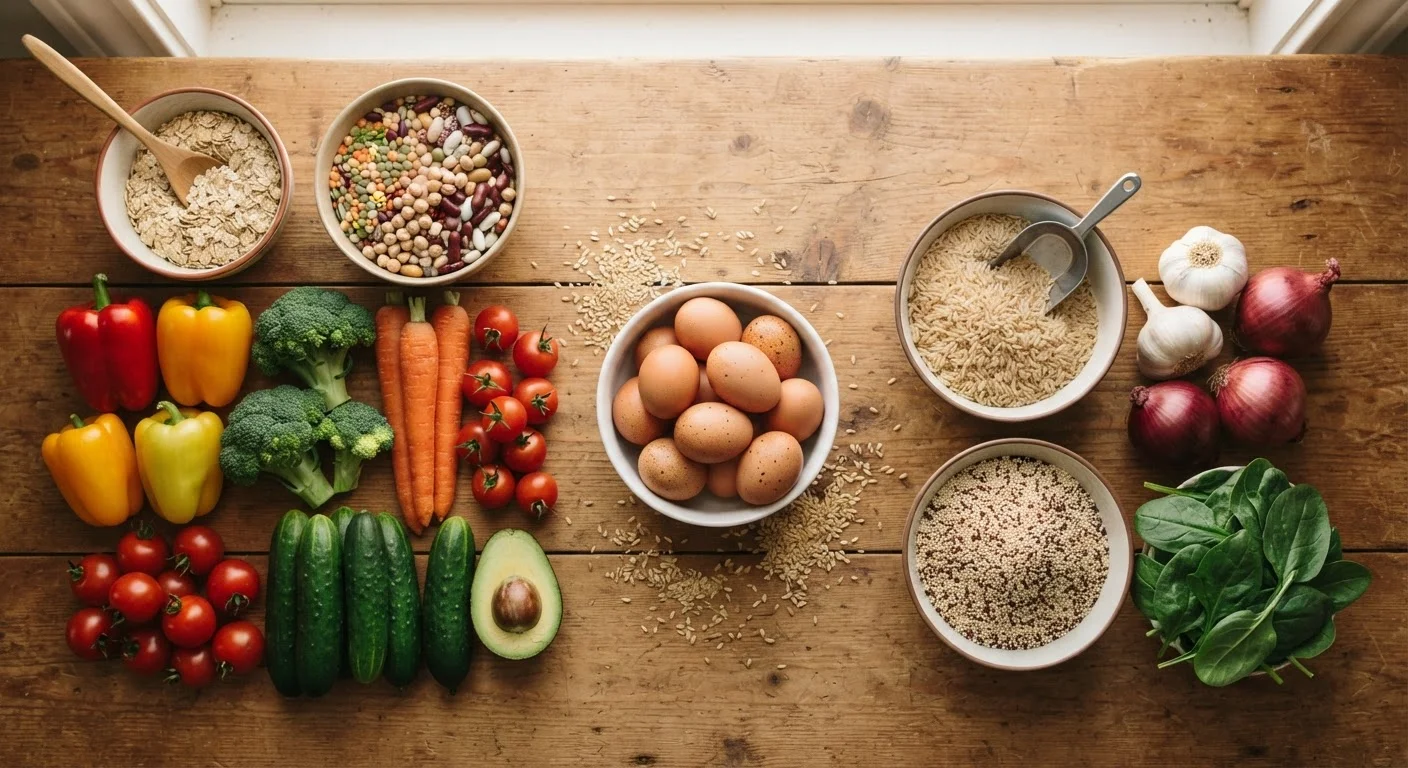
A well-stocked pantry is your single greatest tool for eating affordably. When your shelves contain versatile, long-lasting ingredients, you're always a few steps away from a filling, balanced meal — even when your fridge is nearly empty.
The categories that consistently offer the most value include:
- Legumes: Dried lentils, black beans, chickpeas, and kidney beans are high in protein and fiber. Dried varieties are the most economical; canned versions trade a little cost for significant convenience.
- Whole grains: Brown rice, oats, barley, and whole-wheat pasta provide sustained energy and pair well with almost anything.
- Eggs: One of the most complete and affordable protein sources available. Versatile across breakfast, lunch, and dinner.
- Canned tomatoes and broth: Inexpensive flavor foundations for soups, stews, and sauces.
- Frozen vegetables: Nutritionally comparable to fresh and far less likely to go to waste. Spinach, peas, corn, and mixed stir-fry blends are reliably affordable.
- Aromatics: Onions, garlic, and basic dried spices cost very little and transform simple ingredients into satisfying meals.
Our pantry staples reference guide goes deeper on quantities, storage tips, and how to rotate through these ingredients efficiently.
Simple Meal Planning That Actually Reduces Waste
Food waste is one of the hidden costs of grocery shopping. When ingredients spoil before they're used, you're effectively paying twice — once at the store and once when you throw it away. Even a rough weekly plan dramatically reduces this.
You don't need a rigid system. A practical starting point:
- Choose three to five dinners for the week, centering each around one protein and one or two vegetables.
- Look for overlap — a bag of spinach used in Monday's stir-fry can go into Wednesday's eggs.
- Write a shopping list from those meals only. Check what you already have first.
- Plan at least one meal around pantry staples alone, so fresh items don't have to carry the whole week.
This approach keeps variety manageable, prevents overbuying, and makes shopping faster. For a deeper look at the systems behind sustainable budget meal planning, see our guide on budget meal planning principles.
One pantry-only meal per week saves more than you think
Committing to at least one weekly dinner built entirely from pantry staples — rice and beans, lentil soup, oat-based breakfast for dinner — reduces the pressure on fresh ingredients and naturally extends your grocery budget. Over a month, those meals add up to meaningful savings with minimal effort.
Smart Shopping Habits That Stretch Every Dollar
Where and how you shop matters as much as what you buy. A few consistent habits compound into meaningful savings over time:
- Shop with a list and stick to it. Unplanned purchases are among the most common sources of grocery overspending.
- Compare unit prices, not package prices. A larger bag of rice at a higher sticker price often costs less per serving than the smaller one.
- Buy produce that's in season. Seasonal fruits and vegetables tend to be cheaper, more abundant, and often fresher than out-of-season alternatives.
- Consider store-brand staples. For pantry basics like canned beans, rice, oats, and frozen vegetables, store-brand versions are typically identical in nutritional quality to name-brand products.
- Don't shop hungry. Hunger reliably increases impulse buying and pulls shoppers toward higher-cost convenience items.
The guide to genuinely filling inexpensive foods pairs well here — it identifies which affordable items will keep you satisfied longest, helping you avoid snack overspending between meals.
Avoid the 'bulk buying always saves money' assumption
Buying in bulk only saves money if you actually use what you purchase before it spoils or expires. For perishable items, large quantities can result in more waste, not less. Focus bulk buying on shelf-stable staples — grains, dried beans, canned goods — where long shelf life makes the math reliably work in your favor.
Building Confidence in the Kitchen Without Special Skills
Home cooking is the single most reliable lever for eating well at low cost. Restaurant meals and convenience foods carry significant markups; preparing food yourself inverts that equation. And the skills required to cook simple, nutritious meals are far more accessible than most people assume.
A handful of basic techniques covers the majority of affordable home cooking:
- Boiling or simmering grains and legumes
- Sautéing vegetables in a small amount of oil with aromatics
- Cooking eggs in various forms (scrambled, fried, hard-boiled)
- Building a basic soup or stew from pantry staples and whatever vegetables you have on hand
These four techniques alone unlock dozens of affordable, balanced meals. For anyone who finds the kitchen intimidating, our beginner's guide to home cooking walks through essential skills step by step with minimal equipment required.
If you're also curious about shifting toward more plant-forward meals — which tend to be especially cost-effective — our introduction to plant-based eating offers a grounded, no-pressure starting point.
This article is for general informational purposes only and is not a substitute for personalized nutrition or medical advice. Consult a qualified healthcare professional for guidance specific to your health needs.