

Key Takeaways
- You don't need culinary training or expensive equipment to cook real meals at home.
- A handful of versatile tools and pantry staples covers the vast majority of beginner recipes.
- Learning three or four basic techniques — like sautéing and boiling — unlocks hundreds of meals.
- Starting with simple, forgiving recipes builds genuine skill faster than attempting complex dishes.
- Home cooking consistently costs less and often delivers more nutrition than takeout or convenience food.
Start here
Why Home Cooking Is Worth Starting Now
Next
The Only Tools a Beginner Truly Needs
Then
Essential Skills to Learn First
Practice
Five Fuss-Free Meals to Start With
Keep going
Building Confidence Over Time
Why Home Cooking Is Worth Starting Now
If cooking at home feels intimidating, you're not alone — but the barrier is almost always lower than it seems. You don't need culinary training, expensive gadgets, or hours of free time to put a real meal on the table.
The practical case for cooking at home is straightforward. Preparing your own meals gives you direct control over ingredients, portion sizes, and what goes into your food — things that matter if you're watching a budget or simply want to eat more intentionally. For a deeper look at the money side, eating on a tight budget is a useful companion resource. The nutrition basics hub also covers how to make home cooking work for your overall diet without overcomplicating it.
More importantly, confidence in the kitchen is a skill — and like any skill, it grows with practice. Every meal you make, even an imperfect one, teaches you something useful for next time.
The Only Tools a Beginner Truly Needs
One of the fastest ways to feel overwhelmed is to think you need a full kitchen setup before you start. You don't. A small, purposeful collection of tools handles the vast majority of everyday cooking.
Sauté
To cook food quickly in a small amount of fat over medium to medium-high heat, often to soften ingredients and develop flavor before adding other components.
Simmer
To cook liquid at a temperature just below boiling, producing gentle bubbles. Used for soups, sauces, and grains to develop flavor without breaking down ingredients too fast.
Mise en place
A French term meaning 'everything in its place.' In practice, it means measuring and prepping all your ingredients before you begin cooking, which makes the process calmer and more accurate.
Claw grip
A safe knife-holding technique where your fingertips are curled under your knuckles while holding food, keeping fingers away from the blade as you cut.
Pantry staples
A core set of shelf-stable ingredients — like oil, salt, canned goods, and dry grains — that you keep on hand at all times to form the base of many different meals.
- One medium or large skillet — for sautéing vegetables, cooking eggs, and pan sauces
- One medium saucepan — for pasta, grains, soups, and boiling
- One sturdy chef's knife — a single sharp, general-purpose knife outperforms a block of dull ones
- A cutting board — plastic or wood, large enough to work comfortably
- A colander or strainer — for draining pasta and rinsing vegetables
- Measuring cups and spoons — essential when following recipes accurately
- A wooden spoon or silicone spatula — for stirring without scratching pans
That's genuinely enough to make hundreds of meals. Add a sheet pan and a lidded pot as you grow, and you'll have covered nearly everything a home cook needs.
Essential Skills to Learn First
Rather than mastering dozens of techniques, focus on four that appear in almost every recipe. Once these feel natural, everything else builds on top of them.
Knife skills
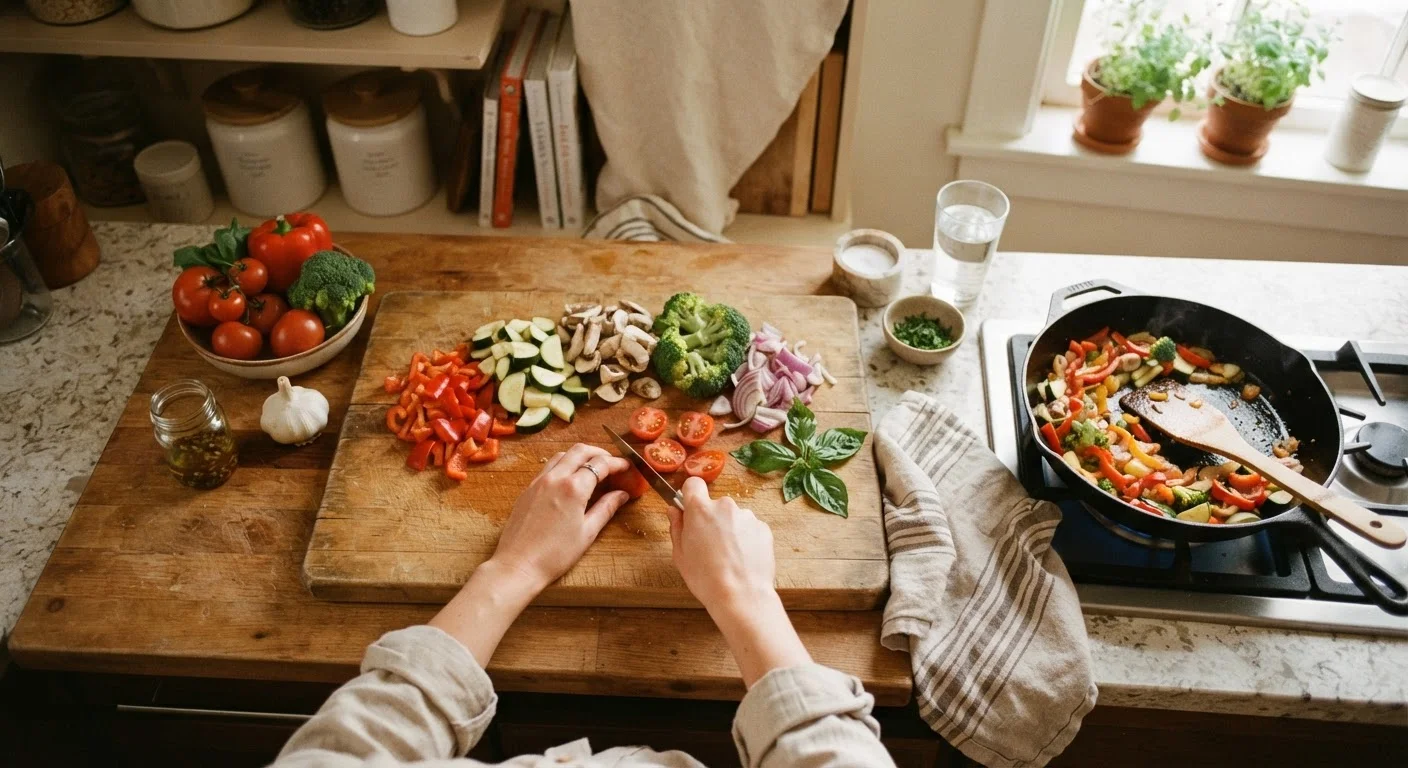
You don't need to chop fast — you need to chop safely and evenly. Keep your fingertips curled under (called the "claw grip") and let the knife do the work. Even cuts mean food cooks evenly, which prevents some pieces from burning while others are still raw.
Controlling heat
Most beginner mistakes happen at too-high a temperature. Use medium heat as your default. It gives you time to react, prevents burning, and still produces well-cooked food. You can always turn the heat up briefly when you need a sear or a quick boil.
Sautéing
Sautéing means cooking food quickly in a small amount of oil over medium to medium-high heat. It's how you build flavor at the start of almost every savory dish — garlic, onion, or vegetables go into a hot oiled pan first, softening and developing aroma before anything else is added.
Boiling and simmering
Boiling (vigorous bubbles, high heat) is for pasta and blanching vegetables. Simmering (gentle bubbles, lower heat) is for soups, sauces, and grains. Knowing the difference prevents watery soups and mushy pasta alike.
Read the Whole Recipe First
Before you touch a pan, read the recipe from start to finish. This takes two minutes and prevents the most common beginner frustration: discovering mid-cook that you needed to preheat something or prep an ingredient 20 minutes ago. It also helps you understand how the steps connect, so nothing catches you off guard.
Five Fuss-Free Meals to Start With
Choose recipes that are forgiving — where a few extra minutes or slightly more seasoning doesn't ruin the dish. These five are genuinely beginner-friendly and use affordable pantry staples.
- Scrambled eggs with toast — teaches heat control and timing; ready in under five minutes
- Pasta with canned tomatoes and garlic — covers sautéing, boiling, and basic sauce-making in one go
- Vegetable stir-fry with rice — flexible, fast, and lets you practice even knife cuts and high-heat cooking
- Lentil or canned bean soup — almost impossible to ruin; simmering builds deep flavor with minimal effort
- Sheet pan roasted vegetables and chickpeas — hands-off cooking; the oven does the work while you clean up
Each of these meals can be made for a fraction of the cost of takeout. Once you're comfortable with these, you'll naturally start experimenting — swapping vegetables, adding spices, or trying a new protein. That's exactly how real cooking confidence grows. When you're ready to plan ahead, the weekly prep checklist makes weeknight cooking noticeably smoother.
Building Confidence Over Time
Progress in the kitchen is rarely dramatic — it's the accumulation of small, repeated moments. The cook who makes pasta twice a week for a month knows far more about timing and seasoning than someone who read a dozen recipes but never tried them.
A few habits that accelerate the learning curve:
- Cook the same recipe twice before moving on. The second time always goes faster and reveals something the first attempt missed.
- Taste as you go. Adjusting seasoning mid-cook is one of the most useful skills you can develop — and you only learn it by doing it.
- Don't fear mistakes. A too-salty soup or slightly overcooked vegetable is a data point, not a failure. Most meal mishaps are still edible.
- Keep a short list of meals you can already make. Seeing that list grow — even slowly — is genuinely motivating.
If you want to extend your skills toward eating more plants affordably, plant-based eating for beginners is a practical next step. And for a broader framework on affordable, nutritious eating, eating well on a tight budget ties it all together.
This article is for general informational and educational purposes only. It is not a substitute for advice from a qualified nutrition or healthcare professional.