

| FDA Standard Serving — Cooked Pasta | ½ cup (about 2 oz dry) (FDA Reference Amounts Customarily Consumed (RACC)) |
| FDA Standard Serving — Meat or Poultry | 3 oz cooked (USDA Dietary Guidelines) |
| FDA Standard Serving — Cheese | 1.5 oz (FDA RACC guidelines) |
| Typical Restaurant Portion vs. Standard | 2–3x larger (National Heart, Lung, and Blood Institute research on portion distortion) |
| FDA Standard Serving — Nut Butter | 2 tablespoons (FDA RACC guidelines) |
Why Serving Sizes Confuse Everyone
The serving size printed on a nutrition label is a standardized reference amount set by the FDA — not a recommendation for how much you should eat, and definitely not a description of how most people actually fill their plates. A single serving of pasta is often listed as two ounces dry, which cooks down to roughly half a cup. Most people serve themselves two to three times that amount without realizing it.
This gap between label reality and real-life eating is one reason it's worth building a mental library of visual references. Once you can eyeball a portion without pulling out a measuring cup, the numbers on a label become much more useful. For more on decoding what those labels actually say, see our guide to reading nutrition labels.
| FDA Standard Serving — Cooked Pasta | ½ cup (about 2 oz dry) (FDA Reference Amounts Customarily Consumed (RACC)) |
| FDA Standard Serving — Meat or Poultry | 3 oz cooked (USDA Dietary Guidelines) |
| FDA Standard Serving — Cheese | 1.5 oz (FDA RACC guidelines) |
| Typical Restaurant Portion vs. Standard | 2–3x larger (National Heart, Lung, and Blood Institute research on portion distortion) |
| FDA Standard Serving — Nut Butter | 2 tablespoons (FDA RACC guidelines) |
The Hand Method: A Built-In Measuring Tool
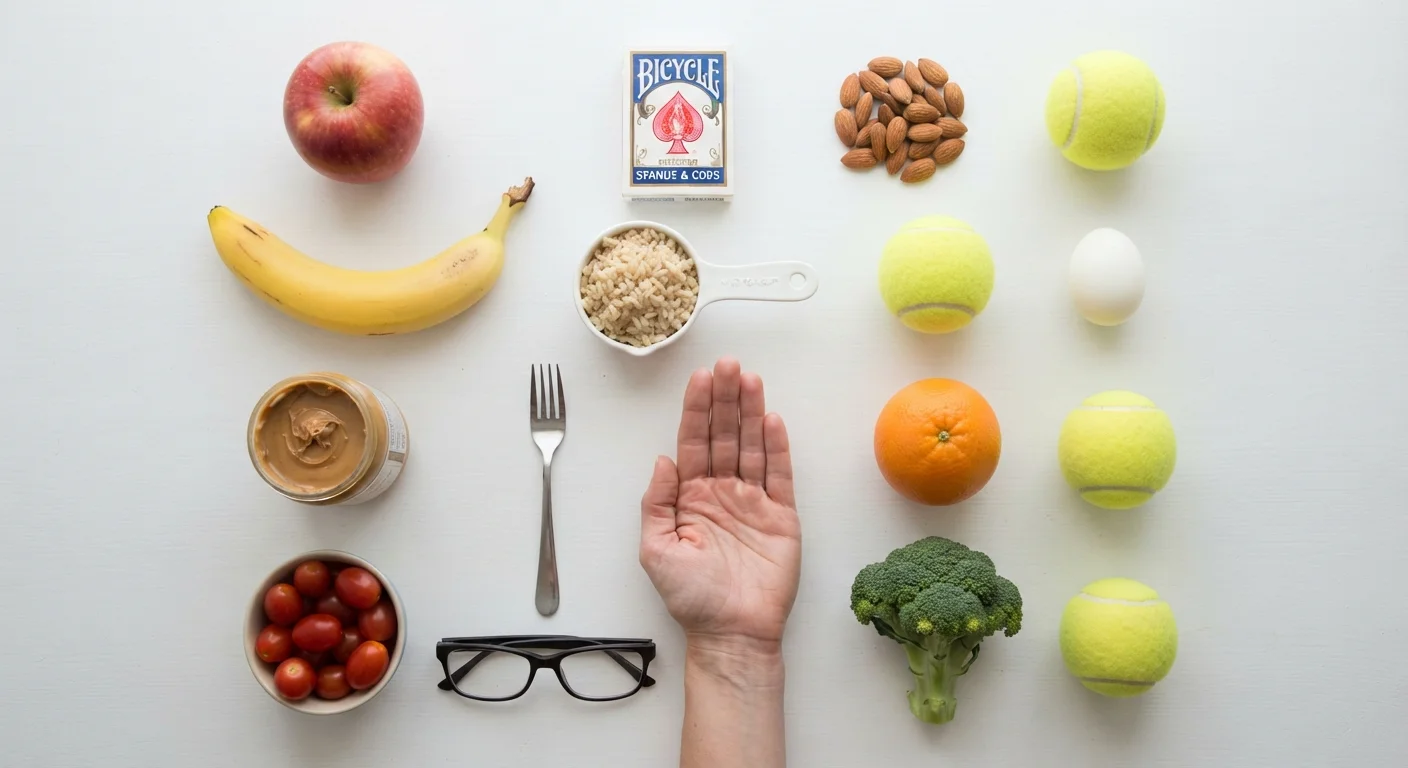
Your hand is proportional to your body — which makes it a surprisingly consistent personal measuring tool. These references are approximate and vary by individual, but they're a practical starting point:
- Palm (without fingers): roughly 3 oz of cooked meat, fish, or poultry — about one standard protein serving.
- Cupped hand: about ½ cup of cooked grains, beans, or chopped fruit.
- Closed fist: approximately 1 cup — useful for raw leafy greens, cereal, or pasta.
- Thumb tip to first knuckle: close to 1 teaspoon — good for oils, butter, or nut butter.
- Full thumb length: approximately 1 tablespoon — useful for salad dressing or condiments.
These visual anchors pair well with the plate-building approach covered in building a balanced plate without counting anything.
Serving Size
A standardized amount of food defined by regulatory bodies like the FDA, used as the basis for all nutrition information on a label. It reflects how much people typically eat in one sitting, not necessarily how much they should eat.
Portion
The actual amount of food a person puts on their plate or eats at one time. A portion may be larger or smaller than the labeled serving size.
Portion Distortion
The tendency to perceive oversized food portions as normal due to cultural exposure to large restaurant and packaged food amounts over time.
Reference Amount Customarily Consumed (RACC)
An FDA term for the standardized quantity used to set serving sizes on nutrition labels, based on national food consumption surveys.
Everyday Objects as Portion References
When hands aren't enough context, common household objects fill in the gaps. These comparisons are widely used in nutrition education as rough visual guides:
| Food | Standard Serving | Visual Reference |
|---|---|---|
| Cooked pasta or rice | ½ cup | Half a tennis ball |
| Cheese | 1.5 oz | 3 stacked dice |
| Meat or poultry | 3 oz | A deck of playing cards |
| Peanut butter | 2 tablespoons | A ping-pong ball |
| Salad dressing | 2 tablespoons | A standard ice cube |
| Baked potato | 1 medium | A computer mouse |
These references aren't perfectly precise, but they train your eye over time. For a deeper look at how visual cues reduce overeating without logging every bite, visit our article on portion awareness without calorie counting.
Putting It Into Practice
Learning portion cues works best when practiced in low-stakes moments — like plating a meal at home rather than trying to estimate at a restaurant under pressure. A few habits help:
- Use smaller plates. A standard dinner plate has grown significantly in diameter over the past few decades. A 9-inch plate naturally encourages more reasonable portions than a 12-inch one.
- Serve before sitting. Putting food on your plate in the kitchen rather than setting serving bowls on the table reduces the likelihood of unconscious second helpings.
- Check the label's serving count. Before eating straight from a package, glance at how many servings it contains. A bag of trail mix labeled as four servings contains four times the listed calories if eaten in one sitting. Our nutrition label walkthrough explains exactly where to find this information.
None of these steps require tracking apps, food scales, or rigid rules. They're practical nudges that make portion awareness a natural part of how you cook and eat — not an extra chore.
This article is for general informational and educational purposes only and is not a substitute for advice from a registered dietitian or qualified healthcare professional. Individual nutrition needs vary.
Portion Needs Vary by Person
The visual guides in this article are general educational references — not personal prescriptions. Calorie and nutrient needs differ significantly based on age, body size, activity level, and health conditions. If you have specific dietary needs or health goals, a registered dietitian can provide personalized guidance.