

Key Takeaways
- Your vehicle's correct PSI is on a sticker inside the driver's door jamb, not on the tyre sidewall.
- Under-inflation is far more common than over-inflation and causes the most safety and wear problems.
- Tyre pressure drops roughly 1 PSI for every 10°F decrease in outside temperature.
- Check pressure when tyres are cold — driven tyres read artificially high due to heat buildup.
- A TPMS warning light means at least one tyre is already significantly underinflated — don't ignore it.
- Correct pressure improves fuel economy, extends tyre life, and shortens stopping distances.
Tyre Pressure (PSI)
Tyre pressure refers to the amount of air inside your tyre, measured in pounds per square inch (PSI). Every vehicle has a manufacturer-recommended pressure range that keeps the tyre performing as designed. Running outside that range — either too high or too low — affects how the car handles, how quickly the tyres wear, and how much fuel you use.
PSI measures gauge pressure — the pressure above atmospheric. Some gauges display bar or kPa instead; 1 bar ≈ 14.5 PSI and 100 kPa ≈ 14.5 PSI.
Why Tyre Pressure Is a Safety Issue, Not Just a Maintenance Chore
Most drivers think of tyre pressure as a fuel-economy footnote. In reality, it's one of the most direct links between routine maintenance and road safety. An underinflated tyre flexes more than it should, generating excess heat. Heat is the primary cause of tyre blowouts — and blowouts at highway speed are genuinely dangerous situations. Our article on handling blowouts and other scary scenarios covers what to do if one happens, but the better move is preventing it through correct inflation.
Pressure also affects how the tyre contacts the road. At the right PSI, the entire tread contacts the pavement evenly, giving you maximum grip for braking and cornering. Too low, and the tyre bows outward, concentrating wear on the outer edges and reducing the effective contact patch. Too high, and the centre of the tread balloons up, so only a narrow strip of rubber actually touches the road. Both conditions increase stopping distances — exactly the wrong tradeoff in an emergency.
~1 PSI
Pressure lost per 10°F temperature drop
This relationship is well-established in tyre engineering; it's why seasonal checks matter as much as monthly ones.
25%
Below spec when TPMS light triggers
Federal TPMS standards require the warning light to illuminate when any tyre is 25% or more below the vehicle's recommended pressure.
Up to 3%
Fuel economy improvement from correct inflation
According to the U.S. Department of Energy, keeping tyres properly inflated can improve gas mileage by up to 3% versus significantly underinflated tyres.
11,000+
Crashes linked to tyre problems annually (US)
NHTSA data consistently shows tyre-related factors — including underinflation — contribute to thousands of crashes each year in the United States.
Finding the Right Numbers for Your Vehicle
Here's the single most important thing to know: the number printed on your tyre's sidewall is not your target pressure. That figure — often 44 or 51 PSI — is the tyre's maximum rated pressure. Inflating to that level is usually too high for normal driving and can make the ride harsh and handling unpredictable.
Your correct pressure is set by the vehicle manufacturer and printed on a sticker inside the driver's door jamb. It's also in your owner's manual. Typical passenger car recommendations fall between 30 and 36 PSI, though trucks, SUVs, and vehicles carrying heavy loads may need more. If your vehicle has different-sized tyres front and rear — common on performance cars — the sticker will list separate figures for each axle. For more on decoding the other numbers on your tyre, see what tyre sidewall markings mean.
How Temperature Changes Your Readings
Air expands when heated and contracts when cooled. For tyres, that translates to a reliable rule of thumb: pressure drops approximately 1 PSI for every 10°F drop in outside temperature. A tyre properly inflated at 35 PSI on a 70°F day will read closer to 32 PSI when the temperature falls to 40°F — without losing a drop of air.
This is why tyre pressure warnings spike every autumn when temperatures drop sharply overnight. It's also why you should always check pressure when the tyres are cold — meaning the car has been parked for at least three hours or driven fewer than a mile. Heat from driving temporarily raises pressure by 4–6 PSI, so a hot reading will make an underinflated tyre look fine when it isn't.
Always Check Pressure Before Driving
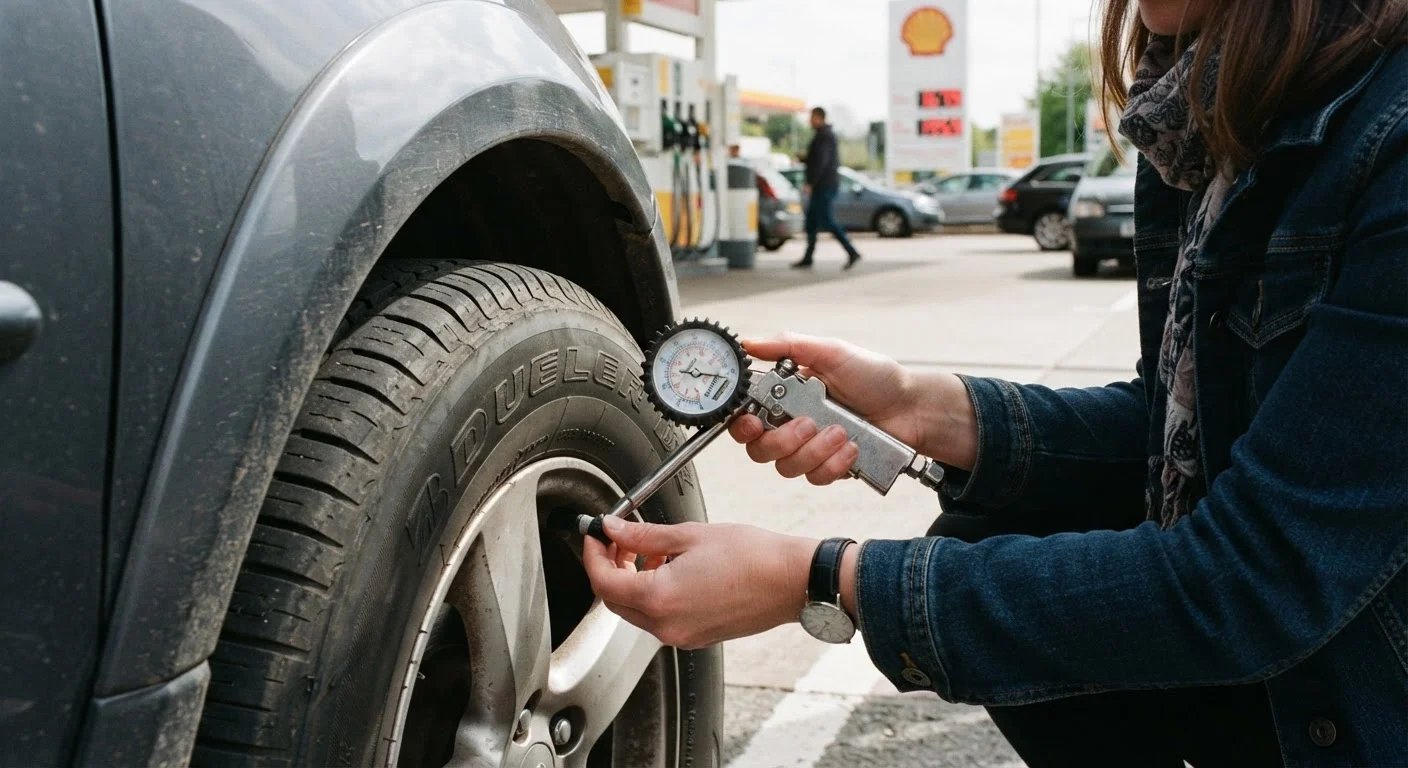
For an accurate reading, check tyres when they've been parked for at least three hours or have been driven less than a mile. Driving heats the air inside the tyre and artificially raises the reading by 4–6 PSI. A hot reading can make an underinflated tyre look fine. Keep a gauge in the glovebox so you can check at home before you leave, not at the gas station after a warm-up drive.
Under-Inflation vs. Over-Inflation: What Each Actually Does
Under-inflation is the more common and more dangerous condition. It increases tyre flex, builds heat, accelerates wear on the outer tread edges, and reduces fuel economy. Severely underinflated tyres can separate from the rim at highway speed. The TPMS (Tyre Pressure Monitoring System) light on your dashboard is federally required on vehicles made after September 2007, but it only triggers when a tyre is already about 25% below recommended pressure — so don't rely on it as your only check. Our overview of dashboard warning lights explains what else that light could mean.
Over-inflation makes the tyre rigid, wears down the centre tread faster, and reduces the tyre's ability to absorb road impacts — increasing the risk of damage from potholes. It also reduces grip, particularly in wet conditions. The fix in either case is simple: use a quality pressure gauge, compare your reading to the door-jamb sticker, and add or release air accordingly. Gauges are inexpensive and available at any auto parts store; many gas stations also have air machines with built-in gauges.
For a broader look at how tyre condition connects to running costs, see small checks that cut running costs. And if you want to understand the full picture of tyre maintenance, tyre rotation, alignment, and balancing is worth reading alongside this one.