

Key Takeaways
- Car camping suits families, beginners, and comfort-seekers; backpacking rewards those willing to trade convenience for solitude.
- Startup gear costs are typically lower for car camping but backpacking gear can pay off over many trips.
- Backpacking requires meaningful physical preparation; car camping has a much lower fitness barrier.
- Both formats can be done affordably — your approach to food and site fees matters more than the format itself.
- The right choice depends on your group size, fitness level, available time, and desired experience.
Our Verdict
Car camping and backpacking aren't competing hobbies — they're complementary tools in any outdoor traveler's kit. Car camping lowers the barrier to entry dramatically and works beautifully for families, weekend warriors, and those new to sleeping outside. Backpacking delivers a deeper wilderness immersion that's genuinely hard to replicate any other way, but it demands real preparation. Start where your current fitness, budget, and gear situation make success realistic.
| Best for | Recommended |
|---|---|
| Families with young children or first-time campers | Car Camping |
| Budget travelers wanting minimal gear investment | Car Camping |
| Those seeking solitude and deep wilderness access | Backpacking |
| Physically active travelers with multi-day availability | Backpacking |
What Each Format Actually Involves
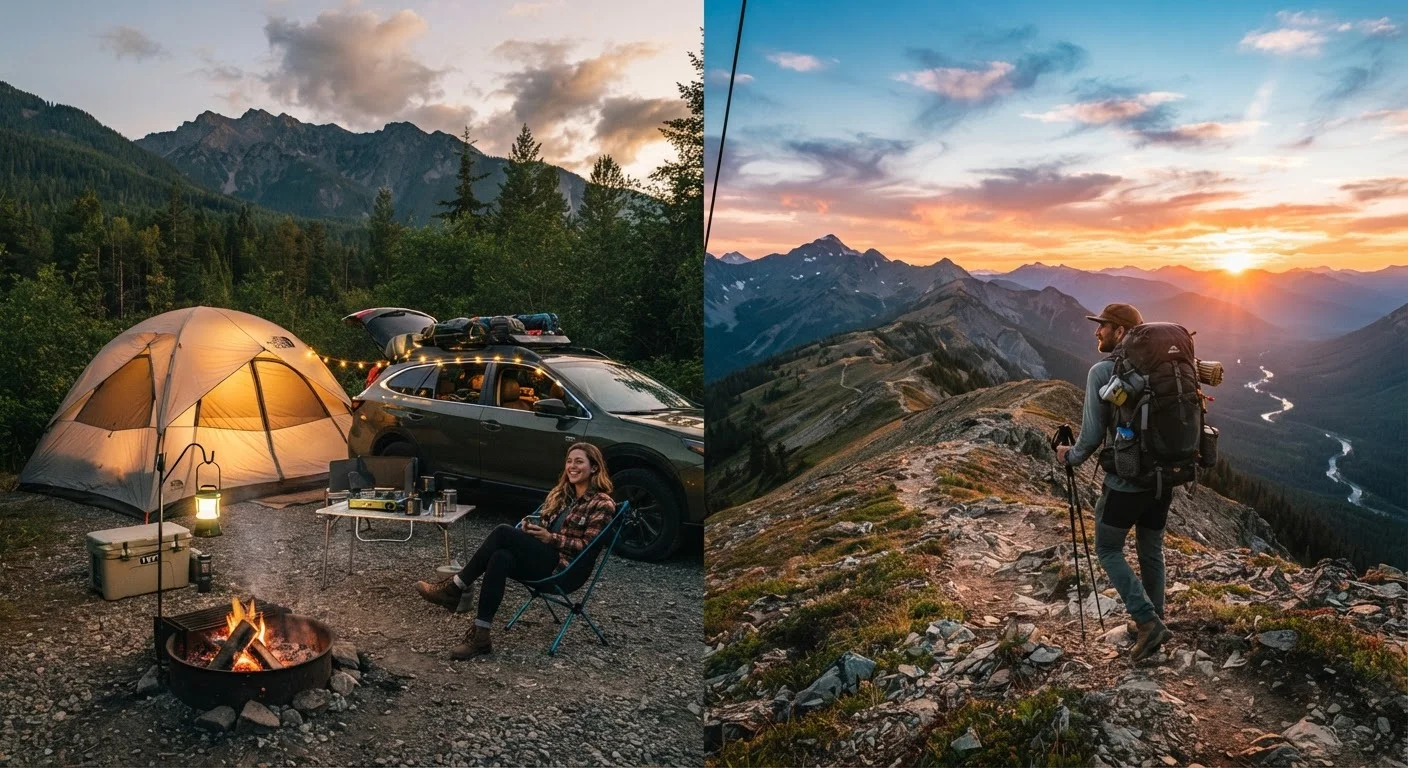
Car camping means driving your vehicle directly to or very near your campsite. You unload what you need — tent, sleeping bag, cooler, folding chairs — set up camp, and enjoy. Most car campgrounds offer amenities like restrooms, fire rings, and sometimes electrical hookups. The tradeoff for convenience is that you share the space with other campers, and true wilderness solitude can be hard to find.
Backpacking flips that equation entirely. You carry everything on your back — shelter, food, water filtration, clothing, and safety gear — and hike into the backcountry to set up wherever your permit allows. The payoff is access to landscapes that roads never reach and a level of quiet that campgrounds rarely offer. The cost is weight, planning time, and physical effort.
Neither format is inherently superior. They serve different goals, different bodies, and different budgets. Understanding exactly what each demands is the fastest way to pick the right one for your next trip. You might also find that matching your destination to your experience level shapes this choice as much as the format itself.
Cost Breakdown: Gear, Fees, and Food
Car camping has a low financial floor. A functional setup — a basic tent, sleeping bag, and foam pad — can often be assembled secondhand for under $100. Campsite fees at public lands typically run $20–$35 per night, though some dispersed camping on national forest land is free. Because you have a vehicle, you can bring a full cooler and cook real meals, which dramatically cuts food costs compared to restaurants or freeze-dried backpacking pouches.
Backpacking gear is more specialized and more expensive upfront. A lightweight pack, a three-season sleeping bag rated for lower temperatures, a compact shelter, a water filter, and a canister stove together can easily run $400–$800 new — though renting or buying used gear brings that number down considerably. Backcountry permits are often free or low-cost ($5–$15), but the bigger ongoing cost is food: lightweight, calorie-dense backpacking meals average $8–$15 per meal. Check out budget travel strategies for ways to stretch your outdoor dollars further, and explore budget eating approaches that translate well to camp cooking.
| Car Camping | Backpacking | |
|---|---|---|
| Gear startup cost | $50–$200 (basic setup) | $400–$800 new; less used |
| Campsite fees | $20–$35/night typical | $0–$15 permit; varies widely |
| Food flexibility | Full cooler, real meals | Lightweight, calorie-dense packs |
| Fitness requirement | Minimal — accessible to most | Moderate to high; multi-mile hiking |
| Solitude access | Limited; shared campgrounds | High; remote backcountry routes |
| Planning complexity | Reserve a site; pack and go | Permits, navigation, gear checks |
| Best trip length | One night to a week | Two to seven nights ideal |
Physical Demands and Planning Requirements
Car camping is genuinely accessible. If you can walk from a parking lot to a campsite — sometimes just 50 feet — you can car camp. This makes it ideal for families with young children, older adults, or anyone recovering from injury. Planning mostly involves reserving a site (some popular campgrounds fill weeks in advance), packing thoughtfully, and knowing campground rules.
Backpacking asks more. Day-one hikers often underestimate how a 35-pound pack changes the experience of even a moderate trail. A realistic starting point is building to 8–10 miles per day with elevation gain before your first overnight trip. Navigation skills, Leave No Trace principles, bear canister requirements, and weather awareness all become essential knowledge rather than optional extras. First-timers benefit enormously from a one-night shakedown trip close to home before committing to a multi-day route. Going solo vs. with a group is another planning dimension worth thinking through, especially for backcountry travel where safety margins are thinner.
Try a Shakedown Night First
Before committing to a multi-day backpacking trip, load your full pack and spend one night at a local campground or even in your backyard. You'll quickly discover whether your boots cause hot spots, your sleep system is warm enough, or your pack fits correctly — problems that are minor inconveniences at home but real issues at mile 10.
Which Format Fits Your Trip?
Choose car camping when your group includes mixed ages or fitness levels, when you value comfort and community, or when you're introducing someone new to outdoor overnights. It's also the practical call when you have only one night available — setting up and breaking down a backpacking camp for a single night rarely feels worth the effort.
Choose backpacking when the destination you want simply isn't reachable by road, when you're craving genuine solitude, or when the journey itself — the daily miles, the physical challenge, the earned views — is part of what you're after. Multi-day trips of three nights or more tend to justify the pack weight and planning investment most satisfyingly.
Some travelers solve the either/or problem by car camping at a trailhead and doing day hikes without overnight gear — a hybrid that gets you deep into a landscape without the full backpacking commitment. If you're exploring campground options closer to home, city-adjacent campgrounds can be a smart entry point. And if you're weighing how much structure you want around any outdoor trip, the comparison in guided vs. self-planned adventures applies here too.