

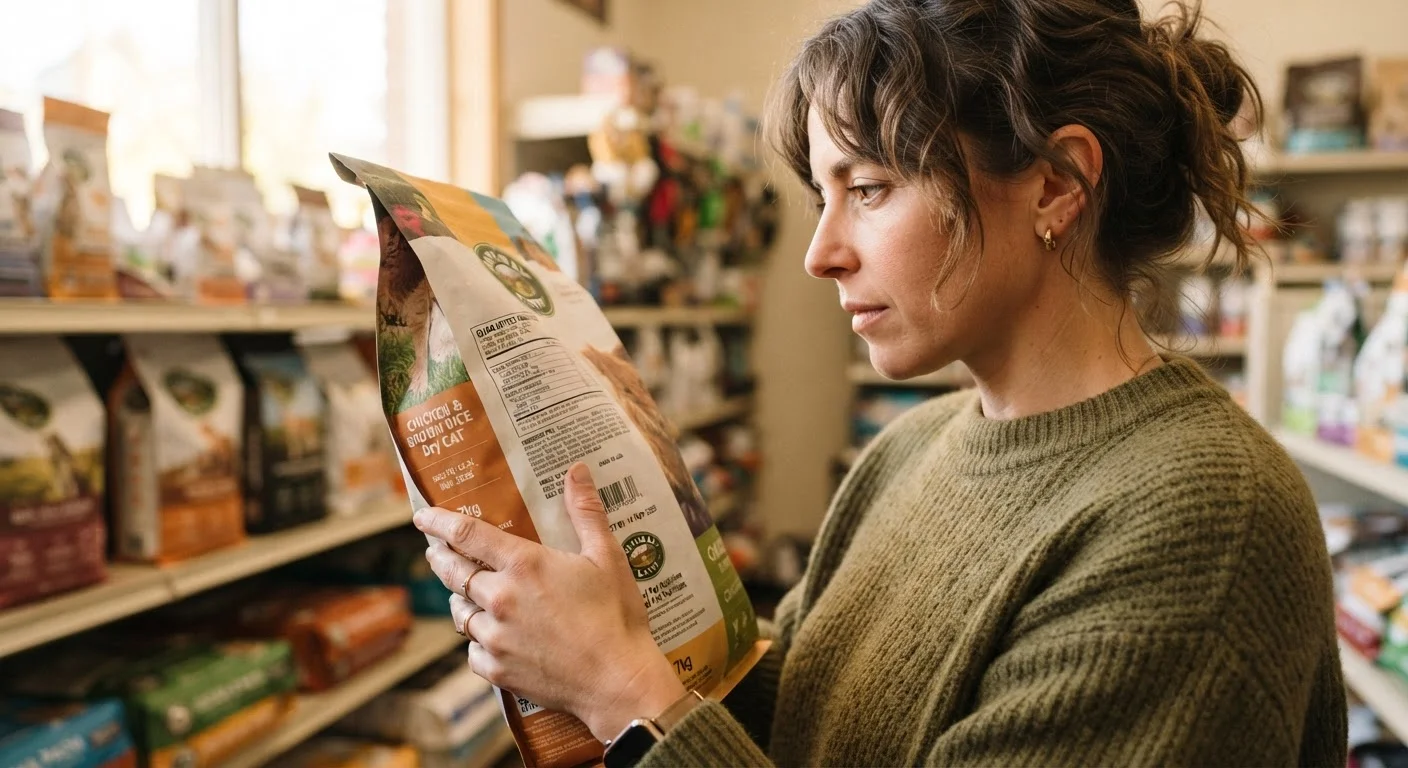
Key Takeaways
- Ingredients are listed by weight before processing, so order alone doesn't tell the full story.
- The guaranteed analysis shows minimum or maximum nutrient percentages, not exact amounts.
- An AAFCO nutritional adequacy statement tells you whether the food is complete and balanced.
- Life stage statements matter — a food for 'all life stages' must meet puppy or kitten standards.
- Feeding guidelines are starting points, not precise prescriptions — adjust based on your pet's needs.
- Marketing claims on the front of the pack are largely unregulated; the back panel is where the facts live.
Pet Food Label
A pet food label is the regulated set of information printed on every commercial pet food package. It includes the product name, ingredient list, guaranteed analysis, feeding directions, and a nutritional adequacy statement. These elements are governed by federal and state rules, and each section communicates something specific about the food inside.
In the U.S., pet food labeling is regulated by the FDA and guided by model regulations developed by the Association of American Feed Control Officials (AAFCO), which most states adopt into law.
Why the Label Matters More Than the Marketing
The front of a pet food bag is advertising. Phrases like "premium," "natural," or "ancestral recipe" are largely unregulated and tell you little about what's actually inside. The real information is on the back or side panel, where federal and state labeling rules require manufacturers to disclose specific, standardized facts.
For budget-conscious pet owners, understanding these sections means you can evaluate foods on substance rather than packaging appeal — and avoid paying a premium for claims that carry no legal weight. See our guide to what pet food labels actually mean for a deeper dive into specific language used across the industry.
~50%
U.S. households that own at least one pet
According to the American Pet Products Association's industry surveys, roughly half of American households include a pet, making food label literacy a broadly relevant consumer skill.
4
Required values in the guaranteed analysis
AAFCO model regulations require all pet food labels to disclose at minimum crude protein, crude fat, crude fiber, and moisture — each as a percentage.
2 types
Ways AAFCO nutritional adequacy can be substantiated
A pet food can establish nutritional adequacy either by meeting published AAFCO nutrient profiles on paper or by completing AAFCO-protocol feeding trials with live animals.
The Ingredient List: What Order Really Tells You
Ingredients are listed in descending order by weight before processing. This matters because raw meat is mostly water. A whole chicken listed first may weigh more than oats in its raw state, but once the moisture is cooked out, the oats could represent a larger share of the finished kibble. This is sometimes called ingredient splitting when manufacturers divide a single ingredient (like different forms of corn) into smaller entries to push it lower on the list.
What to look for: named protein sources ("chicken," "salmon") over vague terms ("meat meal," "animal digest"), and recognizable whole ingredients in the top several slots. A long ingredient list isn't automatically bad — some necessary vitamins and minerals appear as chemical compounds near the bottom.
Nutrition needs also shift as pets age. Our article on pet care at every life stage explains how ingredient priorities may change for puppies, adults, and senior pets.
The Guaranteed Analysis: Floors, Not Facts
The guaranteed analysis panel lists four required values: minimum crude protein, minimum crude fat, maximum crude fiber, and maximum moisture. These are regulatory boundaries — a manufacturer guarantees the food has at least this much protein or no more than this much moisture. The actual content could differ significantly.
One practical complication: wet and dry foods can't be compared directly on a percentage basis because moisture content differs so drastically. A wet food at 10% protein sounds low next to a kibble at 28%, but after removing moisture, the wet food's protein content on a dry matter basis may be comparable or higher. To convert, use this formula: Nutrient % ÷ (100 − Moisture %) × 100.
How to Compare Foods on a Dry Matter Basis
To fairly compare a wet food and a dry food, divide the nutrient percentage by (100 minus the moisture percentage), then multiply by 100. For example, a wet food with 10% protein and 78% moisture: 10 ÷ (100 − 78) × 100 = about 45% protein on a dry matter basis. This puts both foods on equal footing regardless of water content.
The AAFCO Statement: The Most Important Line on the Label
The nutritional adequacy statement — usually a small paragraph near the feeding directions — is the most regulatory-meaningful part of the label. It takes one of two forms:
- Formulated to meet AAFCO nutrient profiles — the recipe was designed on paper to hit minimum nutrient levels, but wasn't tested on live animals.
- Substantiated by AAFCO feeding trials — the food was fed to real animals under controlled conditions and performed adequately. This is generally considered a higher standard.
The statement also specifies a life stage: "adult maintenance," "growth" (puppies/kittens), or "all life stages." A food labeled for all life stages must meet the more demanding growth standards, which can make it calorie-dense — something to factor in if you have an adult or senior pet prone to weight gain.
For context on how raw and commercial diets compare on this standard, see our balanced look at the raw diet vs. commercially prepared pet food debate.
Feeding Guidelines and What They Don't Tell You
Feeding directions provide a starting range based on body weight. They are estimates, not prescriptions, and manufacturers have some incentive to recommend generous portions. Your individual pet's caloric needs depend on age, activity level, whether they're spayed or neutered, and overall health status.
Use the label's guidelines to get in the right range, then adjust based on your pet's body condition — you should be able to feel (not see) their ribs without pressing hard. A veterinarian can help you assess body condition and refine portions, especially for pets with health conditions. This general approach to label-reading applies to human food labels too — our guide to reading a nutrition label without the confusion shows the same critical framework applied to your own grocery choices.
This article is for general informational purposes only and is not a substitute for veterinary advice. Always consult a licensed veterinarian for guidance tailored to your individual pet's health and dietary needs.