

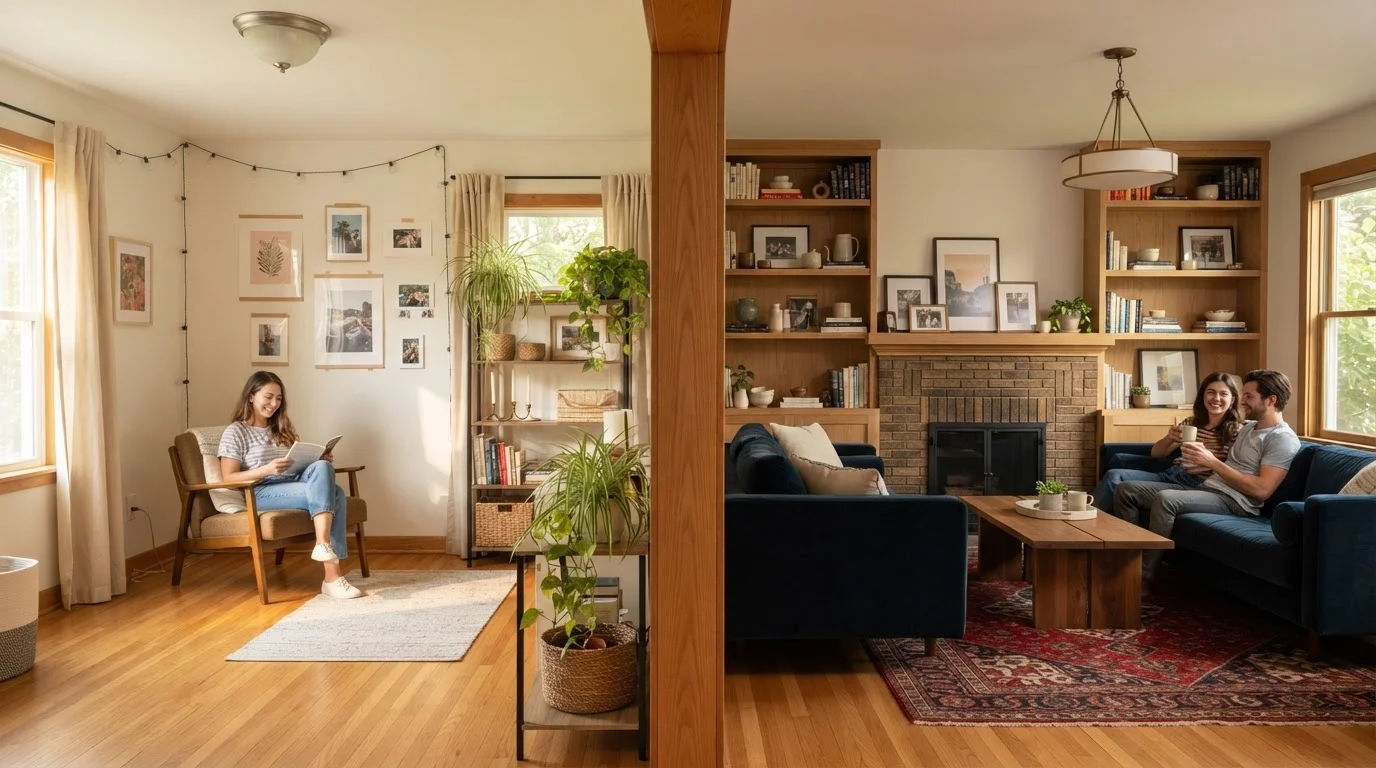
Key Takeaways
- Renters should focus on reversible, non-damaging upgrades that won't jeopardize their security deposit.
- Homeowners can justify higher upfront costs when improvements add long-term value or reduce ongoing expenses.
- Always read your lease before making any changes — even seemingly minor ones can violate terms.
- Some upgrades, like smart thermostats or lighting, make sense for both renters and owners depending on circumstances.
- The key question for any upgrade is: will I recoup this investment in comfort or cost savings before I move?
Option A
Renters
The flexible, low-commitment approach to home improvement.
Best for: People who want more comfort and style without risking their security deposit or violating their lease.
Option B
Homeowners
The long-term, equity-building mindset for lasting improvement.
Best for: People who can invest in permanent changes that add lasting comfort, efficiency, or resale value.
If you rent and want a refreshed, personalised space
Renters
Stick to peel-and-stick wallpaper, removable hooks, furniture arrangement, and lighting swaps. These changes cost little, leave no damage, and move with you.
If you own and want to reduce monthly utility costs
Homeowners
Insulation upgrades, smart thermostats, and energy-efficient windows pay back over time — an investment only worth making when you control the property long term.
If you're a renter planning to stay for several years
Renters
Negotiate with your landlord first. Some landlords approve small permanent upgrades — like ceiling fans — especially if you offer to cover the cost yourself.
If you own and want to improve daily livability without a big project
Homeowners
Homeowners have more flexibility to make mid-scale changes like adding built-in storage, refinishing floors, or upgrading plumbing fixtures without seeking approval.
If you're unsure whether to rent or own your next home
Renters
Start with reversible upgrades in your current space. They're lower risk and help you figure out what improvements actually matter to your daily life before committing to ownership.
The Core Difference: Who Bears the Risk?
Before spending a dollar on any home upgrade, the first question is simple: who owns this space, and who's on the hook if something goes wrong?
Renters operate under a lease, which is a legal contract that typically restricts permanent modifications. Drilling, painting, or rewiring without permission can cost you your security deposit — or worse, trigger a lease violation. Homeowners, by contrast, answer mostly to local building codes and their own budget. That freedom is real, but so is the financial exposure when something goes sideways.
This isn't about which situation is better — renting and owning each have genuine advantages. It's about being honest with yourself about the constraints you're working within. For a broader look at who's legally responsible for what in a rental, see our plain-language repair responsibility guide.
| Criterion | Renters | Homeowners |
|---|---|---|
| Permission required | Yes — check lease first | Self-directed (codes apply) |
| Upgrade reversibility | Must restore original condition | Permanent changes allowed |
| Long-term payback | Limited by move-out date | Can recoup over years |
| Structural changes | Rarely permitted | Allowed with permits |
| Deposit risk | High if work damages property | No deposit at risk |
| Best upgrade type | Removable, plug-in, portable | Built-in, energy-efficient, structural |
| Landlord negotiation | Sometimes possible in writing | Not applicable |
Upgrades That Make Sense for Renters
The renter's rule of thumb: if you can't take it with you or restore the space to its original condition, think twice. That still leaves a surprisingly wide field of options.
- Removable wallpaper and wall decals — Modern peel-and-stick options have improved dramatically. They add real visual impact and come off cleanly when you leave.
- Plug-in lighting — Swapping overhead fixtures without an electrician isn't realistic for renters, but plug-in sconces, floor lamps, and LED strips under cabinets can transform the feel of a room.
- Furniture arrangement and rugs — Rethinking your layout costs nothing. A well-placed rug can define zones in an open-plan space, which is especially useful in shared living situations.
- Tension-mount curtain rods — No holes required. These work in most window frames and make a significant difference in light control and privacy.
- Adhesive hooks and organizers — Command strips and their equivalents handle a lot of weight now, and remove cleanly from most wall surfaces.
If you want to go further, it's always worth having an honest conversation with your landlord. Some will agree to modest permanent upgrades — a new showerhead, a ceiling fan — if you cover the cost. Get any agreement in writing. For foundational skills that protect your deposit, the DIY skills every renter should know is a practical starting point.
Upgrades That Make Sense for Homeowners
Owning unlocks a different calculus. You can think in terms of years, not months, and factor in whether an upgrade adds resale value, reduces running costs, or simply makes daily life more comfortable on a timeline that justifies the spend.
- Insulation and air sealing — Unglamorous but high-impact. Improving attic insulation or sealing drafts around windows and doors can meaningfully reduce heating and cooling costs over time.
- Smart thermostats — Homeowners get the full benefit here because they control the HVAC system and can program it freely without landlord approval.
- Built-in storage — Custom shelving, a mudroom bench, or a pantry retrofit adds function and, in many cases, measurable appeal if you eventually sell.
- Kitchen and bathroom fixture upgrades — Replacing faucets, cabinet hardware, or a vanity light is a moderate DIY project for most people and delivers outsized visual returns.
- Flooring — Refinishing hardwood or replacing worn carpet is a significant project but one that tends to hold value well over time.
The honest caveat: not every upgrade pays back equally. Major renovations — kitchens, bathrooms, additions — often cost more than they return at resale, and estimates vary widely by market. The home maintenance on a tight budget guide covers how to prioritise when money is limited.
~35%
U.S. households that rent their home
According to U.S. Census Bureau data, roughly a third of American households are renters, making renter-appropriate upgrades a significant practical concern.
60–80%
Typical cost-recoup range for kitchen remodels
Remodeling industry surveys consistently show major kitchen renovations recoup less than their full cost at resale, underscoring the need to weigh comfort against investment value.
10–20%
Estimated heating/cooling savings from air sealing
The U.S. Department of Energy estimates that air sealing and insulation improvements can reduce heating and cooling costs by roughly 10–20% in many homes.
The Gray Zone: Upgrades That Work for Both
Some improvements don't fall neatly into either category. These are worth considering regardless of whether you rent or own, as long as you approach them correctly for your situation.
- Smart lighting
- Plug-in smart bulbs require no wiring changes and work in any fixture. Both renters and owners can enjoy scheduling, dimming, and remote control — just pack the bulbs when you move.
- Window treatments
- A quality set of blackout curtains or Roman shades on tension rods improves sleep, energy use, and aesthetics. They're portable and universally useful.
- Air quality improvements
- Portable air purifiers, dehumidifiers, and fans don't require installation and address real comfort issues in any home.
- Organization systems
- Freestanding shelving units, modular closet organizers, and drawer inserts work equally well in a rental or an owned home — and go with you when you leave.
The underlying principle is the same regardless of tenure: spend on things that solve a real problem you live with daily, and be honest about whether the cost is proportional to how long you'll benefit from it.