

Key Takeaways
- Open shelving makes a kitchen feel larger but requires consistent tidying to avoid visual chaos.
- Closed cabinets hide clutter and protect items from grease and dust with almost no extra effort.
- Open shelves cost less upfront if you're removing existing upper cabinets rather than installing new ones.
- Accessibility is a genuine advantage of open shelving — no doors to open, items grabbed in one motion.
- A hybrid approach — open shelving for everyday items, closed storage for the rest — suits many households.
Option A
Open Shelving
The airy, accessible, high-maintenance option.
Best for: Households that keep a curated, tidy set of dishes and want to visually open up a smaller kitchen.
Option B
Closed Cabinets
The forgiving, dust-free, clutter-hiding workhorse.
Best for: Busy households with varied cookware, mismatched items, or anyone who prefers a clean visual finish without daily tidying.
If your kitchen is small and you want it to feel more open
Open Shelving
Removing upper cabinet doors or switching to open shelves reduces visual bulk and can make a tight kitchen feel noticeably less cramped.
If you have a busy household or varied, mismatched kitchenware
Closed Cabinets
Closed doors mean you don't have to curate or tidy constantly — everything gets hidden behind a uniform finish with no effort.
If you're working with a tight renovation budget
Open Shelving
Floating shelves are generally less expensive to install than full upper cabinets, and removing existing cabinet doors costs next to nothing.
If cooking grease and airborne dust are a real concern in your kitchen
Closed Cabinets
Enclosed storage keeps dishes and glassware clean between uses, cutting down on the extra washing that open shelves can require.
If you want the benefits of both without committing fully to either
Open Shelving
Use open shelves for a few everyday items in a visible spot and keep closed cabinets for everything else — a partial switch gives you the style without the full maintenance load.
What You're Actually Choosing Between
Open shelving and closed cabinets aren't just aesthetic preferences — they represent different trade-offs in maintenance, accessibility, and how comfortable your kitchen feels to live in day to day. Neither is universally better. The right choice depends on how your household actually uses the space.
Open shelves are exactly what they sound like: wall-mounted shelves with no doors, leaving everything on them fully visible. Closed cabinets enclose storage behind solid or glass-fronted doors. Most kitchens use some version of closed upper cabinets by default, but in recent years open shelving has become a popular alternative, particularly for smaller kitchens where visual weight matters.
Before deciding, it helps to be honest about two things: how tidy your everyday kitchen habits actually are, and how much maintenance you're willing to absorb. Those two factors will drive most of the decision.
| Criterion | Open Shelving | Closed Cabinets |
|---|---|---|
| Visual effect | Opens up the space, feels lighter | Can feel heavier, more enclosed |
| Dust and grease exposure | High — items need regular wiping | Low — doors keep contents clean |
| Accessibility | Immediate — no doors to open | One extra step to open and close |
| Tidiness demand | High — clutter is always visible | Low — doors hide any disorder |
| Typical upfront cost | Lower for floating shelf installs | Higher for full upper cabinet runs |
| Suitability for renters | Possible with landlord approval | Usually already in place |
| Style flexibility | Items on display must look intentional | Any mix of items, hidden from view |
The Real Costs of Open Shelving
Open shelving looks effortlessly clean in design inspiration photos — but those photos are styled. In a working kitchen, open shelves collect grease film, cooking steam residue, and regular household dust. Items you don't reach for every day will need wiping down before use. That's not a dealbreaker, but it is a real, recurring time cost most people underestimate.
The other hidden cost is visual: open shelves are always "on." A stack of mismatched mugs, an odd assortment of canned goods, or a cluttered row of half-used bottles will be visible every time you walk into the kitchen. For households where the kitchen is a high-traffic, high-activity space, that level of permanent display can feel stressful rather than welcoming.
That said, open shelving genuinely does make items easier to grab — no door to open, no digging to the back of a deep cabinet. For everyday dishes, glasses, and frequently used items, the accessibility advantage is real. It also tends to cost less upfront. Floating shelves are inexpensive to install, and if you already have upper cabinets you're happy to remove, taking the doors off costs almost nothing. See our guide to using vertical space if you're thinking about how to make the most of your wall area once shelves are in place.
Renting? Check Before You Remove Anything
If you rent your home, removing cabinet doors or installing open shelving almost always requires written landlord approval. Even seemingly minor changes — like adding shelf brackets to walls — may count as alterations under your lease. Get permission in writing before making any changes, and confirm whether you'll be expected to restore the kitchen to its original state when you move out.
Where Closed Cabinets Hold Their Ground
Closed cabinets forgive a lot. Dishes don't need to match. Pantry items can be stacked haphazardly. The morning rush doesn't leave the kitchen looking chaotic because everything gets shut away. For households with kids, multiple cooks, or simply a lot of stuff, that forgiving quality is genuinely valuable.
Closed storage also protects what's inside. In kitchens where frying, sautéing, and high-heat cooking are regular occurrences, the grease and steam that settle on open shelves stay off your dishes when there's a door in the way. Items you use less frequently — the holiday serving dish, the spare set of glasses — stay clean between uses without any extra effort.
The trade-off is visual weight. Upper cabinets, especially in a smaller kitchen, can make the space feel more closed-in. Choosing lighter finishes, glass-front doors, or simply reducing the total number of upper cabinets can help offset that. It's also worth exploring overlooked storage spots elsewhere in the kitchen if closed cabinets alone aren't giving you enough room.
Making the Hybrid Approach Work
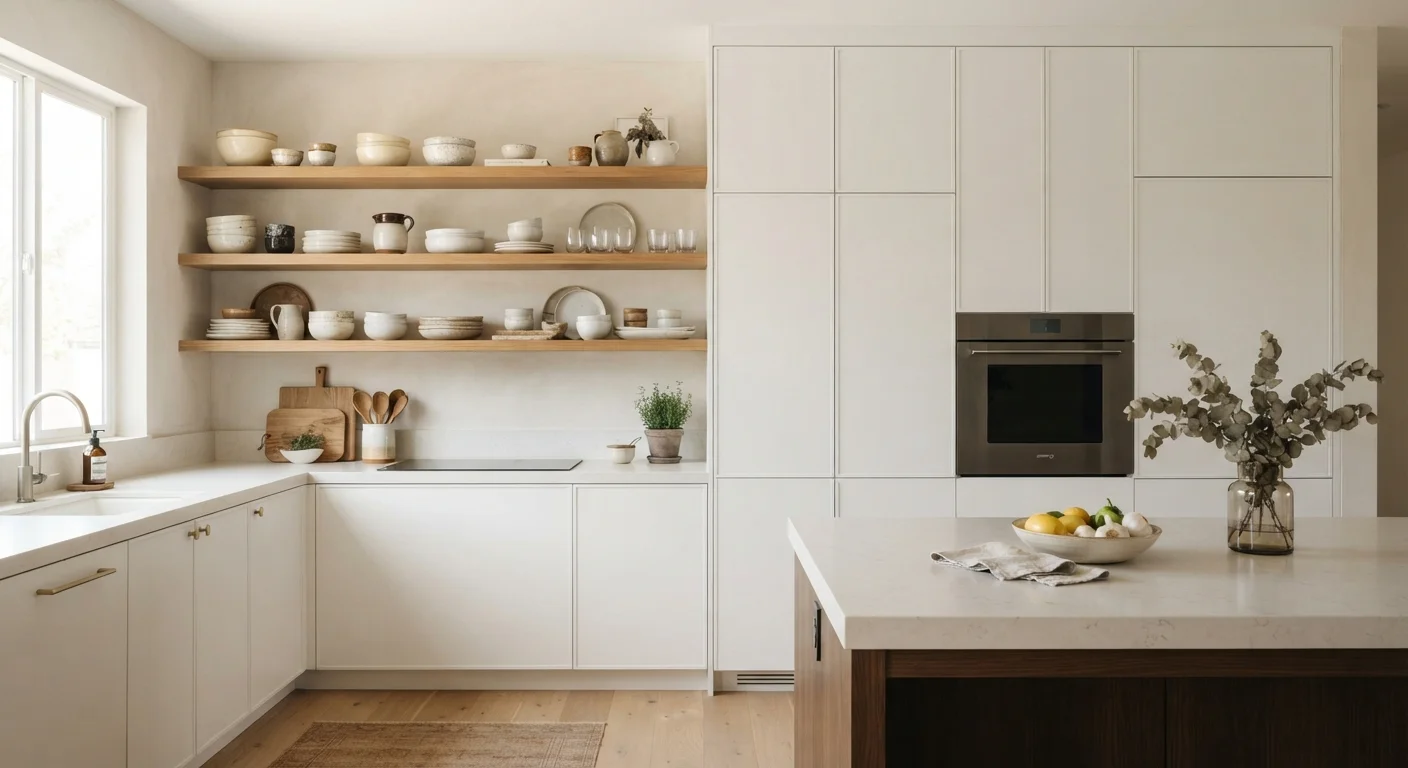
For many households, the most practical answer isn't a full commitment to either option — it's a deliberate mix. Open shelves work well for a small, curated set of everyday items: the plates you use at every meal, a few glasses, a handful of frequently reached-for items. Closed cabinets handle everything else.
This approach lets you get the visual openness and grab-and-go convenience of open shelving in a controlled zone, while closed storage absorbs the clutter and variety that don't photograph well. The key is deciding upfront which items will live on the open shelves and sticking to it — the hybrid model falls apart when open shelves become overflow storage for whatever doesn't fit elsewhere.
If you share your kitchen with others, it's worth having a direct conversation about who will manage what. Shared living spaces work best when storage systems match how everyone uses the space — not just how one person prefers it to look. And if you find yourself wrestling with clutter regardless of which system you choose, common organisation myths may be part of the problem.