
Organic Fertiliser vs. Synthetic Fertiliser: What the Difference Means for Your Garden

Key Takeaways
- Organic fertilisers release nutrients slowly and improve soil structure over time.
- Synthetic fertilisers deliver fast, measurable nutrients but don't improve the soil itself.
- Overuse of synthetic fertilisers can lead to nutrient runoff and salt buildup in soil.
- Organic options are generally safer around children and pets when used as directed.
- Cost per application is often lower for synthetics, but organics reduce long-term soil inputs.
- Neither type is universally superior — your soil needs and goals determine the right fit.
Option A
Organic Fertiliser
The slow-and-steady soil builder.
Best for: Gardeners focused on long-term soil health and sustainability over quick results.
Option B
Synthetic Fertiliser
The fast-acting, predictable plant feeder.
Best for: Gardeners who need quick nutrient corrections or consistent results in a single season.
If you want to improve soil health over multiple seasons
Organic Fertiliser
Organic fertilisers feed soil microbes and build structure over time, making each subsequent growing season easier and cheaper.
If you need to fix a specific nutrient deficiency quickly
Synthetic Fertiliser
Synthetic formulas deliver precise, immediately available nutrients, making them effective for addressing a known shortage fast.
If you're gardening on a tight budget this season
Synthetic Fertiliser
Synthetic fertilisers typically cost less per application upfront, which matters when you're managing expenses closely.
If you have children or pets regularly in the garden
Organic Fertiliser
Most organic options pose lower chemical exposure risks in garden spaces where kids and animals roam, though you should still follow label directions.
If you're working with poor or depleted garden soil
Organic Fertiliser
Depleted soil needs more than nutrients — it needs organic matter and microbial life, which organic fertilisers actively support.
What Each Type Actually Does
Fertilisers serve one basic purpose: supplying plants with nutrients they need to grow. But organic and synthetic fertilisers go about this in fundamentally different ways, and understanding that difference helps you make smarter decisions in your own yard.
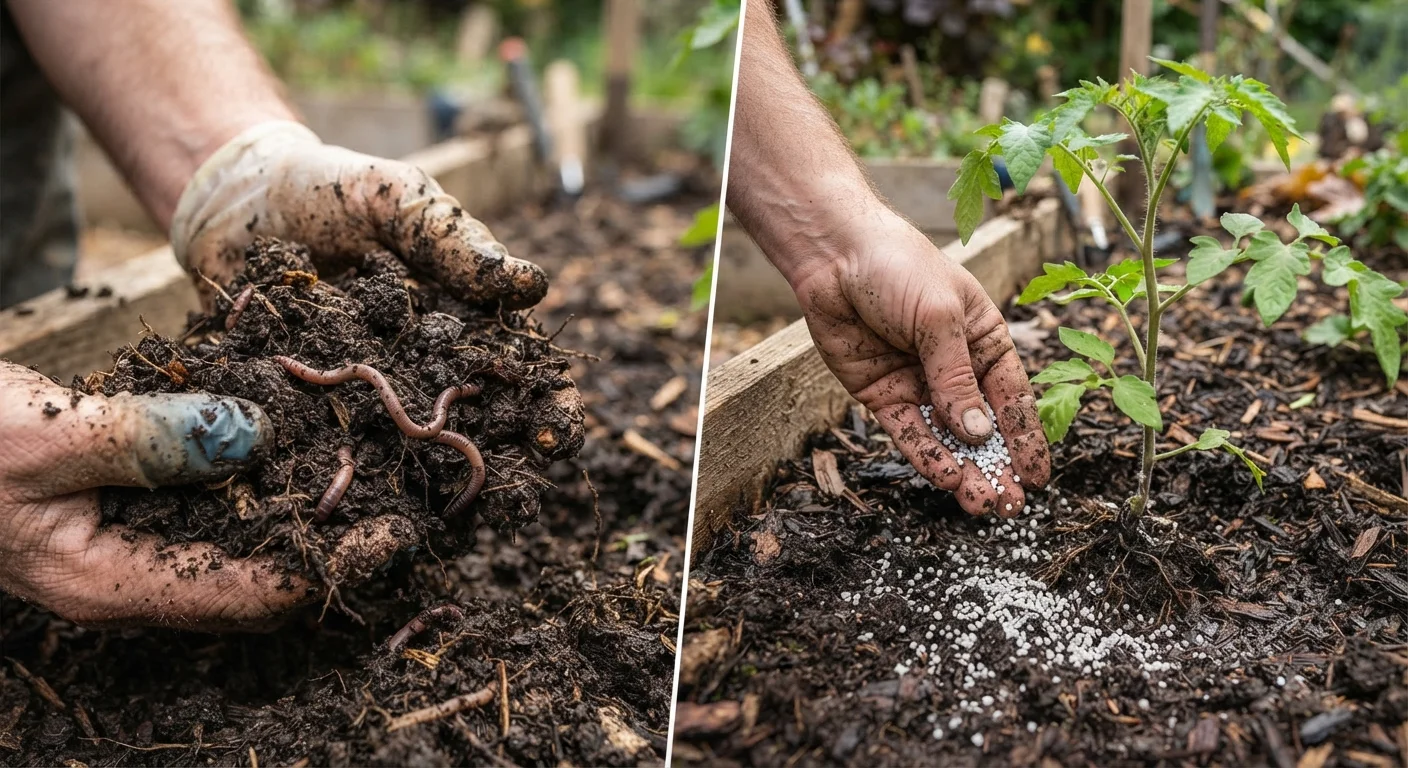
Organic fertilisers come from natural sources — composted plant matter, manure, bone meal, kelp, and similar materials. They don't deliver nutrients directly to plant roots in an immediately usable form. Instead, soil microbes break down the organic matter first, gradually releasing nutrients into the soil. This process improves soil biology as a side effect, encouraging earthworms, beneficial bacteria, and fungal networks that make soil more fertile over time. For more on why that underlying ecosystem matters, see our guide on soil health foundations.
Synthetic fertilisers are manufactured compounds — typically blends of nitrogen, phosphorus, and potassium (labeled as N-P-K on packaging). These nutrients are water-soluble and available to plants almost immediately. Synthetics don't improve soil structure or microbial activity, but they do give you precise control over what your plants receive and when.
| Criterion | Organic Fertiliser | Synthetic Fertiliser |
|---|---|---|
| Nutrient release speed | Slow, over weeks to months | Fast, often within days |
| Soil biology impact | Improves microbial activity | Minimal to none |
| Nutrient precision | Variable by product/batch | Consistent, labeled N-P-K |
| Runoff risk | Lower | Higher with excess use |
| Upfront cost | Often higher per bag | Often lower per application |
| Salt buildup risk | Very low | Higher with repeated use |
| Best use scenario | Long-term soil building | Quick nutrient correction |
The Trade-Offs Worth Knowing
Neither option is without drawbacks. Organic fertilisers act slowly — sometimes too slowly if your plants show signs of nutrient stress mid-season. They're also harder to apply at precise dosages because nutrient concentrations vary by product and batch. Cost per pound is often higher than synthetics, though this can even out over seasons as your soil improves and requires fewer inputs. See keeping a garden on a tight budget for a broader look at where fertiliser fits in your spending.
Synthetic fertilisers carry their own concerns. Because nutrients are immediately water-soluble, they can wash out of soil quickly — especially with heavy rainfall — leading to runoff that can affect nearby waterways. Repeated use without organic matter additions can gradually degrade soil structure, making it increasingly dependent on added fertiliser to support plant growth. Excess salts from synthetic applications can also accumulate in soil and stress plant roots over time.
Get a Soil Test First
Many cooperative extension services and local garden centers offer affordable soil testing. A basic test tells you your soil's pH and which nutrients are already present or deficient. This takes the guesswork out of choosing a fertiliser and prevents unnecessary spending on nutrients your soil doesn't actually need.
A soil test before choosing any fertiliser is the single most useful step most home gardeners skip. It tells you exactly what nutrients are lacking, so you're not guessing — and not over-applying.
How to Decide What Your Garden Needs
The honest answer is that many experienced gardeners use both, depending on the situation. A base of compost or aged manure worked into beds each spring handles long-term fertility. A targeted synthetic application addresses an acute deficiency when a crop is underperforming mid-season.
If you're building a new garden bed or working with compacted or depleted soil, organic matter is the higher priority — no fertiliser compensates for poor soil structure. Pairing fertiliser with mulch also helps retain nutrients in the root zone; garden mulching basics explains why that combination works well together.
~40%
Of US home gardens estimated to have imbalanced soil pH
Soil pH affects how well plants can absorb nutrients, making it a key factor before any fertiliser decision.
3–6 weeks
Typical lag before organic fertilisers show visible results
The slower release timeline is a common reason gardeners combine organic base applications with targeted synthetic top-dressing.
For container gardening, where soil volume is small and nutrients deplete quickly, synthetics often make practical sense. For raised beds and in-ground plots with long-term goals, organics generally build more value over time. Your soil type, local rainfall, and what you're growing all factor in — there's no formula that fits every yard.