

Key Takeaways
- Effective workouts require very little floor space — a yoga mat's worth is often enough.
- Bodyweight exercises like squats, lunges, and push-ups deliver real fitness benefits without equipment.
- Breaking movement into short sessions throughout the day is a legitimate and effective strategy.
- Shared or small spaces call for low-impact options that respect neighbors and housemates.
- Consistency over intensity is what builds lasting fitness habits in limited environments.
Why Apartment Living Doesn't Have to Mean Sitting Still
Millions of Americans live in apartments, studios, or compact flats where space is genuinely limited. The assumption that you need a dedicated home gym — or a gym membership — to stay active is one worth questioning. The research behind exercise's health benefits doesn't require a squat rack or a 500-square-foot workout room. It requires consistency, effort, and a little creative thinking about the space you already have.
If you work from home or spend long stretches at a desk, you may already know the stiffness that builds up by afternoon. Our guide on adding movement to long workdays covers low-disruption strategies for that. This article focuses specifically on what's possible within your four walls — including approaches that work in tight quarters, around roommates, and without disturbing downstairs neighbors.
How Much Space Do You Actually Need?
Most bodyweight exercise sequences fit within the dimensions of a standard yoga mat (roughly 68 by 24 inches). Some movements — like lateral lunges or certain stretches — benefit from slightly more room, but there are almost always space-efficient alternatives. If your living area is especially limited, standing and wall-based exercises work in even tighter footprints.
7 Practical Ways to Move More in a Small Home
Define your movement zone — even if it's just a mat
The first step is identifying a spot in your home that can reliably be cleared for movement. This doesn't need to be permanent — a 6-by-2-foot rectangle of floor, roughly the size of a standard yoga mat, is genuinely enough for a full-body routine. Push a coffee table aside, fold back a rug, or use a bedroom corner. The key is making the mental shift that this spot is usable for exercise, not just for walking through.
Having a defined space — even a small one — reduces the friction of getting started. You know where you'll go, and that consistency is what supports habit formation over time.
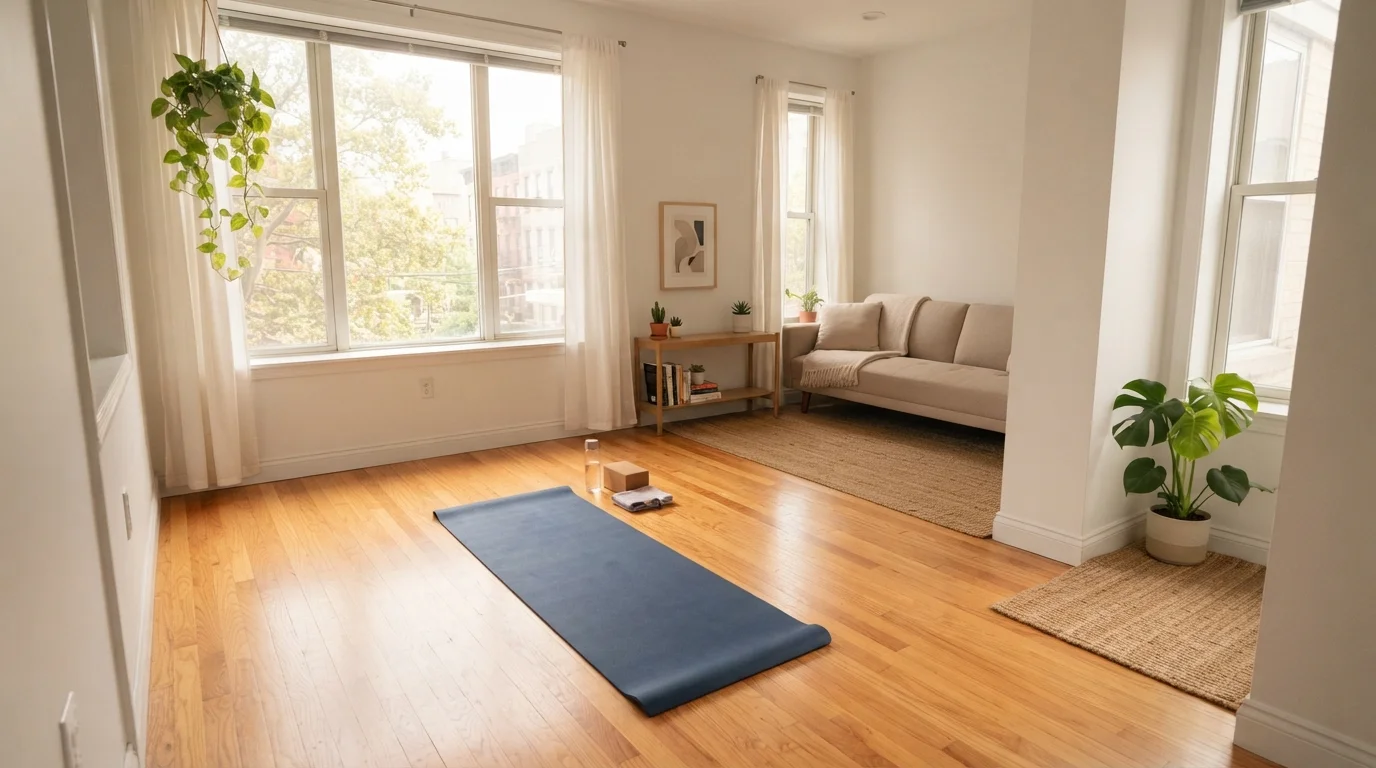
A yoga mat's worth of floor space is enough for a complete full-body routine.
Use bodyweight exercises that don't need equipment or extra room
Squats, push-ups, lunges, planks, mountain climbers, and glute bridges can all be done in a very small footprint. These movements work major muscle groups, elevate your heart rate, and build functional strength — all without a single piece of equipment. A sequence cycling through several of these exercises for 20–30 minutes represents a genuinely effective workout by mainstream fitness standards.
You can also modify for space: wall push-ups, standing oblique crunches, and standing balance exercises take up almost no lateral space at all, making them practical for studio apartments or shared rooms.
Push-ups, squats, and planks cover major muscle groups in a tiny floor footprint.
Go low-impact to protect downstairs neighbors
One of the most common concerns for apartment dwellers is noise — specifically the thudding impact that comes with jumping jacks, burpees, or running in place. Low-impact alternatives deliver similar cardiovascular and muscular benefits with far less noise and vibration. Try marching in place with high knees instead of jumping, slow controlled squats instead of jump squats, or step-out lateral movements instead of lateral hops.
Low-impact doesn't mean low-effort. Slowing down a movement and increasing control often makes it harder, not easier — and is better for joint health over the long run.
Low-impact alternatives can match the effort of jumping exercises without the noise.
Break movement into short sessions across the day
There's strong evidence in exercise science that accumulated movement throughout the day — sometimes called exercise snacking — provides meaningful health benefits, even when sessions are short. Three 10-minute movement blocks can be just as useful for many health markers as a single 30-minute workout. This approach works particularly well in small homes because you're not committing to a full setup every time.
Set a reminder, link movement to an existing habit (after coffee, before lunch, after your last work call), and keep the barrier low. Even five focused minutes of movement is worth more than none.
Short movement sessions accumulated across the day deliver real, measurable health benefits.
Use walls, chairs, and counters as support tools
Your apartment's fixed features are underused fitness tools. A sturdy wall supports wall sits, standing push-offs, and balance work. A stable chair works for tricep dips, seated leg raises, or step-ups if it's the right height and solidly built. A kitchen counter at the right height can support single-leg balances or light upper-body work.
None of these require purchasing anything. They simply require looking at your existing environment differently — similar to the mindset shift described in our piece on using vertical space more creatively. The resources are already there.
Walls, chairs, and counters are ready-made fitness tools hiding in plain sight.
Incorporate movement into everyday tasks
Exercise doesn't have to be a separate block of time. Calf raises while washing dishes, slow bodyweight squats while waiting for the kettle, or holding a plank during a TV ad break all add up. This isn't a replacement for dedicated movement sessions, but it meaningfully increases your daily activity total — which has its own independent health value.
Think of it as reducing sedentary time rather than replacing structured exercise. The two work together. If you're also trying to build a morning movement routine, weaving smaller moments into the rest of your day reinforces the overall habit.
Weaving movement into everyday tasks meaningfully raises your daily activity total.
Keep any equipment minimal and storable
If you want to add any physical tools, prioritize items that store flat or small: a resistance band, a jump rope (used outdoors or in a hallway), or a single set of light dumbbells. A yoga or exercise mat is the most versatile starting point — it defines your space, cushions floor-based work, and rolls up for storage. Avoid bulky equipment that creates ongoing clutter, as it tends to become a barrier rather than a motivator in small homes. The trade-offs of multifunction furniture apply to fitness gear too — what sounds useful in theory can dominate a small room in practice.
A rollable mat and a resistance band cover most needs without crowding a small space.
Start With What You'll Actually Do
The most effective workout in a small space is the one you'll repeat consistently. Choose two or three movements you find tolerable — not necessarily exciting — and do them regularly before adding variety. Consistency is what drives results, not novelty. Keep your first routine short enough that skipping it feels harder than doing it.
Making It Stick in a Shared or Compact Space
Movement habits in small homes succeed when they're low-friction. That means not needing to rearrange furniture every time, keeping any equipment easy to access, and choosing routines that fit your actual schedule rather than an idealized one. If you're sharing your space with others, it helps to communicate about when and where you plan to move — something our piece on making shared spaces work for different people addresses from a broader angle.
If you're brand new to regular movement, don't try to do everything at once. Our first-month beginner guide maps out a gentle, realistic starting point. And when you're ready to expand outdoors, public parks and paths offer more than most people use. Small spaces are a starting point, not a ceiling.
This article is for general informational purposes only and is not a substitute for professional medical or fitness advice. If you have any health conditions or concerns, consult a qualified healthcare provider before starting a new exercise routine.