

Key Takeaways
- The 3,000-mile oil change rule is outdated — most modern engines go 5,000 to 10,000 miles or more between changes.
- Idling to warm up a cold engine wastes fuel and can actually harm modern engines.
- Premium gasoline offers no benefit in engines designed for regular fuel.
- Tire pressure should be set to the vehicle specification, not the number stamped on the tire sidewall.
- A fully charged battery can still fail a load test — age and condition matter more than voltage alone.
Why These Myths Still Circulate
Car maintenance advice spreads fast and sticks around long after it stops being relevant. Some of these myths were once grounded in reality — older engines, older oil formulations, and older fuel systems genuinely required more frequent attention. But vehicles have changed dramatically over the past few decades, and advice that made sense in 1985 can now cost you time and money without delivering any real benefit.
The goal here isn't to shame anyone for following outdated guidance. It's to give you accurate, current information so you can maintain your vehicle confidently and stop spending money on services you don't need. For a broader foundation, our car maintenance basics guide covers the essential checks and schedules every driver should know.
Myth
You need to change your oil every 3,000 miles, no exceptions.
Fact
Most modern vehicles with conventional oil can go 5,000 to 7,500 miles between changes; many using full synthetic oil can safely go 10,000 miles or more.
The 3,000-mile rule originated when engine tolerances were looser and oil quality was lower. Today's engines are precision-built, and modern oil formulations — especially full synthetics — hold up far longer under normal driving conditions. Your owner's manual will specify the correct interval for your vehicle and oil type. Following that recommendation rather than the more conservative number protects your engine just as well while reducing how often you pay for service. For a clear explanation of how oil types differ, see synthetic vs. conventional motor oil.
Myth
You should let your car idle for several minutes to warm up the engine in cold weather.
Fact
Modern fuel-injected engines warm up faster and more safely by driving gently from the start — prolonged idling is unnecessary and can cause carbon buildup.
Carbureted engines — common before the mid-1980s — did benefit from idling because carburetors needed time to meter fuel correctly in cold temperatures. Today's fuel-injected engines use sensors to adjust the fuel mixture automatically, so they're ready to be driven within about 30 seconds. Idling for several minutes wastes fuel and, in gasoline engines, can allow unburned fuel to wash lubricating oil off cylinder walls. The best warm-up strategy is to drive moderately for the first few minutes, avoiding high RPMs until the temperature gauge begins to rise.
Myth
Premium gasoline gives every car better performance and fuel economy.
Fact
Premium fuel only benefits engines specifically engineered to require or recommend it — using it in a regular-fuel engine offers no measurable gain.
Premium gasoline has a higher octane rating, which resists engine knock (premature ignition) in high-compression engines. If your engine is designed for regular 87-octane fuel, the extra octane provides nothing useful — combustion simply completes the same way it would with regular. Your owner's manual will clearly state whether your vehicle requires premium or merely recommends it. "Required" means the engine needs it to function correctly; "recommended" typically means slight performance gains under hard driving, but regular fuel won't harm the engine.
Myth
The pressure number on the tire sidewall is what you should inflate your tires to.
Fact
The sidewall number is the tire's maximum pressure limit — the correct inflation pressure for your vehicle is listed on the driver's door jamb sticker or in the owner's manual.
Overinflating tires to the sidewall maximum reduces the contact patch with the road, which shortens braking distances and makes the ride harsher. It also accelerates wear in the center of the tread. Underinflation creates its own problems — increased rolling resistance, uneven shoulder wear, and higher blowout risk. The vehicle manufacturer's recommended pressure accounts for ride quality, handling, load capacity, and fuel efficiency specific to that model. Check pressures when tires are cold (not driven for at least three hours) for the most accurate reading.
Myth
If your battery holds a charge overnight, it's fine.
Fact
A battery can show normal resting voltage and still fail under the electrical load of starting the engine, particularly in cold weather.
Resting voltage only tells you the battery isn't completely dead — it says nothing about how the battery performs when the starter motor draws a high current. A load test, available at most auto parts stores, measures how the battery behaves under simulated starting conditions. Batteries degrade gradually, and a unit that passes a voltage check today may fail on a cold morning when internal resistance climbs and cranking demand spikes. Most automotive batteries have a service life of three to five years, depending on climate and usage.
Myth
You should replace all four tires at once, every time.
Fact
Replacing tires in pairs on the same axle is the standard practice for most vehicles — all four only need replacement simultaneously when wear is even across all positions.
Tire replacement decisions should be based on tread depth and wear patterns, not a blanket rule. When one axle's tires are worn but the other pair still has adequate tread, replacing in pairs is the appropriate approach. The exception is all-wheel-drive vehicles, where mismatched tread depths across all four tires can stress the drivetrain — for those vehicles, replacing all four at once is often recommended by the manufacturer. Check your owner's manual or ask a mechanic if you're unsure which approach applies to your specific drivetrain.
What Actually Keeps Your Car Running Longer
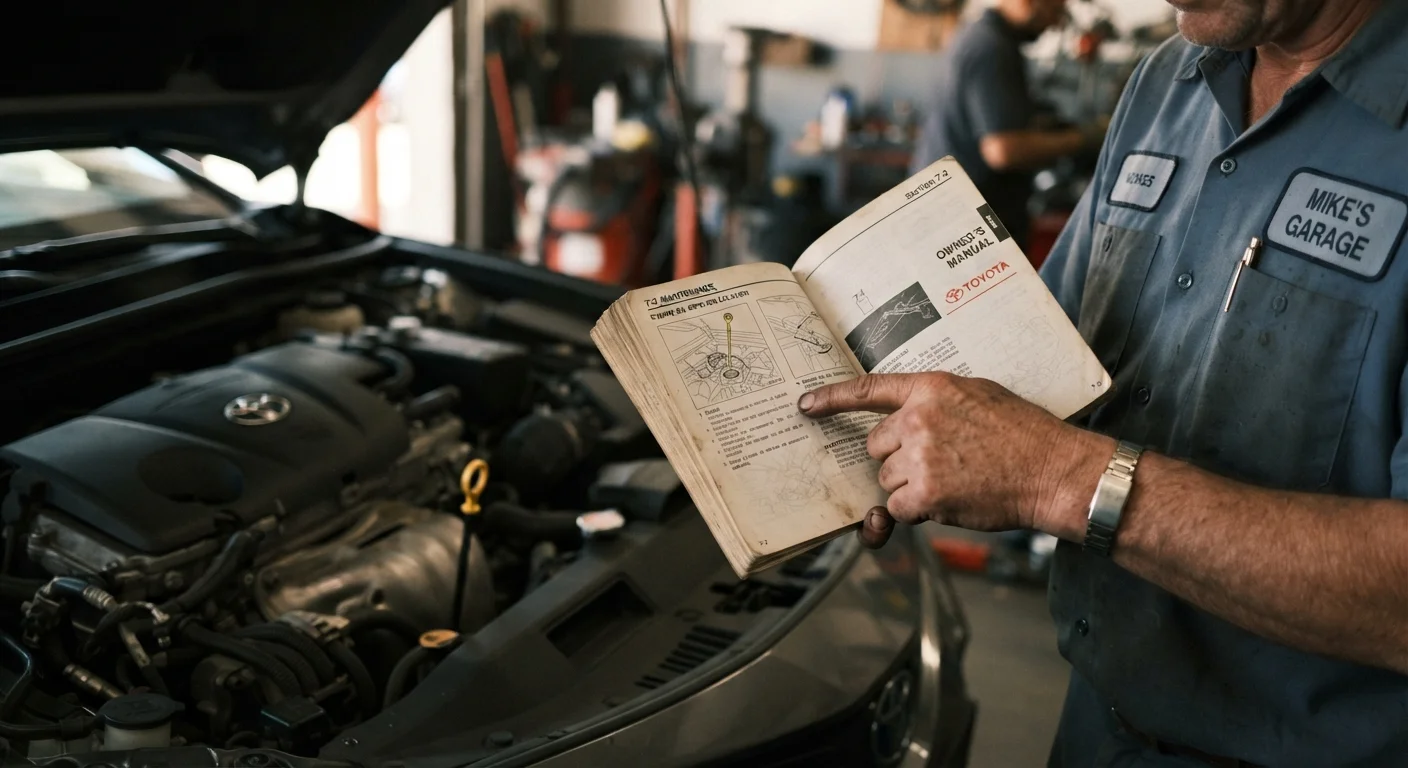
The most reliable maintenance schedule isn't based on what a quick-lube shop posts on its wall — it's in your owner's manual. Manufacturers test their vehicles extensively and specify service intervals based on real engineering data. Following those intervals, rather than arbitrary rules, protects your engine and your wallet at the same time.
5,000–10,000 mi
Typical modern oil change interval
The U.S. Department of Energy notes that many newer vehicles using synthetic oil can safely exceed the old 3,000-mile guideline by a significant margin.
~25%
Fuel wasted idling a cold engine for 10 minutes
Natural Resources Canada estimates that idling for 10 minutes each cold morning can waste a meaningful fraction of daily fuel consumption with no engine protection benefit.
A few habits genuinely do extend a vehicle's useful life: checking tire pressure monthly, keeping up with fluid changes on schedule, and addressing warning lights promptly rather than hoping they go away. For a deeper look at commonly skipped items, see fluids, filters, and belts most drivers overlook. And if you're wondering how much of this you can handle yourself versus when to call a mechanic, our DIY vs. garage guide lays out the honest trade-offs.
Always Check Your Owner's Manual First
No single piece of generic advice applies equally to every vehicle. Your owner's manual contains manufacturer-tested, model-specific guidance on oil type, service intervals, fuel grade, and tire pressure. Keeping that manual in the glovebox — or bookmarking the digital version — is one of the simplest and most effective maintenance habits you can build. When in doubt, the manual outweighs what anyone else tells you at the pump or in a parking lot.
Seasons also affect what your car needs. Before temperature extremes hit, it's worth running through a dedicated checklist — our seasonal car maintenance guide covers exactly that. And if you're keeping an older, high-mileage vehicle, what changes past 100,000 miles can help you anticipate costs before they surprise you.