

Key Takeaways
- Your owner's manual is the single most reliable source of maintenance intervals for your specific vehicle.
- Several basic checks — oil, tires, lights — require no tools and take under 10 minutes.
- Skipping routine maintenance typically leads to larger, more expensive repairs later.
- Keeping a written maintenance log helps you track what's been done and supports resale value.
- Not all commonly repeated maintenance rules are accurate — verify advice against your manufacturer's guidance.
Start here
Why Maintenance Matters from Day One
Next
The Checks You Can Do Yourself
Then
Understanding Your Service Schedule
When you're ready
Building Habits That Protect Your Investment
Why Maintenance Matters from Day One
A car is one of the larger recurring expenses most households carry. What many first-time owners don't realize is that a significant portion of major repair costs is preventable — not through expensive services, but through consistent, simple upkeep done on schedule.
Neglected maintenance rarely announces itself with a single dramatic failure. More often, small problems compound quietly: low oil leads to increased engine wear, underinflated tires wear unevenly and reduce fuel efficiency, and a marginal battery becomes a dead battery on the coldest morning of the year. The pattern holds across vehicle makes and models — deferred maintenance tends to multiply costs.
The good news for new owners is that the core of car maintenance isn't complicated. A handful of regular checks, combined with following the service schedule in your owner's manual, covers the vast majority of what keeps a vehicle reliable.
Owner's manual
The booklet that comes with your vehicle from the manufacturer, listing maintenance schedules, fluid specifications, and operational guidelines specific to your car.
PSI
Pounds per square inch — the unit used to measure tire air pressure. The correct PSI for your vehicle is specified by the manufacturer, not the tire brand.
Service interval
The mileage or time period after which a specific maintenance task — such as an oil change or filter replacement — is recommended by the vehicle manufacturer.
Dipstick
A long, thin metal rod inserted into the engine that lets you check the oil level without any tools other than a clean cloth or paper towel.
Synthetic oil
A type of engine oil manufactured through a chemical process rather than refined from crude oil. It typically lasts longer between changes than conventional oil and is specified for many modern engines.
Tread depth
The depth of the grooves in your tire surface. Adequate tread depth allows water to escape from under the tire, maintaining grip on wet roads.
The Checks You Can Do Yourself
Several important maintenance tasks require no mechanical training and no specialized tools. Getting comfortable with these checks is the most practical first step any new owner can take.
Engine Oil
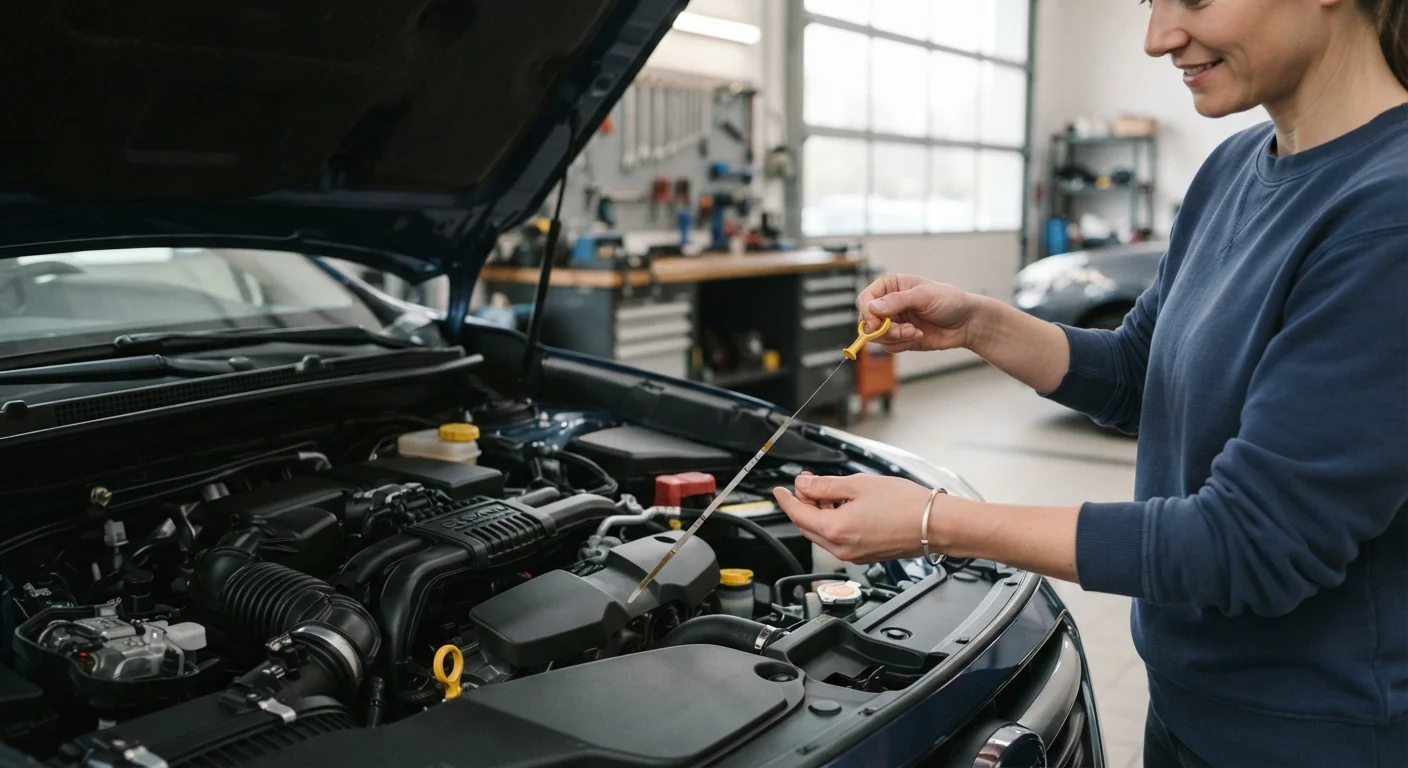
Oil lubricates your engine's moving parts and degrades over time. Pull the dipstick, wipe it, reinsert it fully, then pull it again to read the level. The oil should fall between the minimum and maximum marks. Also note the color — fresh oil is amber; very dark or gritty oil may be due for a change. Your owner's manual specifies the correct oil grade and change interval.
Tire Pressure and Tread
Underinflated tires wear faster, handle poorly, and reduce fuel economy. The correct pressure for your vehicle (measured in PSI) is listed on a sticker inside the driver's door jamb — not on the tire itself. Use an inexpensive pressure gauge to check all four tires monthly. For tread depth, the penny test offers a rough check: insert a penny into the tread groove with Lincoln's head facing down. If you can see the top of his head, the tread is likely worn to a point where replacement should be discussed with a tire professional.
Other Fluid Levels
Coolant, brake fluid, power steering fluid (on applicable vehicles), and windshield washer fluid all have visible reservoirs under the hood with min/max markings. Topping up washer fluid is straightforward; for brake fluid or coolant, consult your owner's manual or a mechanic if levels are consistently low, as that can signal a leak.
Lights
Walk around your vehicle periodically and confirm that headlights, taillights, brake lights, and turn signals are all working. A burned-out light can earn you a traffic stop and, more importantly, reduces your visibility to other drivers.
Check Your Tires Before Every Long Trip
Tire pressure changes with temperature — roughly 1 PSI for every 10°F shift. Before a long drive, especially in changing seasons, take two minutes to check all four tires when they're cold (before you've driven more than a mile). It's one of the simplest things you can do for fuel efficiency and safety.
Understanding Your Service Schedule
Every vehicle comes with a manufacturer-defined service schedule, typically laid out in the owner's manual. These intervals — set by mileage, time elapsed, or both — specify when components like engine oil, air filters, spark plugs, and transmission fluid should be inspected or replaced.
One widespread misconception is that all cars need an oil change every 3,000 miles. Many modern vehicles with synthetic oil have intervals of 5,000 to 10,000 miles or more. Following the manufacturer's actual specification, rather than outdated rules of thumb, can save you money without compromising the engine. For a deeper look at what service types actually include, see our guide on understanding your car's service schedule.
There are also items many drivers routinely overlook — cabin air filters, transmission fluid, and drive belts among them. Our article on fluids, filters, and belts most drivers forget to check covers these in detail.
If your vehicle displays a service warning light, don't dismiss it. These systems are calibrated to your specific vehicle and driving patterns. Addressing them promptly is nearly always less costly than waiting.
Building Habits That Protect Your Investment
The difference between a car that costs a fortune over its lifetime and one that doesn't usually comes down to habits established early. Three practices make a measurable difference for most drivers.
Keep a Maintenance Log
Recording every service — oil changes, tire rotations, brake inspections — gives you a reliable reference for what's been done and what's coming due. It also supports resale value by demonstrating to future buyers that the vehicle was properly cared for. Our guide on keeping a car maintenance log covers what to track and simple ways to stay consistent.
Prepare for Seasonal Changes
Hot summers and cold winters place different demands on your vehicle. Tire pressure drops in cold weather, batteries struggle more at low temperatures, and coolant needs to be at the correct concentration for freezing conditions. Building a pre-season check into your routine addresses these issues before they strand you. The seasonal car maintenance checklist is a useful reference for both.
Question Maintenance Myths
A lot of car advice circulates by word of mouth and is outdated or simply inaccurate. Checking what your manufacturer actually recommends — rather than relying on popular rules — is consistently the more reliable approach. Our article on car maintenance myths many drivers still believe walks through several of the most common ones.
Starting these habits in the first weeks of ownership is far easier than trying to build them later. The investment in time is small; the payoff in reliability and avoided costs is significant.
When to Call a Mechanic
The checks described in this guide are appropriate for most drivers to handle themselves. However, any work involving brakes, suspension, steering components, fuel systems, or anything requiring the vehicle to be raised safely off the ground should be handled by a qualified mechanic. If you're unsure whether a task is within your comfort level, erring on the side of professional service is always reasonable.