

Key Takeaways
- Most drivers underestimate annual car costs because expenses are spread across many categories throughout the year.
- A structured audit splits costs into fixed, variable, and irregular buckets to reveal the true total.
- Depreciation is typically the largest single cost of ownership — yet many drivers never account for it.
- Once you see each category clearly, realistic savings opportunities become much easier to spot.
- Running this audit once a year gives you a reliable baseline for smarter financial decisions.
What you will need
Why Most Drivers Get the Number Wrong
Ask most drivers what their car costs them per year, and they'll quote the monthly loan payment or insurance premium. That's understandable — those are the bills that show up on a schedule. But the real number is almost always significantly higher once you add fuel, maintenance, tires, registration, parking, and the silent drain of depreciation.
Our companion piece on what running a car truly costs breaks down each of these categories in detail. This guide takes the next step: giving you a repeatable framework to calculate your own number every year, specific to your vehicle and driving habits.
The goal isn't to stress you out about spending — it's to replace vague anxiety with clear numbers. Once you know what you're actually paying, you can make deliberate choices rather than passive ones.
What you will need
The Three Buckets: Fixed, Variable, and Irregular
Before you start collecting receipts and statements, it helps to organize car costs into three categories. This structure makes the audit faster and highlights where spending is controllable.
- Fixed costs — expenses that stay roughly the same regardless of how much you drive: loan or lease payment, insurance premium, registration and taxes, and parking permits.
- Variable costs — expenses that scale with use: fuel, tolls, and per-mile wear items like tires and wiper blades.
- Irregular costs — maintenance, repairs, and unexpected expenses that don't follow a monthly pattern but are real and predictable over time.
Depreciation sits in its own category. It doesn't produce a bill, but it represents real money leaving your net worth every year. For most vehicles, depreciation is the single largest annual cost of ownership. A reasonable estimate is to look at your car's current market value versus what it was worth twelve months ago — resources like Kelley Blue Book can provide rough market value estimates.
For a thorough overview of every line item you might encounter, see everything that goes into the true annual cost of running a car.
Start Simple — A Spreadsheet Is Enough
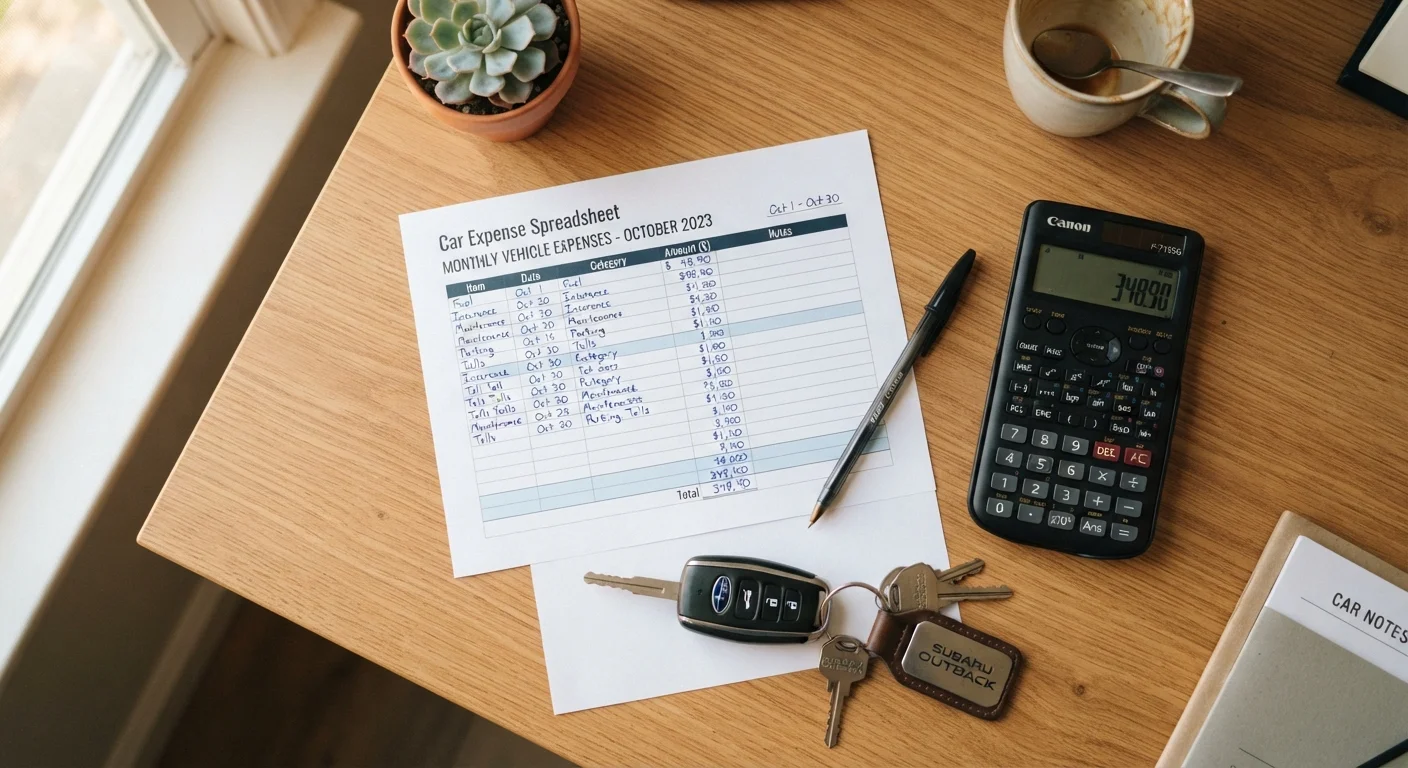
You don't need specialized software to run this audit. A basic spreadsheet with five rows — one for each cost bucket plus depreciation — is sufficient. The discipline of actually filling it in matters far more than the tool you use. Even a paper ledger works.
Running the Audit: Step by Step
Gather 12 months of records
Collect bank statements, credit card statements, and any paper receipts covering the past 12 months. Look specifically for anything car-related: fuel purchases, insurance payments, loan or lease payments, repair bills, registration fees, parking, and tolls. If you use a budgeting app, export the relevant transactions. Don't rely on memory — the entire point of the audit is to use actual figures.
Total your fixed costs
Add up all loan or lease payments made over the year. Then add your total insurance premiums paid (check your policy declarations page if you pay semi-annually or annually). Include registration fees, any annual parking permits, and any state or local vehicle taxes. Write this subtotal down.
Total your variable costs
Add up all fuel purchases from your statements. If you paid tolls electronically, pull the annual statement from your transponder account — most providers offer a full year summary. Include any car washes or other per-use expenses. Divide your total fuel spend by the number of gallons purchased (if you can estimate it) to get a rough cost-per-mile sense of your fuel efficiency in practice.
Total your irregular costs
This bucket covers everything maintenance and repair-related: oil changes, tire rotations, new tires, brake work, unexpected repairs, and any parts you purchased. Pull service invoices and match them against your payment records. If you're unsure what certain service charges covered, a guide to understanding service invoices can help you decode each line.
Estimate depreciation
Look up your car's approximate market value today using a reputable vehicle valuation resource, then compare it to the value from roughly 12 months ago. The difference is your depreciation for the year. This won't be a precise figure, but even a rough estimate is more useful than ignoring it entirely. Depreciation tends to be highest in the first few years of a vehicle's life and slows as the car ages.
Once you've completed each step, add the subtotals from all three buckets plus your depreciation estimate. That final number is your actual annual car cost. For most US households with a mid-range vehicle and average mileage, the total lands well above what most people assume — often between $8,000 and $12,000 per year, though your figure will vary based on your vehicle, location, and driving patterns.
If your service invoices look confusing when you pull them together, this guide to reading a service invoice explains what each line item typically means.
Turning the Numbers Into Decisions
The audit's value comes from what you do with the total. Look at each bucket and ask one question: Is this spending giving me proportionate value?
Fixed costs are the hardest to change quickly, but they're worth reviewing annually. Insurance premiums, in particular, can shift significantly when you shop coverage at renewal — comparing quotes doesn't guarantee savings, but paying the same insurer the same rate year after year without checking is a common and avoidable oversight.
Variable costs respond most directly to behavior. Fuel is the obvious lever; small maintenance checks like tire pressure and air filter condition can make a measurable difference in fuel economy without requiring mechanical expertise.
Irregular costs are where the audit often surfaces the biggest surprises. A string of deferred maintenance items catching up in the same year can look alarming — but with a running log, you can anticipate and spread out those expenses instead of absorbing them all at once.
Finally, if your total looks high relative to how much you actually use the vehicle, it may be worth reading the real financial picture of car ownership vs. long-term renting. For some driving patterns, ownership isn't the lowest-cost option — and knowing your audit number is the starting point for that comparison.
Don't Cut Maintenance to Improve Your Numbers
It can be tempting to see irregular maintenance costs as a category to slash. Skipping or delaying scheduled maintenance typically increases costs over time through accelerated wear and more expensive repairs. See common car spending traps for a clearer picture of where cuts tend to backfire.