

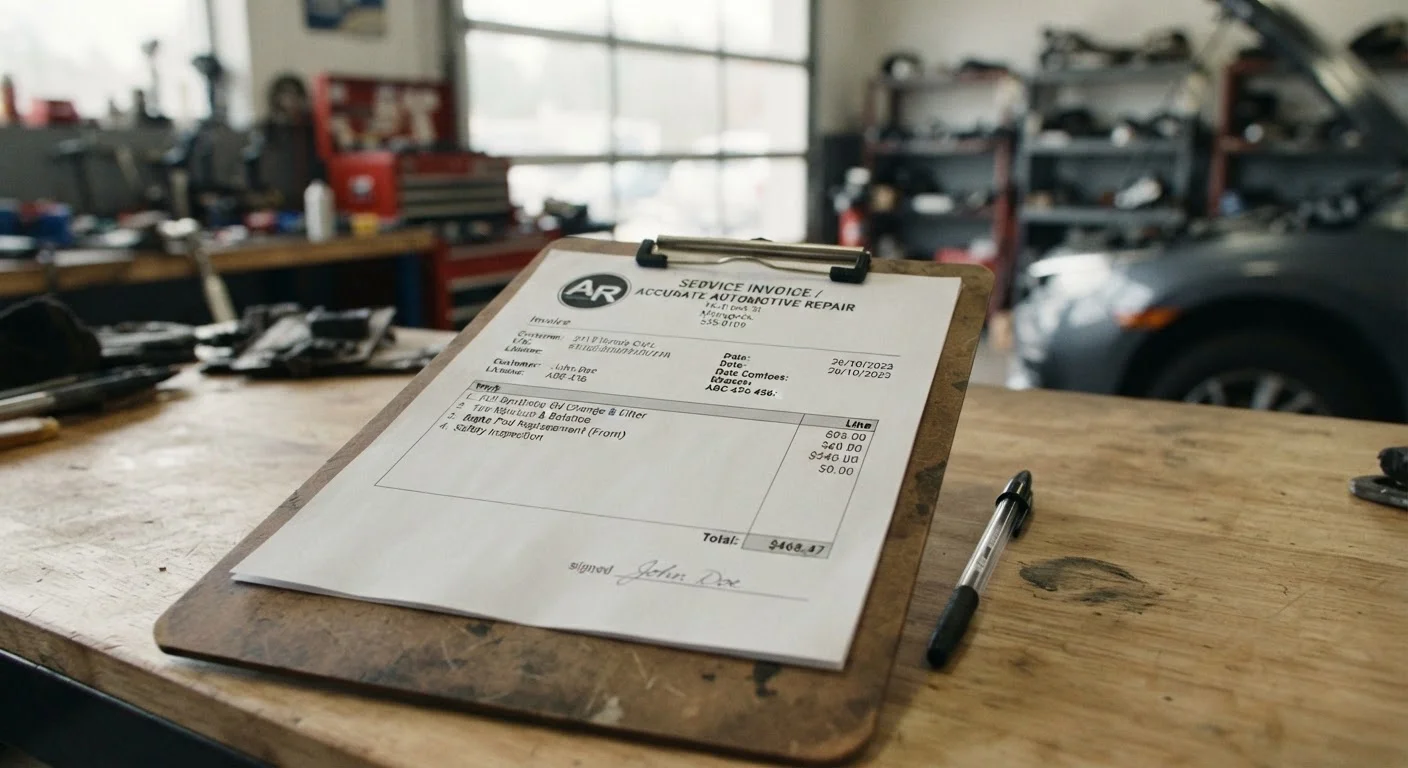
Key Takeaways
- Service invoices are split into three main charge categories: labor, parts, and fees.
- Labor rates vary widely — knowing what you're being charged per hour is essential.
- OEM and aftermarket parts carry different price points and warranty implications.
- Miscellaneous shop fees are common but negotiable or worth questioning.
- Always request an itemized invoice before authorizing any work.
What you will need
What a Service Invoice Is Actually Telling You
A service invoice isn't just a bill — it's a record of every decision made about your vehicle while it was in someone else's hands. Most drivers glance at the total and hand over a card. That's exactly the moment shops — whether dealerships or independent garages — count on. Understanding the structure of the document takes less than five minutes and can prevent you from quietly absorbing charges you didn't authorize or don't owe.
Every invoice, regardless of where you had the work done, follows a similar structure. There are three core charge categories: labor, parts, and shop fees. Occasionally you'll also see a diagnostic charge listed separately. Each of these means something specific, and each is worth scrutinizing before you sign.
For a broader picture of what service visits contribute to your yearly spending, see the full annual cost breakdown — it puts individual invoices in useful context.
Ask for the Old Parts Back
When parts are replaced — brake pads, filters, belts — you're generally entitled to the old ones. Asking for them serves two purposes: it confirms the work was actually done, and it lets you inspect whether the part genuinely needed replacing. Most shops will comply without hesitation.
Breaking Down Each Line Item
Labor Charges
Labor is typically the largest portion of any invoice. Shops charge a flat hourly rate — often between $80 and $180 per hour depending on location and whether you're at a dealership or an independent garage. The invoice should show the number of hours billed for each task, not just a lump labor total. Many shops use standardized labor time guides (sometimes called "book time") that estimate how long a job should take, regardless of how fast their technician actually completed it. That means a 2-hour book-time job gets billed at 2 hours even if it took 90 minutes. This is standard industry practice, but worth understanding.
Parts Charges
Parts will be listed individually with a part number, description, and unit price. You may see OEM parts — which match factory specifications — or aftermarket alternatives, which can be cheaper but vary in quality and warranty coverage. If the invoice just says "filter" or "brake pad" without a part number, ask for the full detail. You have a right to know exactly what was installed in your vehicle.
Diagnostic Fees
If the shop plugged in a scan tool or spent time identifying a problem, you'll likely see a diagnostic line item. This is a legitimate charge — skilled diagnosis saves time and prevents misguided repairs. However, many shops will waive or credit the diagnostic fee if you proceed with the recommended repair. Ask upfront before authorizing any inspection.
Shop Supply and Miscellaneous Fees
These are the charges that frustrate drivers most, because they're often vague. "Shop supplies," "environmental fees," or "hazardous waste disposal" can appear as either a flat fee or a percentage of the total bill. Some of these cover genuine costs (disposing of used oil legally isn't free). Others are margin-padding. Ask what each fee covers and whether it applies to your specific job. Reading a mechanic's quote in detail walks through how to have that conversation without confrontation.
Don't Confuse the Estimate With the Final Bill
An estimate is not a ceiling. Shops can and do update costs if they discover additional problems mid-job — but they are generally required to contact you before proceeding beyond the authorized amount. If the final invoice is significantly higher than your estimate and you weren't contacted for approval, that's worth disputing line by line before you pay.
How to Review an Invoice Step by Step
Follow these steps every time you pick up your vehicle. This process takes under ten minutes at the service desk and protects you from paying for work that wasn't done or wasn't authorized.
What you will need
Request an itemized invoice before you authorize work
Before signing any repair order, ask for a written estimate that breaks out labor hours, parts with part numbers, and any fees. A verbal quote is not enough. In most U.S. states, shops are legally required to provide a written estimate above a certain dollar threshold — but asking upfront is always the right move.
Check that every line matches what you authorized
Go through each line item and confirm it corresponds to work you agreed to. If you see a part or service you don't recognize, ask the service advisor to explain it before you pay. Shops occasionally add recommended items without explicit approval — some states require written authorization for each add-on.
Verify the labor hours and rate
Find the hourly labor rate on the invoice (it's often printed near the top or in a summary box). Multiply it by the hours billed for each job and verify the math. Then compare the hours billed against publicly available labor time guides — services like those used by professional estimators are sometimes accessible via automotive reference sites.
Cross-reference part numbers and prices
Take the part numbers listed on your invoice and look them up online. You can often find the same parts at common auto parts retailers to gauge whether the markup is reasonable. Shops do mark up parts — that's standard — but an extreme markup on a commodity part is worth questioning.
Scrutinize every fee line
For each miscellaneous or supply fee, ask what it specifically covers in the context of your job. A hazardous waste fee on an oil change makes sense; the same fee on a tire rotation does not. If a fee cannot be explained clearly, ask for it to be removed or reduced.
Keep the invoice and file it with your vehicle records
A complete service history — with invoices — adds credibility if you sell the car and helps identify repeat issues. Store invoices digitally (a photo or scan works) alongside your other vehicle documents. This record is also essential if a warranty claim arises related to parts installed during that service.
Once you're comfortable reading invoices, you'll start to see patterns — which shops are transparent, which pad fees, and whether your car's actual service needs match what your service schedule recommends. You can also compare invoice patterns across providers using the framework in dealership vs. independent garage cost comparisons.