

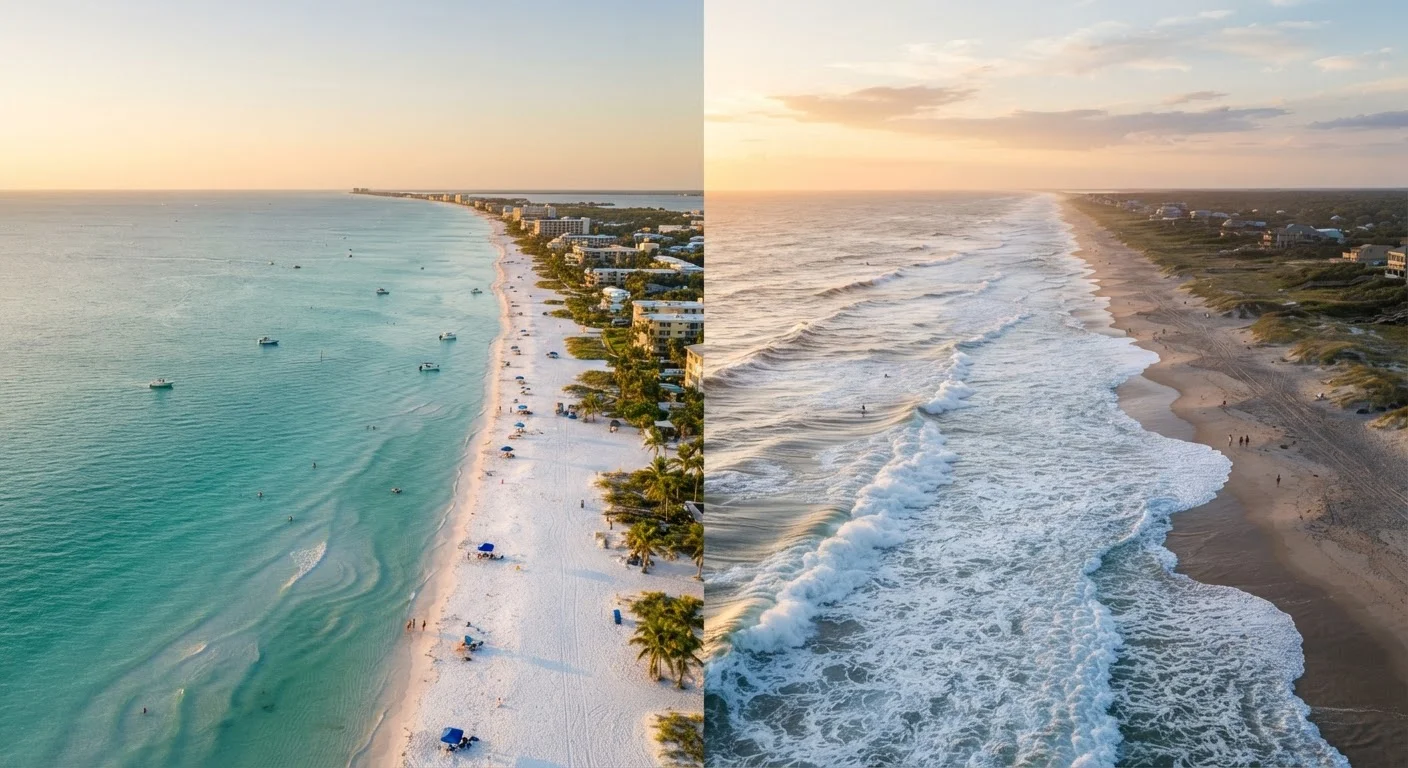
Key Takeaways
- Gulf Coast waters are warmer and calmer year-round, making them ideal for young children and casual swimmers.
- Atlantic beaches generally offer more geographic variety, from the rocky Maine shore to the subtropical Florida Keys.
- Gulf Coast destinations like the Florida Panhandle and Alabama's Gulf Shores tend to carry lower overall trip costs than popular Atlantic resort towns.
- Atlantic coastal areas face a longer and more active hurricane season exposure than the Gulf at certain latitudes.
- Off-season timing on either coast can significantly reduce costs and crowd pressure.
Option A
Gulf Coast
The calm, warm, family-friendly retreat.
Best for: Travelers who want gentle waves, sugar-white sand, and a laid-back pace without the premium price tag of top Atlantic resort towns.
Option B
Atlantic Coast
The energetic, diverse, surf-ready shoreline.
Best for: Travelers seeking variety — from surf towns and historic boardwalks to wildlife-rich barrier islands — across a range of budgets and climates.
If you're traveling with toddlers or young children
Gulf Coast
Shallow, calm waters and gently sloping beaches make swimming far less intimidating for little ones, and crowds are manageable outside of June and July.
If you want surf, variety, or historic character
Atlantic Coast
From the Outer Banks to Cape Cod, the Atlantic delivers distinct local cultures, stronger waves for surfing, and a range of price points across hundreds of miles of coastline.
If your primary concern is keeping costs down
Gulf Coast
Gulf Shores, Alabama and Panama City Beach, Florida consistently offer lower lodging and dining costs compared to the most popular Atlantic resort areas.
If you want the longest possible swimming season
Gulf Coast
Gulf waters routinely reach swimmable temperatures earlier in spring and stay warm later into fall than most Atlantic beaches north of Miami.
If you value wildlife encounters and natural scenery
Atlantic Coast
The Atlantic seaboard hosts exceptional wildlife destinations like the Outer Banks, Assateague Island, and Cape Hatteras National Seashore, offering memorable natural experiences beyond the beach.
Water, Weather, and What to Expect Underfoot
The most immediate difference between these two coastlines isn't visual — it's physical. Gulf Coast water temperatures regularly hover between 80–85°F in summer, with a calm, glassy surface created by the Gulf of Mexico's semi-enclosed geography. Waves are typically small, making swimming comfortable and predictable. The sand itself is another distinction: quartz-based beaches from Pensacola to Gulf Shores, Alabama are famously white and fine, almost powder-like underfoot.
Atlantic beaches run a dramatically wider spectrum. South Florida's Miami Beach sits just a few degrees cooler than the Gulf in summer, but head north to the Carolinas and you're looking at water in the mid-70s°F; further north toward New Jersey and New England, summer water temperatures can dip into the 60s°F. Atlantic waves are also more powerful, shaped by open-ocean swells — a plus for bodyboarders and surfers, but a consideration for families with very young children.
Seasonality matters on both coasts. The Gulf's peak season runs June through August, with hurricane risk increasing from August onward. The Atlantic's hurricane exposure is broader and shifts by latitude. For either coastline, traveling in May or September often means thinner crowds and lower costs — something worth exploring in depth through our guide to off-season travel in the US.
| Criterion | Gulf Coast | Atlantic Coast |
|---|---|---|
| Water temperature (summer) | 80–85°F, very warm | 60–82°F, varies by latitude |
| Wave conditions | Calm, small waves | Moderate to strong surf |
| Sand character | Fine white quartz | Varies: tan, rocky, or fine |
| Average trip cost | Generally lower | Wide range, some very affordable |
| Geographic stretch | ~1,600 miles of shoreline | ~2,000+ miles of varied coast |
| Peak crowd season | June–August | July–August (varies by region) |
| Wildlife & nature access | Good (Everglades, barrier islands) | Exceptional (Outer Banks, Assateague) |
| Cultural variety | Moderate | High, coast-wide |
Cost, Crowds, and the Character of Each Shore
Budget-conscious travelers will find the Gulf Coast generally more forgiving on the wallet. Destinations like Gulf Shores, Alabama and Florida's Emerald Coast (Destin, Fort Walton Beach, Panama City Beach) offer beachfront lodging, seafood restaurants, and family attractions at prices that undercut comparable Atlantic resort towns by a noticeable margin. That said, Miramar Beach and 30A in Florida have gentrified significantly, so specific community choices matter.
The Atlantic Coast's pricing is far less uniform. The Jersey Shore, Virginia Beach, and the Outer Banks offer genuinely affordable beach weeks, while the Hamptons, Nantucket, or Hilton Head skew toward premium visitors. This variety is actually a strength — it means savvy travelers can find Atlantic coastline experiences at nearly any price point if they look beyond the marquee names.
~1,630
Miles of Gulf Coast shoreline in the US
According to NOAA data, the Gulf Coast spans from the Florida Keys to the Texas-Mexico border, with significant variation in beach character along the way.
Top 3
Most visited US beach states include Florida
Florida consistently ranks among the most-visited states for leisure travel, drawing visitors to both its Gulf and Atlantic shores, per Visit Florida research.
~10°F
Typical summer water temp gap (Gulf vs. northern Atlantic)
NOAA sea surface temperature data shows Gulf waters often run roughly 10°F warmer than mid-Atlantic and New England beaches in the same summer months.
Character-wise, the Gulf tends toward a relaxed, sun-and-sand focus. The Atlantic offers more cultural layering: historic fishing villages in New England, music and food culture in the Carolinas (which pairs nicely with our look at New Orleans vs. Nashville), and diverse ecosystems stretching from subtropical to subarctic. If you crave adventure beyond the towel, the Atlantic's longer stretch simply provides more options.
Hurricane Season Applies to Both Coasts
The Atlantic hurricane season officially runs June 1 through November 30, and both the Gulf Coast and Atlantic seaboard fall within its reach. The Gulf Coast — particularly the Florida Panhandle and Texas — can be impacted by Gulf-formed storms, while the Atlantic coast faces threats from storms tracking up from the Caribbean. If you're traveling between August and October, always check current National Hurricane Center advisories and verify your accommodation's cancellation policies before booking.