

Key Takeaways
- New Orleans rewards slower, exploratory visits; Nashville suits packed, high-energy weekend itineraries.
- Both cities offer significant free or low-cost entertainment — live music in particular — that keeps budgets manageable.
- New Orleans has notably lower average hotel rates than Nashville's booming downtown corridor.
- Nashville's dining scene skews toward comfort food and meat-and-threes; New Orleans offers one of America's most distinctive culinary traditions.
- Timing matters for both: Mardi Gras and Jazz Fest spike New Orleans prices, while Nashville's peak weekends push hotel rates sharply higher.
- Neither city requires a rental car — both are walkable or navigable via rideshare for most visitors.
Option A
New Orleans, Louisiana
The atmospheric, culturally layered Southern original.
Best for: Travelers who want immersive history, Creole cuisine, and a city that moves on its own unhurried schedule.
Option B
Nashville, Tennessee
The energetic, fast-growing bachelorette-friendly boomtown.
Best for: Visitors seeking high-energy nightlife, country music culture, and a compact, walkable downtown scene.
If you want the richest cultural and culinary depth for your dollar
New Orleans, Louisiana
New Orleans packs history, architecture, music, and Creole cuisine into a compact, walkable footprint — and accommodation tends to run cheaper outside peak festival periods.
If you're planning a high-energy group trip or bachelorette weekend
Nashville, Tennessee
Nashville's dense downtown strip, abundant bars, and party-friendly infrastructure make it the more natural fit for celebratory group travel.
If budget predictability is your top priority
Nashville, Tennessee
Outside of CMA Fest and major event weekends, Nashville pricing is relatively stable and easier to forecast than New Orleans during festival season.
If you want a trip that feels genuinely off the beaten path within a well-known city
New Orleans, Louisiana
Neighborhoods like Bywater, Tremé, and Mid-City offer authentic local character that few tourists bother to explore, rewarding curious, slower travelers.
Atmosphere and Pace: Night-and-Day Differences
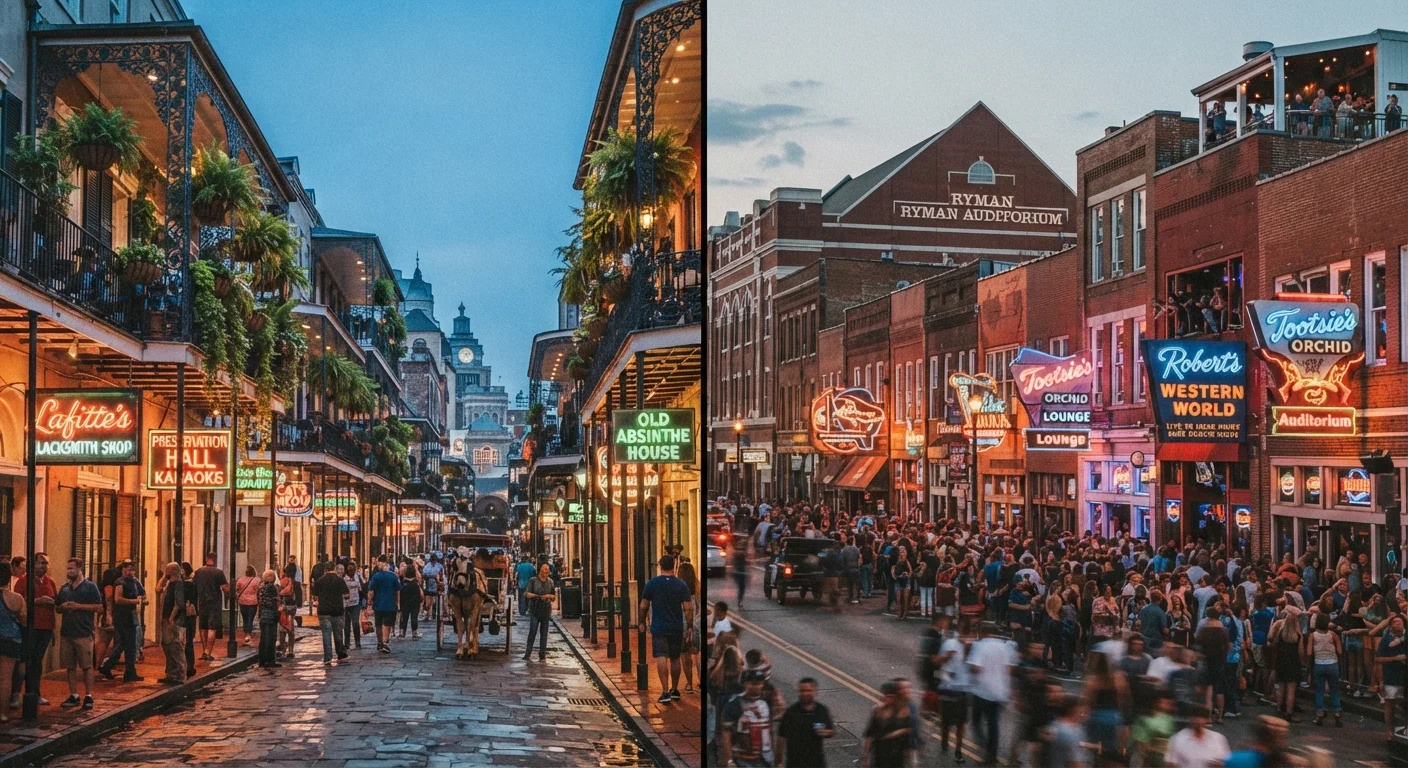
Ask anyone who's visited both cities back-to-back and they'll tell you the vibe gap is enormous. New Orleans moves at a languid, jazz-soaked pace shaped by centuries of Creole, French, and African cultural layering. The French Quarter's wrought-iron balconies, above-ground cemeteries, and streetcar lines create a city that feels architecturally unlike anywhere else in America. Wandering is the point — neighborhoods shift character every few blocks, and the rewards are unpredictable in the best way.
Nashville, by contrast, operates at a brisk, celebratory sprint. Lower Broadway's honky-tonks run live music noon to 2 a.m., the crowds are dense on weekends, and the entire downtown infrastructure seems purpose-built for short, high-intensity visits. That's not a criticism — it's a genuinely fun formula — but it's a fundamentally different energy than NOLA's dreamy, improvisational rhythm.
For a structured 48-hour city itinerary, Nashville's compactness gives it an edge. New Orleans, though, rewards anyone who builds in an extra day or two to get lost.
Costs: Where Each City Stings and Where It Surprises
| Criterion | New Orleans | Nashville |
|---|---|---|
| Average hotel rate (non-peak) | Moderate; lower off-festival season | Moderate–high; elevated year-round downtown |
| Free live music access | Frenchmen Street, second lines, street performers | Broadway honky-tonks, no cover charge |
| Walkability | High in French Quarter and Marigny | High in downtown core |
| Food identity | Deeply distinctive Creole cuisine | Hot chicken, BBQ, meat-and-threes |
| Best trip length | 3–5 days to explore neighborhoods | 2–3 days covers highlights comfortably |
| Peak crowd periods | Mardi Gras, Jazz Fest | CMA Fest, major event weekends |
| Daytime culture options | Museums, cemeteries, architecture tours, bayou trips | Country Music Hall of Fame, Ryman Auditorium, The Parthenon |
Both cities punch above their weight for free entertainment. In New Orleans, Frenchmen Street in the Marigny neighborhood offers world-class live jazz most nights with no cover charge. Nashville's honky-tonks on Broadway are similarly free to enter, sustained by drink revenue. Street food and food trucks keep meal costs flexible in both cities.
Where New Orleans wins on budget is accommodation. Outside of Mardi Gras (February or early March) and Jazz Fest (late April/early May), mid-range hotels and short-term rentals in neighborhoods like the Marigny or Garden District undercut Nashville's downtown rates meaningfully. Nashville hotel pricing near Broadway surged through the early 2020s alongside rapid tourism growth and has stayed elevated on peak weekends.
For a sharper look at how timing affects both destinations, the off-season travel breakdown for US cities is worth reading before you book.
19M+
Annual visitors to New Orleans
New Orleans & Company estimates the city attracts over 19 million visitors annually in recent pre- and post-pandemic reporting periods.
16M+
Annual visitors to Nashville
Nashville Convention & Visitors Corp has reported annual visitor figures exceeding 16 million in recent years, reflecting rapid tourism growth.
~30%
Hotel rate premium during New Orleans festival weeks
Industry lodging data consistently shows significant rate spikes during Mardi Gras and Jazz Fest compared to the city's off-peak average.
Food, Music, and What You Actually Do All Day
New Orleans has one of the most distinctive food cultures in the United States — gumbo, étouffée, muffulettas, beignets, and po'boys rooted in a culinary tradition that blends French, Spanish, African, and Caribbean influences. Even budget-level options taste exceptional. Casamento's, Café Du Monde, and countless neighborhood lunch counters deliver authentic flavor without fine-dining prices.
Nashville's food scene centers on hot chicken (a genuinely great contribution to American cuisine), meat-and-three plate lunches, and a growing farm-to-table restaurant culture. It's satisfying and affordable, but less regionally distinctive than New Orleans' offerings.
Musically, both cities have legitimate claims on American roots music. New Orleans is the birthplace of jazz and carries a living brass-band culture that spills into the streets unprompted. Nashville is the undisputed center of country music and offers excellent live performances beyond the tourist strip — the Bluebird Cafe's songwriter nights being a well-known example. If music is your primary travel motivation, the choice may come down to which genre moves you more.
Travelers curious about other Southern and Gulf-adjacent destinations might also find the Gulf Coast vs. Atlantic Coast comparison useful for planning a longer regional trip.
Safety and Neighborhood Awareness
Both cities have neighborhoods that warrant situational awareness at night, as is common in any major American city. In New Orleans, staying alert outside well-trafficked tourist areas — particularly late at night — is advisable. In Nashville, the downtown corridor is generally busy and well-lit, but the same common-sense precautions apply. Always check current travel advisories and consult local sources when planning your itinerary.