

Key Takeaways
- Bodyweight training uses your own mass as resistance — no gym or equipment needed.
- It can build genuine strength, endurance, and mobility across all fitness levels.
- Progression happens by modifying leverage, tempo, and movement complexity.
- It's well-suited for beginners, travelers, and anyone on a tight budget.
- Consistency over intensity is what drives long-term results with any training approach.
Bodyweight Training
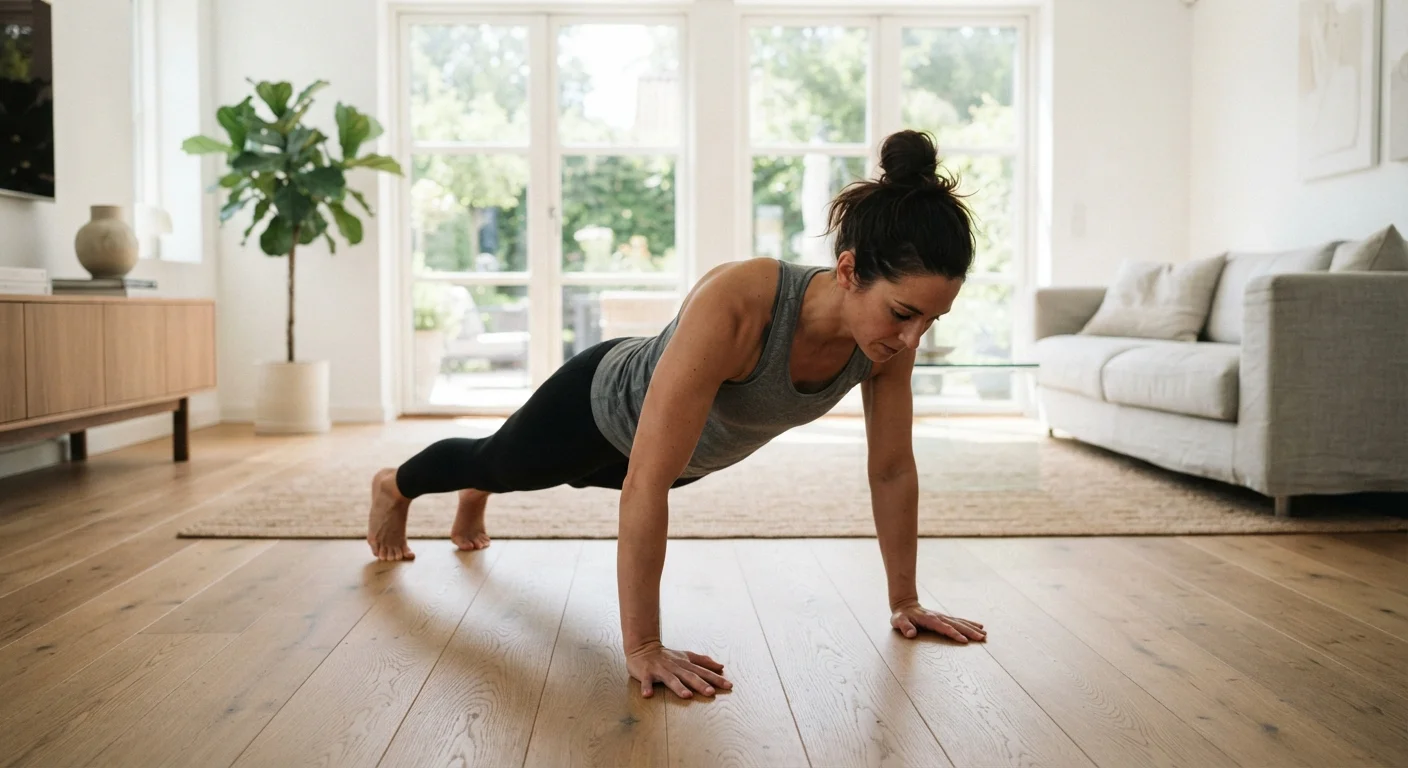
Bodyweight training is a form of physical exercise that uses your own body's mass as the primary source of resistance, rather than weights, machines, or bands. Movements like push-ups, squats, lunges, and planks challenge your muscles by working against gravity. Because no equipment is required, it can be done almost anywhere — at home, in a park, or in a small apartment.
Bodyweight exercises are classified as a form of resistance training. Progressive overload — the key driver of strength gains — is achieved by adjusting leverage, tempo, range of motion, or movement complexity rather than adding external load.
How Bodyweight Training Works
Every resistance exercise works on the same basic principle: your muscles contract against a force. In the gym, that force usually comes from dumbbells or machines. In bodyweight training, the force is gravity acting on your own mass.
What makes this more nuanced than it sounds is leverage. By changing your body position, you can dramatically shift how hard a muscle has to work. A push-up with your feet elevated puts more load on your upper chest and shoulders than a flat push-up. A squat performed slowly, pausing at the bottom, is significantly harder than a quick one. These adjustments — not added weight — are how bodyweight training creates progressive overload, the stimulus your body needs to grow stronger over time.
The key variables you can manipulate include:
- Leverage: Change the angle or position of your body relative to the floor.
- Tempo: Slow the lowering phase of a movement to increase time under tension.
- Range of motion: Deeper squats or push-ups recruit more muscle fibers.
- Complexity: Progress from two-legged to single-legged movements, or static to dynamic variations.
This is why bodyweight training isn't just for people who can't access a gym — it's a legitimate, scalable system used by athletes, military personnel, and fitness practitioners worldwide.
150+ min
Weekly activity recommended for adults
The U.S. Department of Health and Human Services Physical Activity Guidelines for Americans recommend at least 150 minutes of moderate-intensity aerobic activity per week, alongside muscle-strengthening activities on two or more days.
2x
Muscle-strengthening days recommended weekly
Major public health guidelines recommend adults engage in muscle-strengthening activities — which include bodyweight exercises — targeting all major muscle groups at least twice per week.
~0
Equipment cost to begin
Unlike gym memberships or home equipment purchases, foundational bodyweight training requires no financial outlay — making it one of the most accessible forms of structured resistance exercise available.
What It Can — and Can't — Do for Your Fitness
Bodyweight training is effective for building functional strength (the kind that supports everyday movement), improving muscular endurance, developing core stability, and maintaining mobility. Research consistently supports resistance training — including bodyweight forms — as beneficial for cardiovascular health, bone density, and metabolic function.
That said, it's worth being realistic. Bodyweight training has a natural ceiling when it comes to maximum strength and hypertrophy (muscle size). Elite powerlifters or bodybuilders need external load that bodyweight alone can't replicate. But for the vast majority of people — those seeking general fitness, a leaner physique, better posture, or improved energy — bodyweight methods are more than adequate.
Form Before Volume, Always
With bodyweight training, moving correctly matters more than moving often. A well-executed squat with full depth and a neutral spine delivers far more benefit — and far less injury risk — than twenty rushed repetitions. If a movement feels unstable or causes sharp discomfort, reduce the range of motion or choose a simpler variation until your form is solid. When in doubt, a session with a qualified fitness professional can help establish safe movement patterns from the start.
One area where bodyweight training genuinely excels is injury prevention. Because movements tend to be compound (working multiple joints and muscle groups at once) and load is self-limiting, the risk of overloading a joint the way a heavy barbell might is lower. This doesn't mean injuries can't happen — poor form and overtraining are always risks — but the barrier to safe participation is generally lower.
Who Bodyweight Training Is Best Suited For
Bodyweight training works across a wide range of people and contexts, but it's particularly well-matched for:
- Beginners — The ability to scale movements down (wall push-ups, assisted squats) makes it non-intimidating and accessible.
- Budget-conscious individuals — There's no gym fee, no equipment to buy, and no subscription required.
- People with limited space — A yoga mat's worth of floor is genuinely enough to start. See our guide on moving more in a small apartment for practical ideas.
- Travelers or those with unpredictable schedules — A consistent routine that doesn't depend on a facility is more likely to survive a busy life. Our article on building a morning movement routine shows how this fits into daily life.
- People returning to exercise — Reintroducing movement after a break, illness, or injury benefits from low-barrier, controllable resistance. Always get medical clearance before resuming exercise after an injury or health event.
It's worth noting that bodyweight training also pairs naturally with other fitness approaches. If you're preparing for an active trip, for instance, a base of bodyweight strength work supports the endurance demands of hiking or paddling — as our guide on building a fitness base for outdoor adventure explores.
Getting Started Without Overthinking It
One of the most persistent obstacles to exercise isn't ability — it's the belief that you need more before you can begin. More space, more equipment, more knowledge. Common fitness myths reinforce this idea, but the evidence points the other way: starting simple and staying consistent beats elaborate programs performed sporadically.
A functional starting framework for most adults might look like:
- Choose three to five foundational movements covering pushing (push-ups), pulling (rows if you have a low bar or table), hinging (hip hinges), squatting (bodyweight squats), and core bracing (planks).
- Perform each at a difficulty level where you can complete the movement with control — not to exhaustion.
- Rest adequately between sessions, and add difficulty gradually over weeks, not days.
For guidance on session structure and frequency, our article on keeping training sessions short and effective offers practical principles that translate directly to fitness training.
Above all, the goal is movement that fits your life — not a program that demands your life fits around it.
This article is for general informational purposes only and is not a substitute for professional medical advice. Consult a qualified healthcare provider before beginning any new exercise program, especially if you have an existing health condition, injury, or are returning to exercise after a prolonged break.