

Key Takeaways
- Processing exists on a spectrum — canned beans and packaged cookies are not the same category.
- Ultra-processed foods, not minimally processed ones, are most associated with poor health outcomes.
- Whole foods deliver more fiber, vitamins, and minerals per calorie than most ultra-processed options.
- Reading ingredient lists is more useful than relying on front-of-package health claims.
- Frozen vegetables and canned legumes are affordable, minimally processed staples worth keeping on hand.
Option A
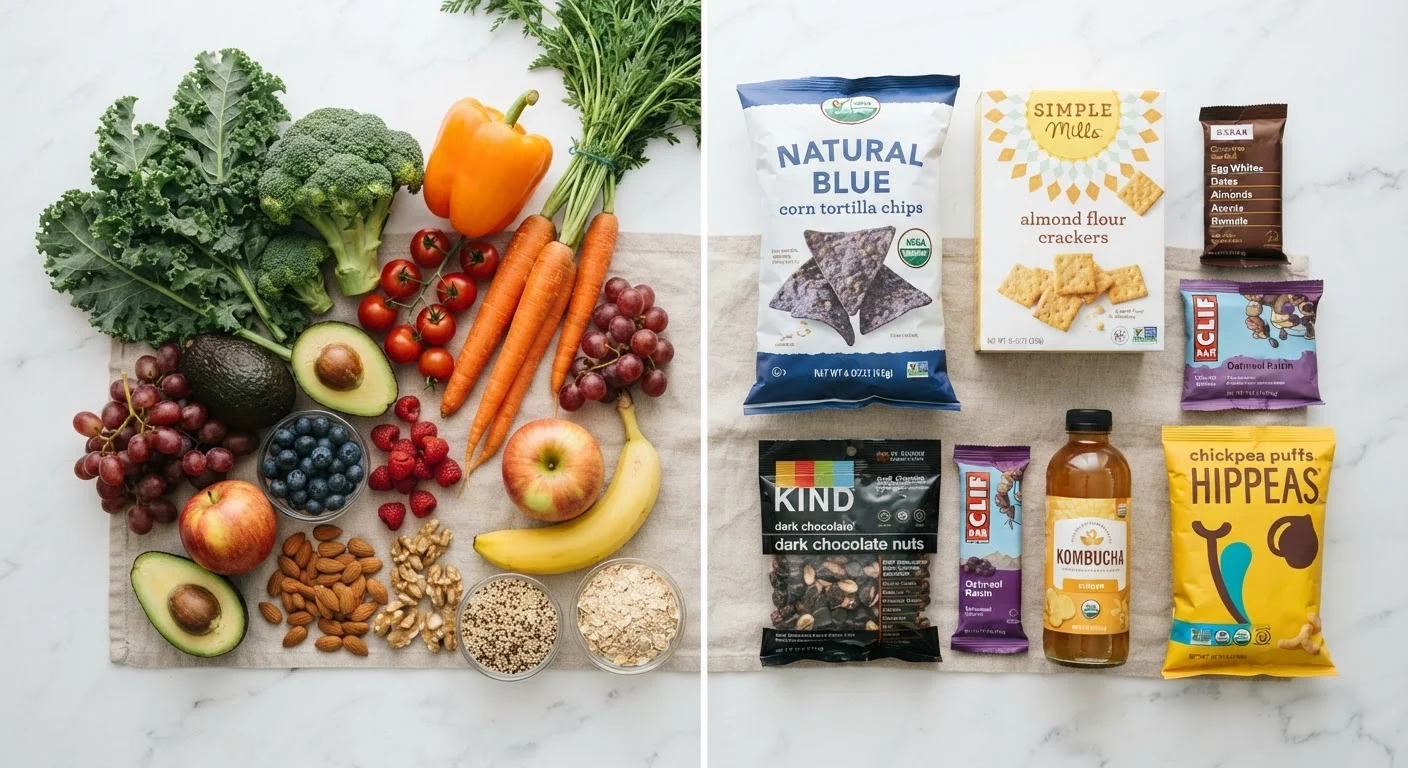
Whole Foods
Foods as close to their natural state as possible.
Best for: People looking to maximize nutrient density and minimize additives in their daily diet.
Option B
Processed Foods
A broad spectrum from lightly altered to heavily engineered.
Best for: Busy, budget-conscious households who need convenience without necessarily sacrificing all nutritional value.
If you want to maximize nutrient density on a tight budget
Whole Foods
Whole foods like dried beans, oats, and seasonal produce deliver the most vitamins, fiber, and minerals per dollar spent.
If convenience is a priority and time is limited
Processed Foods
Minimally processed options like canned tomatoes, frozen vegetables, and plain yogurt offer real nutritional value with minimal prep time.
If you're trying to reduce sugar, sodium, and additives
Whole Foods
Whole foods contain no added sugars, preservatives, or artificial flavors — what you see is what you get.
If you need shelf-stable, long-lasting pantry staples
Processed Foods
Lightly processed pantry items like canned fish, nut butters, and rolled oats store well and remain nutritionally solid choices.
What Does 'Processed' Actually Mean?
The word processed gets thrown around as if it means one thing — but it covers an enormous range. By the broadest definition, any food that has been altered from its raw state has been processed. That includes washing, cutting, freezing, fermenting, and canning. Under that definition, your bag of pre-washed spinach is processed — and so is your soda.
A more useful framework comes from the NOVA classification system, developed by researchers at the University of São Paulo. NOVA groups foods into four categories based on the extent and purpose of processing:
- Group 1 – Unprocessed or minimally processed: Fresh fruits, vegetables, plain meats, eggs, milk, unsalted nuts, and dried grains. These foods are either in their natural state or have only been cleaned, dried, or frozen.
- Group 2 – Processed culinary ingredients: Olive oil, butter, sugar, salt, and flour. These are derived from whole foods and used in cooking, but not typically eaten on their own.
- Group 3 – Processed foods: Foods made by combining Group 1 and Group 2 items — canned vegetables, simple cheeses, smoked fish, plain breads. They may contain preservatives but are still recognizable as food.
- Group 4 – Ultra-processed foods: Industrially formulated products containing additives, flavor enhancers, emulsifiers, and colorings rarely found in a home kitchen. Think packaged snack cakes, sugary cereals, fast-food nuggets, and flavored chips.
The distinction that matters most for health isn't processed vs. unprocessed — it's minimally processed vs. ultra-processed. For a deeper look at how this plays out on food packaging, see our guide on reading a nutrition label without getting lost.
| Criterion | Whole Foods | Ultra-Processed Foods |
|---|---|---|
| Ingredient complexity | One ingredient (or very few) | Long list with additives and preservatives |
| Fiber content | Naturally present and intact | Largely removed or absent |
| Added sugars | None | Often high, in multiple forms |
| Sodium | Naturally low | Typically high |
| Micronutrient density | High — vitamins and minerals intact | Lower — often stripped then fortified |
| Shelf life | Short without refrigeration | Long — preserved for stability |
| Cost per meal | Variable; staples very affordable | Varies; convenience adds cost |
| Satiety per calorie | Higher due to fiber and protein | Lower; engineered for palatability |
Why the Distinction Matters for Your Health
Research consistently links high consumption of ultra-processed foods to elevated risks of weight gain, cardiovascular disease, and type 2 diabetes. A large observational study published in The BMJ found that a 10% increase in ultra-processed food consumption was associated with a 12% higher risk of cancer — though it's important to note that observational studies show association, not direct causation, and diet is one of many contributing factors.
The mechanisms are fairly well understood, even if the research is still evolving. Ultra-processed foods tend to be:
- High in added sugars and refined carbohydrates, which can spike blood sugar rapidly
- Low in dietary fiber, which slows digestion and supports gut health
- Engineered for hyper-palatability, meaning they're formulated to override the body's natural fullness signals
- Dense in sodium, which affects blood pressure over time
Whole foods, on the other hand, arrive with their fiber, micronutrients, and natural food structures intact. An apple delivers sugar alongside pectin (a fiber) that slows absorption. Oats provide complex carbohydrates wrapped in beta-glucan fiber. That structural difference changes how your body responds. If you want to understand exactly how fiber and sugar interact, our article on fiber vs. sugar in carbohydrates breaks it down clearly.
57%
Share of US calories from ultra-processed foods
Research published in BMJ Open estimated that ultra-processed foods account for roughly 57% of total caloric intake in the average American diet.
~28g
Daily fiber recommended for adults
The U.S. Dietary Guidelines recommend around 28 grams of fiber per day, yet most Americans consume well under half that amount — partly due to low whole-food intake.
4x
More additives in ultra-processed vs. processed foods
NOVA classification research shows ultra-processed products contain on average four times as many distinct additives as Group 3 processed foods.
Practical Guidance: Building a Smarter Grocery Basket
Shifting toward more whole foods doesn't require eliminating every packaged item or spending more money. The goal is to move your overall diet toward the minimally processed end of the spectrum — consistently, not perfectly.
Use the ingredient list, not the front of the package
Front-of-package claims like "natural," "wholesome," or "made with real fruit" are marketing language, not regulated nutrition terms. Flip the package over and scan the ingredient list. A shorter list with recognizable ingredients generally signals less processing. If you see emulsifiers, artificial flavors, modified starches, or multiple forms of added sugar listed, you're in ultra-processed territory.
Lean on affordable minimally processed staples
Some of the most budget-friendly foods in the grocery store are also the least processed: dried lentils, rolled oats, frozen vegetables, canned tomatoes, eggs, and plain Greek yogurt. These items are easy to cook with and hold significant nutritional value. For a head-to-head on fresh versus frozen options specifically, see frozen vs. fresh produce.
Reserve ultra-processed foods rather than banning them
Rigid elimination often backfires. A more sustainable approach is to treat ultra-processed items as occasional choices rather than daily staples. When they appear in your diet, pair them with whole-food components — vegetables, legumes, or fruit — to round out the nutritional picture. Our budget eating hub offers practical meal-planning ideas that make this shift achievable without overhauling your entire routine.
This article is for general informational and educational purposes only and is not a substitute for professional medical or dietary advice. If you have specific health concerns, consult a qualified healthcare provider or registered dietitian.