

Key Takeaways
- Unit price tells you the cost per standard measure, not just the total price on the label.
- Larger packages usually have a lower unit price, but not always — always check.
- Sale items, store brands, and bulk sections can all look attractive but unit pricing reveals the real winner.
- Most shelf tags already show unit price — learning to find it takes seconds.
- Comparing unit prices is one of the simplest habits for reducing your grocery bill over time.
Unit Price
A unit price is the cost of a product broken down to a standard measure — typically per ounce, pound, liter, or count. It lets you compare two different-sized packages on equal terms, regardless of how each is packaged or promoted. Instead of comparing a 12-oz jar to a 32-oz jar by total price, you compare both by price per ounce.
In the US, retailers are often required by state law to display unit prices on shelf tags, though requirements vary by state and product category.
What Unit Pricing Actually Tells You
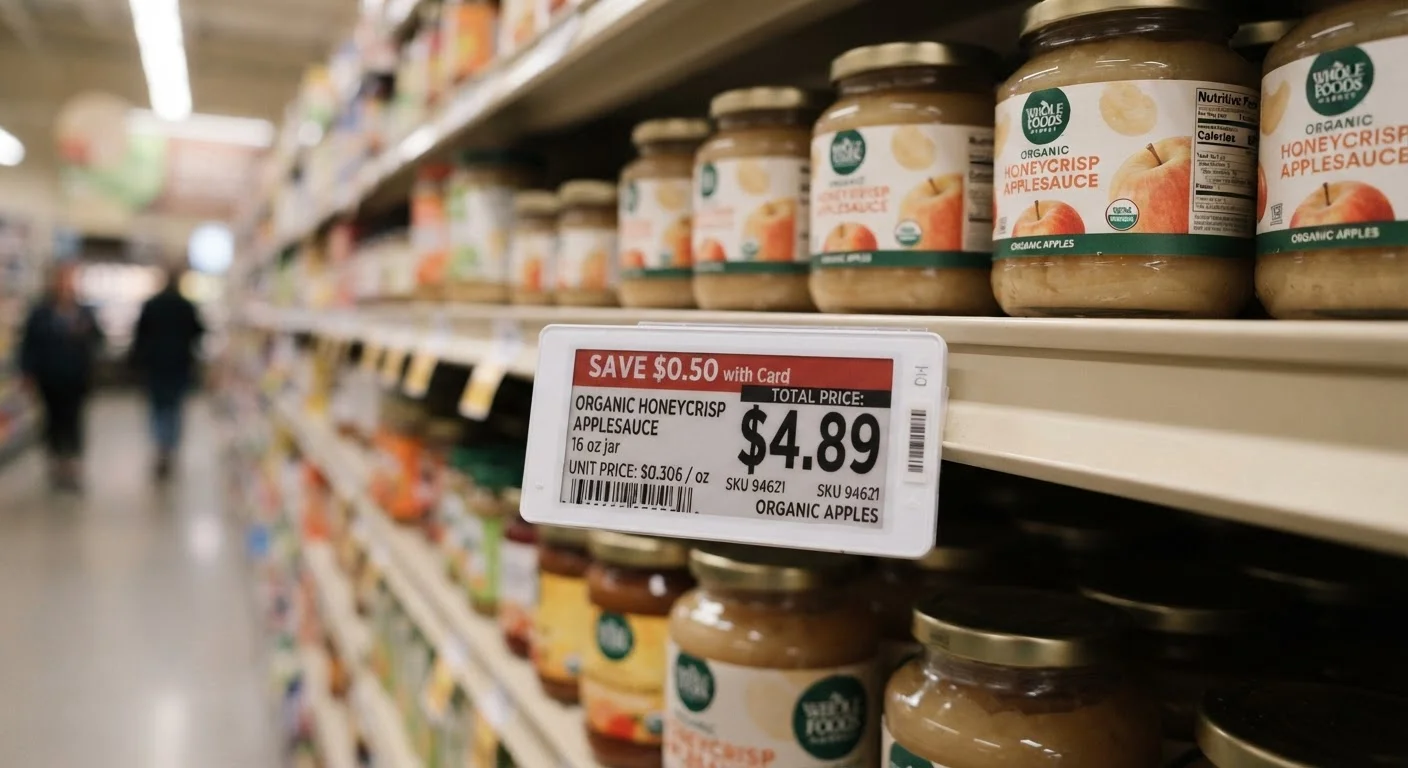
Every shelf tag in a grocery store carries two numbers: the total price you pay at the register, and a smaller figure that most shoppers walk right past. That smaller figure is the unit price — the cost per standardized measure, such as per ounce, per 100 grams, or per fluid ounce.
The total price tells you what leaves your wallet. The unit price tells you what you're actually getting for that money. Without it, comparing a 16-oz bottle of olive oil to a 33.8-oz bottle is guesswork. With it, the math is already done for you.
Unit pricing removes the packaging from the equation. Manufacturers know that eye-catching sizes, bundled multipacks, and bold "value" labels influence buying decisions. Unit pricing cuts through that. It's the one number that standardizes everything on the shelf into a fair comparison.
Unit Price Requirements Vary by State
While many US states require grocery retailers to display unit prices, the rules differ in scope and enforcement. Some states mandate it only for stores above a certain size or for specific product categories. If you shop at a smaller independent grocer or a market where tags are inconsistent, it's worth knowing how to calculate unit price yourself — total price divided by net weight or volume.
How to Read a Unit Price Label
Shelf tags can look cluttered, but the unit price follows a consistent pattern once you know what to look for. It typically appears as a dollar amount followed by a slash and a measure — for example: $0.18 / oz or $1.24 / lb.
The measure used depends on the product type. Dry goods like pasta or cereal are often priced per ounce or per pound. Liquids like juice or cleaning products appear per fluid ounce or per liter. Some products, like paper towels or trash bags, may show price per sheet or per bag.
One important note: different products on the same shelf may use different unit measures. A 12-oz jar priced per ounce and a 750g jar priced per 100g can't be directly compared without a quick conversion. When measures differ, use your phone's calculator to convert both to the same unit before comparing.
For a broader look at what those food labels are really communicating, see our guide to reading nutrition labels without confusion — it pairs well with understanding unit pricing.
~50%
Shoppers who regularly check unit prices
Research consistently finds that fewer than half of grocery shoppers actively use unit pricing to guide purchase decisions, despite labels being widely available.
Up to 40%
Potential savings on comparable products
Consumer research has shown that choosing the lowest unit-priced option within a product category can reduce spending by a significant margin over time, particularly on staple goods.
When the "Better Deal" Isn't
Unit pricing routinely reveals surprises. Here are three common scenarios where it overturns an assumption:
- Multipacks vs. single units: A six-pack of yogurt may look economical, but if the store-brand single cup has a lower unit price, the multipack isn't the deal it appears to be.
- Sale items: A promotional sticker doesn't guarantee the lowest unit price. A non-sale item in a larger size can still undercut the "deal" once you compare per-ounce costs.
- Bulk bins: Bulk sections often offer excellent unit prices — but weigh the product before assuming. Specialty items in bulk bins can occasionally cost more per ounce than a packaged equivalent on the same aisle.
The pros and cons of buying in bulk explores this further, including when larger quantities genuinely save money and when they quietly cost more.
Building a Habit That Pays Off
The biggest barrier to using unit pricing isn't complexity — it's habit. Most shoppers reach for the familiar brand or the prominently placed product without checking the tag at all. A small shift in routine is all it takes.
Start with the categories where you spend the most: cooking oils, grains, canned goods, dairy, and cleaning supplies. These are high-frequency purchases where unit price differences compound over many shopping trips. Even saving $0.05 per ounce on olive oil across a year adds up.
If you want a fuller picture of where grocery spending quietly grows, the article why your weekly shop costs more than it should covers the planning habits and blind spots that inflate most people's bills — unit pricing awareness fits directly into that framework.
This article is for general informational and educational purposes only. It does not constitute financial or dietary advice. Individual results will vary based on personal circumstances, local store policies, and product availability.