

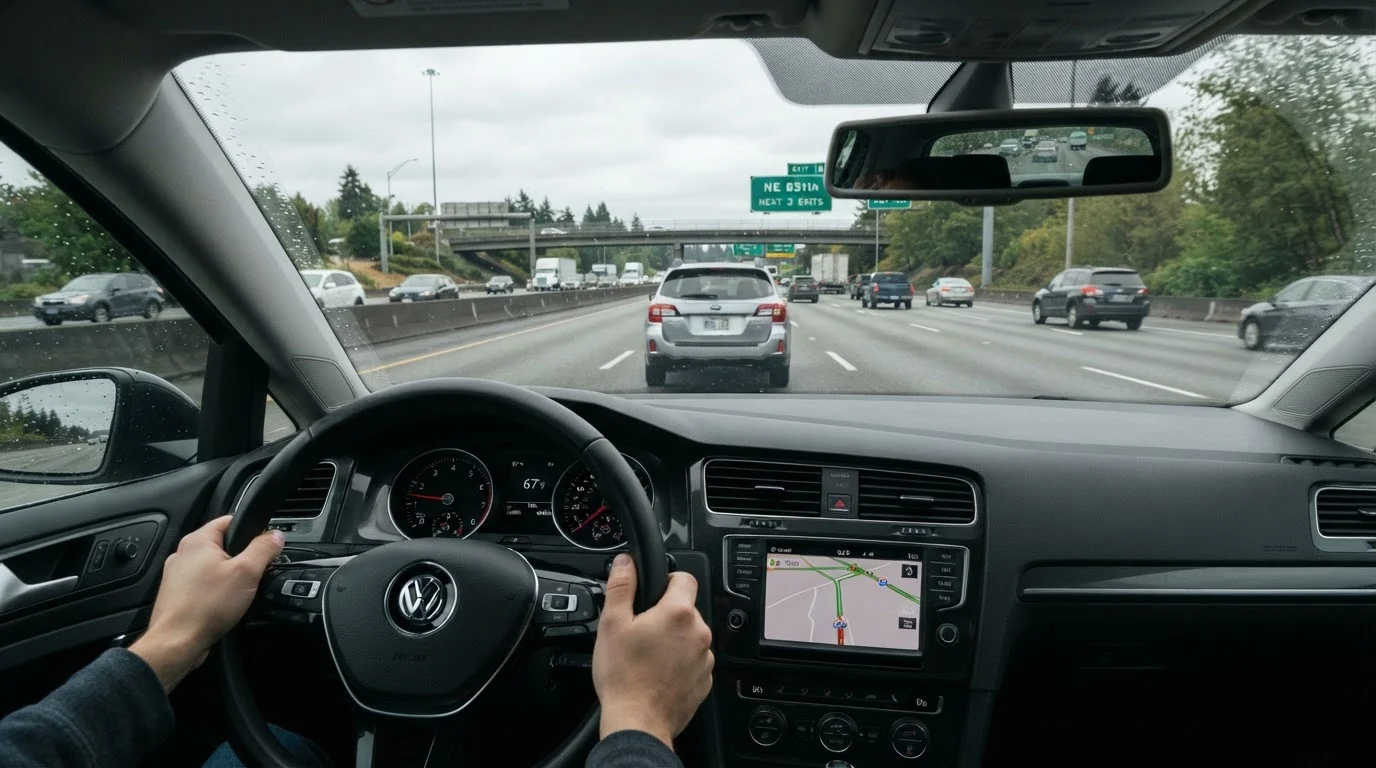
Key Takeaways
- The two-second rule sets a minimum gap, not an ideal one — conditions often demand more.
- Most drivers underestimate how quickly a safe gap closes at highway speeds.
- Wet roads, heavy loads, and fatigue all extend the stopping distance your car needs.
- Checking your gap using a fixed roadside point takes under three seconds and costs nothing.
- Tailgating is a leading cause of rear-end crashes, which account for roughly 29% of all US collisions.
What the Two-Second Rule Actually Says
The two-second rule is straightforward: when the vehicle ahead passes a fixed point — a sign, a bridge, a shadow line — you should not reach that same point for at least two seconds. If you get there sooner, you're too close.
The logic behind it is reaction time plus braking distance. Average human reaction time is roughly 1.5 seconds. Add the distance your car travels while the brakes engage and grip, and two seconds becomes the floor for a dry road at moderate speed — not a comfortable cushion, just the bare minimum.
That distinction matters. The rule is often taught as a universal safe-following standard, but it was never intended to cover every situation. It's a baseline for good conditions. On a wet road, in heavy traffic, or at freeway speeds, many driver education programs and road safety organizations recommend stretching that gap to three or four seconds.
For new drivers especially, building this habit early pays dividends. See our guide for new licence holders for more foundational habits worth locking in from the start.
Common Mistakes Drivers Make with Following Distance
Even drivers who know the rule break it regularly. Here's where things go wrong — and why.
Treating two seconds as a comfortable gap rather than a minimum.
Why it happens: Driver education often presents the rule as the safe standard without emphasizing it assumes ideal conditions. Drivers internalize it as the target rather than the floor.
Counting too fast when checking the gap.
Why it happens: Under the mild stress of traffic, people count faster than one beat per second without realizing it. A rushed count of "one-two" can represent under a second of real time.
Holding a safe gap until another driver fills it, then closing back up.
Why it happens: Leaving a gap feels like an invitation for merging. When another car slots in, the instinct is to close the new gap quickly to avoid the same thing happening again.
Not adjusting for vehicle weight or towing.
Why it happens: Drivers apply the same following distance they'd use in their sedan when driving a loaded SUV, a pickup with a trailer, or a van. Heavier vehicles take significantly longer to stop.
Misjudging how speed compresses apparent distance.
Why it happens: At higher speeds, gaps that look generous in the driver's field of view are actually dangerously short. Human vision struggles to accurately judge closing speed and distance at freeway speeds.
Following distance also interacts with speed in ways that catch drivers off guard. On a motorway or interstate, the same two-second gap that felt adequate at 40 mph represents a much larger physical distance at 70 mph — and you need every inch of it. Highway and urban driving demand different spacing habits, and treating them the same is a mistake that contributes to high-speed rear-end crashes.
How to Check Your Gap Without Guessing
You don't need any equipment to apply this correctly. When the rear of the car ahead passes a fixed roadside marker, count slowly: "one thousand one, one thousand two." If your front bumper reaches that marker before you finish counting, close the gap by easing off the accelerator — not by braking hard.
On wet or slippery roads, extend your count to three. In fog, poor visibility, or when towing, extend to four. If you're tired or your tires are worn, your effective stopping distance increases further still. The rule gives you a method; your conditions tell you how much buffer to add.
~29%
Share of US crashes that are rear-end collisions
Rear-end crashes consistently represent one of the largest single collision types in annual US traffic safety data from the National Highway Traffic Safety Administration.
1.5 sec
Average human reaction time before braking
Road safety research generally cites 1.5 seconds as a typical driver reaction time, meaning significant distance is covered before brakes even begin to engage.
One practical tip: avoid anchoring your sense of safe distance to the car directly behind you. Drivers often unconsciously match the gap of the vehicle following them, which can cascade into a whole lane of cars running too close. Your gap is your responsibility regardless of what others are doing.
For a broader look at reading road conditions before they become problems, anticipating hazards before they become emergencies is worth working through.
Tailgating Is a Legal and Financial Risk
In most US states, following too closely is a ticketable offense and can be cited as contributing negligence in an at-fault accident determination. Rear-end collisions where the following driver is too close are routinely assigned fault to that driver, which directly affects insurance premiums. Maintaining proper distance isn't just a safety choice — it's a financial one.