

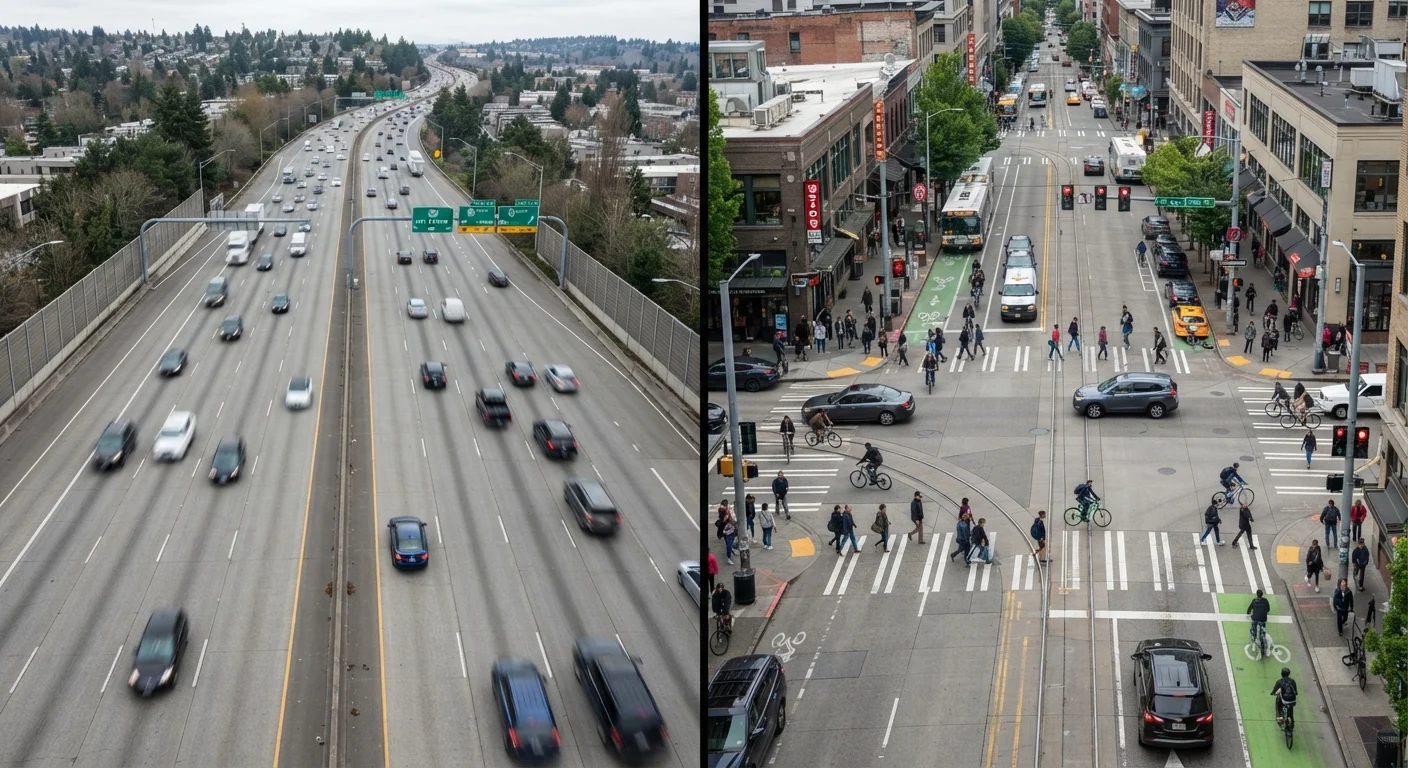
Key Takeaways
- Motorway driving demands longer scanning distances and much greater following gaps than city roads.
- Urban driving requires constant short-range awareness of pedestrians, cyclists, and unpredictable hazards.
- Highway monotony can cause attention lapses even in alert drivers — active mental engagement is essential.
- Speed limits are a ceiling, not a target; conditions often require driving well below posted limits.
- Switching between environments without mentally resetting your habits is one of the most common causes of near-misses.
Option A
Motorway Driving
High speed, low interaction — but high consequence if you drift.
Best for: Covering long distances efficiently when you can maintain consistent speed and attention over extended periods.
Option B
Urban Road Driving
Slow speed, constant decision-making — demands sharp short-range awareness.
Best for: Navigating dense traffic, pedestrians, and frequent stops where quick judgment matters more than pace.
If you mostly commute on high-speed highways
Motorway Driving
Focus on gap management, lane discipline, and combating monotony-driven inattention — these are the dominant risks at sustained high speeds.
If most of your driving is city or suburban streets
Urban Road Driving
Short-range scanning, pedestrian awareness, and anticipating sudden stops will pay off most in dense, unpredictable traffic environments.
If you regularly transition between both environments
Motorway Driving
The motorway-to-city transition is the more dangerous direction — drivers often carry over high-speed following distances and slower reaction habits into stop-start traffic.
Two Roads, Two Completely Different Skill Sets
Most drivers treat the road as one continuous challenge with a single rulebook. In reality, motorway driving and urban road driving draw on different instincts, different attention patterns, and different risk profiles. Applying motorway habits to a city street — or city habits to a 70 mph highway — is one of the most underappreciated sources of near-misses.
This isn't about driver skill level. Even experienced drivers can fall into the trap of carrying over the wrong habits when they switch environments. Understanding exactly what changes — and why — is the first step to actively adjusting your approach rather than just defaulting to whatever you did last.
For a broader foundation on reading the environment around you, see our guide to anticipating hazards before they escalate.
Speed, Space, and Stopping Distance
The most obvious difference is speed — but the more important difference is what speed does to stopping distance. At 70 mph, a typical car needs roughly 315 feet to stop under good conditions. At 30 mph in a city, that figure drops to around 75 feet. Those numbers mean the two-second following rule used in city traffic is nowhere near enough on a motorway, where a three- or four-second gap is the starting point in dry conditions.
| Criterion | Motorway Driving | Urban Road Driving |
|---|---|---|
| Typical speed range | 55–70 mph | 15–40 mph |
| Recommended following gap | 3–4 seconds minimum | 2 seconds minimum |
| Primary scanning distance | 12–15 seconds ahead | 4–6 seconds ahead |
| Main hazard type | Speed, fatigue, lane drift | Pedestrians, cyclists, cross traffic |
| Decision frequency | Low (fewer choices per mile) | High (constant micro-decisions) |
| Key attention risk | Monotony-induced inattention | Sensory overload, missed hazards |
Urban driving, by contrast, involves far more frequent speed changes, sudden stops, and vehicles cutting across your path. The hazard here isn't the distance to stop — it's the number of things you need to stop for. Pedestrians stepping off curbs, cyclists in blind spots, and delivery vehicles double-parked all demand close-range scanning rather than the long-distance horizon scanning that motorways require.
As our speed limits explainer makes clear, posted limits are a ceiling — actual safe speed in both environments often demands going slower than the sign says.
Attention and Where It Should Be Focused
Motorway driving creates a paradox: it feels lower-effort because there are fewer decisions per mile, but that sense of ease is exactly what makes it dangerous. Research on driver fatigue consistently shows that monotonous high-speed driving degrades attention faster than drivers expect. You don't fall asleep dramatically — you drift into a reduced-awareness state while still appearing to drive normally.
~20%
Of fatal crashes linked to driver fatigue
The National Highway Traffic Safety Administration estimates drowsy driving accounts for roughly 20% of fatal crashes in the US annually.
4–6 sec
Recommended urban scanning distance ahead
Driver education guidelines consistently recommend scanning four to six seconds ahead in city traffic, versus 12–15 seconds on high-speed roads.
315 ft
Stopping distance at 70 mph in dry conditions
Stopping distance data from the UK Highway Code and comparable US sources show that 70 mph stopping distances are more than four times longer than at 30 mph.
The fix isn't white-knuckling the wheel. It's actively scanning — picking out lane markers, tracking multiple vehicles ahead, and anticipating merge points well before they arrive. On a motorway, your attention should be 12 to 15 seconds ahead of your vehicle, not the four to six seconds that's appropriate in city traffic.
Urban roads flip this entirely. There, the volume of stimuli is so high that selective attention becomes critical. You can't track everything, so experienced drivers learn to prioritise: moving objects over stationary ones, unpredictable road users (children, cyclists) over predictable ones (parked cars), and intersections over mid-block sections. If you're building these habits from scratch, our guide for new licence holders walks through the fundamentals in a practical way.
The Transition Problem: When You Switch Environments
The most underappreciated risk isn't driving on motorways or urban roads — it's the moment you switch between them. Exiting a motorway after an hour at 70 mph and immediately entering a 30 mph zone is genuinely disorienting. Your speed perception recalibrates slowly, which means 40 mph can feel like 25 mph for several minutes after coming off a highway. This is a well-documented perceptual effect, not carelessness.
Practical countermeasures are simple but require deliberate habit: check your speedometer actively when exiting motorways, not just glancing at it. Give yourself an extra beat at the first few urban junctions. And recognise that your following distance instincts are still calibrated for high speed — consciously close the gap to something appropriate for city traffic.
Speed Perception Recalibrates Slowly
After extended motorway driving, your brain adapts to high speed as a baseline. Research on velocity adaptation suggests this recalibration can take several minutes after exiting. During that window, actively reading your speedometer — rather than trusting how fast you feel — is the most reliable correction. This effect is more pronounced in drivers who have been at highway speed for 45 minutes or longer.
The reverse transition — city driving to motorway — carries its own risks. Drivers accustomed to constant stop-start often fail to build speed smoothly on slip roads, or maintain city-style short following gaps at 60 mph. If wet or low-visibility conditions are added to the mix, those risks compound. Our guide to driving in rain, fog, and ice covers how conditions change safe following distance and speed in both environments.
Distraction is equally dangerous in both settings — but it shows up differently. On motorways, phone use tends to be rationalised as lower-risk because the road is straightforward. It isn't. See our hands-free phone use explainer for why even hands-free calls divide attention in genuinely dangerous ways.