

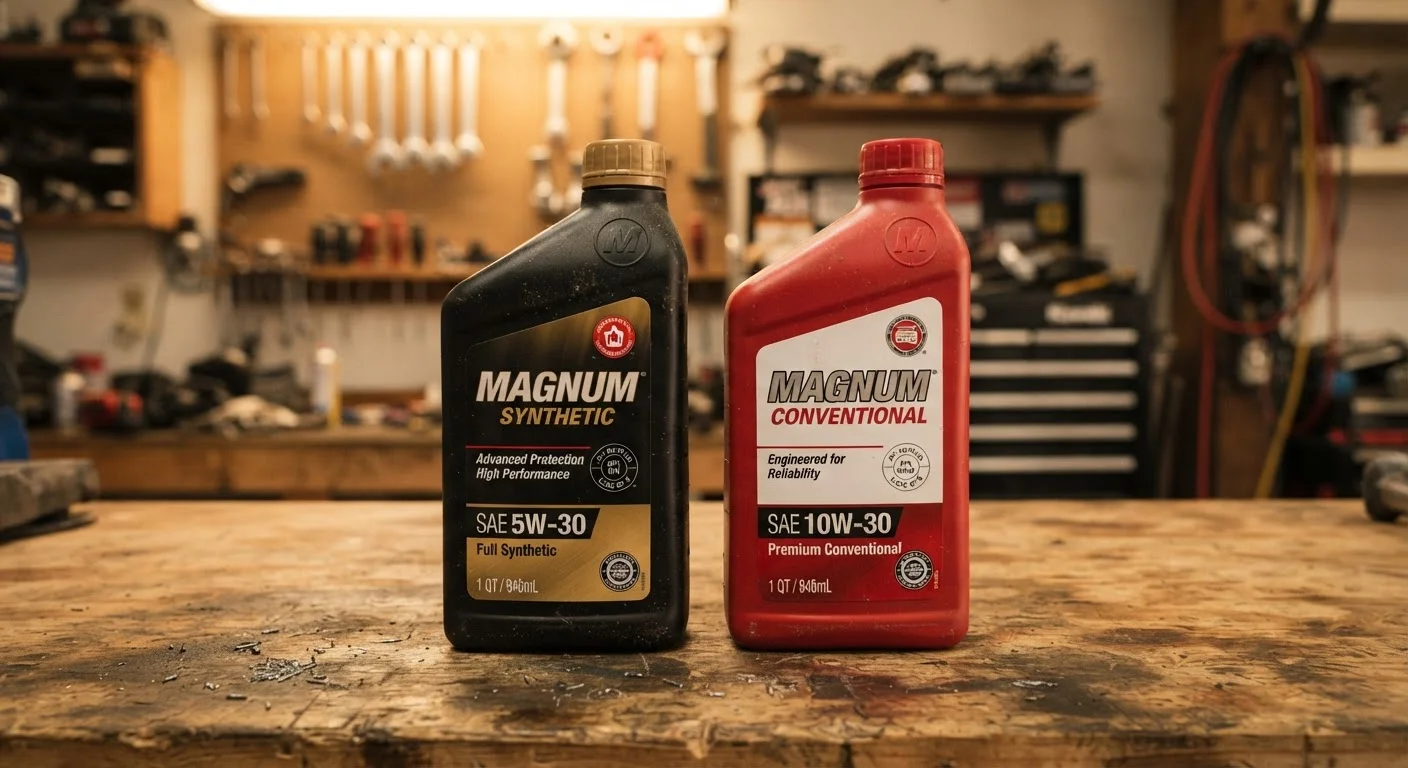
Key Takeaways
- Synthetic oil is chemically engineered for consistency; conventional oil is refined directly from crude petroleum.
- Synthetic oil typically lasts 7,500–15,000 miles per change; conventional oil is usually recommended at 3,000–7,500 miles.
- Synthetic costs more per quart but fewer changes per year can offset some of that price difference.
- Your owner's manual — not the oil change shop — is the authoritative source for what your engine needs.
- Mixing synthetic and conventional oils in an emergency is generally safe, but it's not a long-term strategy.
Option A
Synthetic Motor Oil
The engineered, high-performance option for modern engines.
Best for: Drivers with newer vehicles, turbocharged engines, or those who want longer intervals between oil changes.
Option B
Conventional Motor Oil
The time-tested, budget-friendly baseline for standard engines.
Best for: Drivers with older, simpler engines doing routine city or highway driving who change oil on a regular schedule.
If you drive a newer vehicle with a turbocharged or high-output engine
Synthetic Motor Oil
Modern turbocharged engines run hotter and tighter tolerances than older designs. Synthetic oil holds up better under that stress and is often required by the manufacturer.
If you own an older vehicle with high mileage and no history of synthetic use
Conventional Motor Oil
Older engines with worn seals may experience minor leaks when switching to synthetic. Staying with conventional — or choosing a high-mileage formula — is typically the safer call.
If minimizing how often you visit the shop matters to you
Synthetic Motor Oil
Synthetic oil's longer service life means fewer oil changes per year, which saves time and shop visits even if each fill-up costs more.
If you're driving an older, basic engine on a tight budget
Conventional Motor Oil
Conventional oil does the job adequately for straightforward engines when changed on schedule, and the lower per-quart price keeps routine maintenance affordable.
How Each Oil Is Made — and Why It Matters
Conventional motor oil starts as crude petroleum pumped from the ground. It's refined to remove most impurities, but the resulting fluid still contains a range of hydrocarbon molecules of different sizes and shapes. That molecular inconsistency is just the nature of the starting material.
Synthetic oil, by contrast, is built in a lab. Chemists start with a base stock — often derived from natural gas or refined petroleum — and engineer uniform, purpose-designed molecules. The result is a fluid with a more predictable structure, fewer impurities, and additives that are carefully matched to the base oil's chemistry.
That difference in manufacturing is what drives nearly every performance gap between the two. It also explains why understanding viscosity ratings matters — the oil type and grade work together, not independently.
Performance and Protection: Where the Gaps Show Up
For most everyday driving at moderate temperatures, both oil types do an adequate job of lubricating engine parts and reducing wear. The differences become more meaningful at the extremes.
Cold starts: Synthetic oil flows faster at low temperatures, which means critical engine parts are lubricated sooner after startup. Cold starts account for a disproportionate share of engine wear, so this matters more than it might seem.
High heat: Turbocharged engines, towing, and stop-and-go traffic push oil temperatures up. Synthetic oil resists thermal breakdown better, maintaining its protective film longer under sustained heat.
Oxidation and sludge: Over time, oil reacts with oxygen and forms deposits. Synthetic formulas are more chemically stable, which means they tend to resist sludge buildup longer than conventional oils do.
| Criterion | Synthetic Motor Oil | Conventional Motor Oil |
|---|---|---|
| Source | Engineered base stock | Refined crude petroleum |
| Typical change interval | 7,500–15,000 miles | 3,000–7,500 miles |
| Cold-weather performance | Flows faster at low temps | Slower to circulate when cold |
| High-heat stability | Resists breakdown well | Breaks down faster under heat |
| Cost per quart | Higher | Lower |
| Sludge resistance | Higher chemical stability | More prone to oxidation deposits |
| Required by manufacturer | Many modern engines require it | Common in older engine specs |
None of this means conventional oil is unsafe — it's been protecting engines reliably for decades. But if your engine faces regular stress, the gap between the two oils becomes more practically significant.
Change Intervals and Real-World Cost
The old "every 3,000 miles" rule is worth addressing directly: it's largely outdated for modern engines. Several widely repeated maintenance guidelines like this one no longer reflect what today's engines and oil formulations actually need.
Most conventional oils are recommended at 5,000–7,500 miles depending on driving conditions and the manufacturer's guidance. Full synthetic oils are commonly rated for 7,500–15,000 miles, with some manufacturer-approved intervals going longer.
7,500–15,000 mi
Typical synthetic oil service interval
Many synthetic oil manufacturers and automakers publish extended drain intervals for full synthetic formulas under normal driving conditions.
~2x
Approximate cost difference per quart
Full synthetic motor oil generally costs roughly twice as much per quart as conventional oil, though pricing varies by brand and retailer.
Up to 40%
Of engine wear occurs at cold start
Industry lubrication research has long identified cold-start conditions as a disproportionate contributor to overall engine component wear over time.
The cost math is straightforward but often misread. A conventional oil change might run less per visit, but if you're doing it twice as often, the annual spend narrows considerably. Add in the time and inconvenience of extra shop visits and the gap narrows further. That said, synthetic oil does cost more per quart — typically noticeably so — and for some drivers and vehicles, the added cost simply isn't justified.
The right number to check is always your owner's manual. It specifies both the recommended oil type and the change interval for your engine under normal and severe driving conditions.
Which Oil Does Your Engine Actually Need?
Many newer vehicles — especially those with turbocharged engines, direct injection, or tight manufacturing tolerances — specify synthetic oil outright. Using conventional oil in those engines isn't just a performance downgrade; it can void warranty coverage or fail to meet the manufacturer's lubrication requirements.
Older vehicles, particularly those built before the mid-2000s, were typically designed around conventional oil. Many run fine on it indefinitely. Switching a high-mileage older engine to synthetic after years on conventional can occasionally surface minor oil leaks at aging seals, though this risk is often overstated and depends heavily on the specific engine's condition.
The practical answer for most drivers: open the owner's manual, find the oil specification section, and follow what it says. If it specifies synthetic, use synthetic. If it gives you a choice, weigh your driving habits and budget. What the shop recommends upselling you to matters far less than what the manufacturer engineered your engine for.
For a deeper look at how grade and viscosity interact with oil type, see our guide on engine oil grades and viscosity.