

Key Takeaways
- The number before the 'W' describes cold-weather flow; the number after describes hot-engine thickness.
- Your owner's manual specifies the exact viscosity grade your engine was designed for — that's the authoritative source.
- Using the wrong grade can increase engine wear, reduce fuel economy, or cause oil pressure problems.
- Multi-grade oils (e.g., 5W-30) handle a wide temperature range, replacing the need for seasonal oil changes.
- Thicker oil is not always better — modern engines with tight tolerances often require thinner grades.
Engine Oil Viscosity Grade
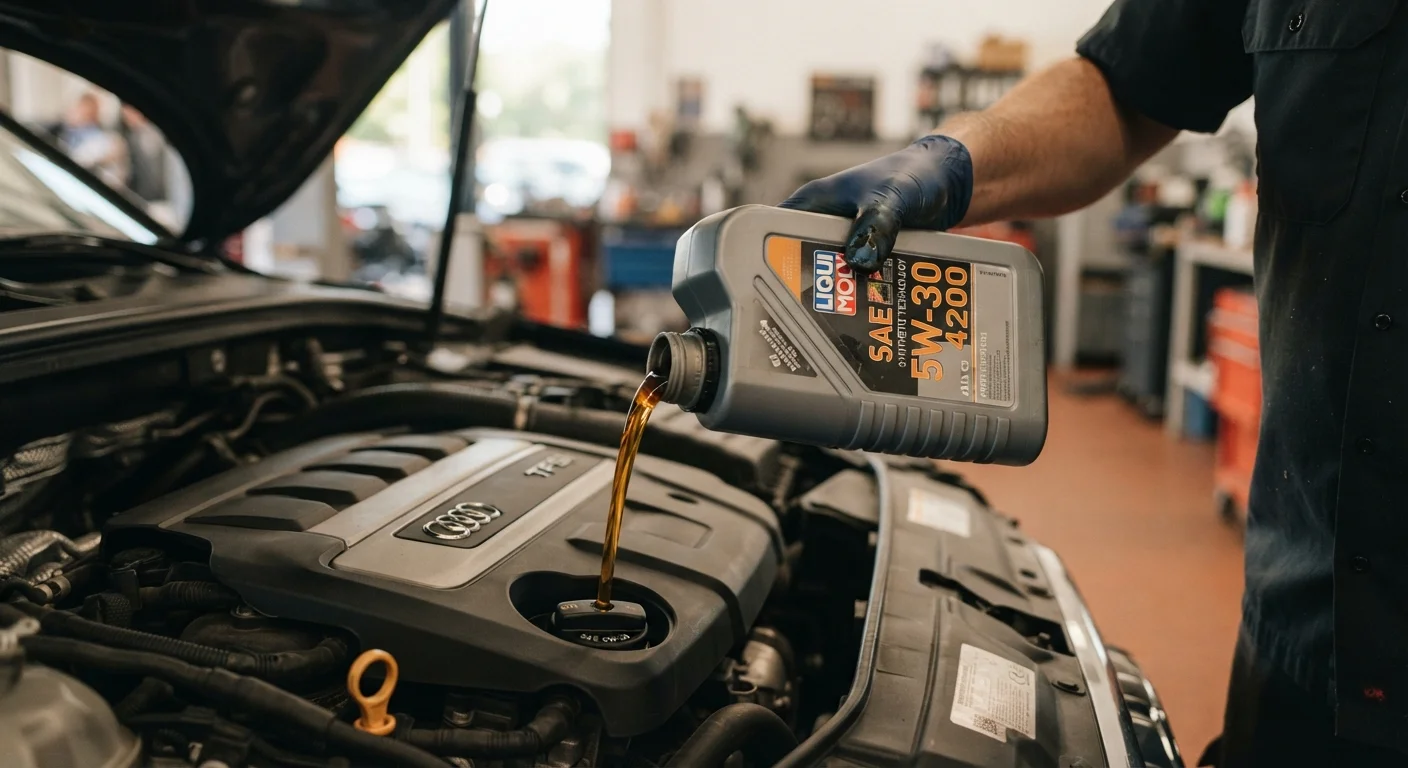
Viscosity grade is a number code — like 5W-30 or 10W-40 — that tells you how thick or thin an engine oil is under different temperature conditions. The rating is set by the Society of Automotive Engineers (SAE) and appears on every oil container. It determines how easily oil flows when your engine is cold at startup and how well it holds up under heat when the engine is running.
The 'W' in the rating stands for 'Winter,' not weight. The number before the W reflects cold-temperature pumpability; the number after reflects viscosity at 212°F (100°C) operating temperature.
Breaking Down the Number Code
Pick up any oil container and you'll see a code like 5W-30, 0W-20, or 10W-40. These aren't arbitrary marketing labels — each part of the number carries specific meaning about how the oil behaves at different temperatures.
The number before the W describes how the oil flows in cold conditions. A lower number means the oil stays thinner and pumps more easily when the engine is cold. This matters most during startup, when oil needs to circulate quickly before the engine warms up. The W stands for Winter, not weight — a common misconception worth clearing up.
The number after the W describes viscosity at full operating temperature (around 212°F). A higher number means the oil maintains more thickness under heat, which helps maintain a protective film between metal parts under load.
So a 5W-30 oil flows well in cold weather and holds moderate thickness at operating temperature. A 10W-40 is slightly thicker on both ends. Neither is universally better — it depends entirely on what your engine requires.
Multi-Grade Oils Are the Standard Today
Decades ago, drivers switched between lighter summer oils and heavier winter oils seasonally. Multi-grade oils eliminated that need by using polymer additives that help the oil behave appropriately across a wide temperature range. Almost every oil you'll find on the shelf today is a multi-grade formulation.
Why the Right Grade Actually Matters
Engine tolerances — the microscopic gaps between moving parts — are engineered around a specific oil viscosity. When the oil grade matches those tolerances, it creates the right film thickness to prevent metal-to-metal contact. When it doesn't, things go wrong in either direction.
Too thin: Oil that's too light may not maintain enough pressure or film thickness at high temperatures, especially in older engines or during highway driving. This can accelerate wear on bearings and camshafts.
Too thick: Oil that's too heavy resists flowing quickly at startup — the most critical moment for lubrication. It also forces the engine to work harder to pump oil, which can slightly reduce fuel economy and put unnecessary load on the oil pump.
Many drivers assume thicker oil is always a safer choice. It isn't. Modern engines, particularly those with variable valve timing or turbochargers, often require thinner grades like 0W-20 or 5W-20 to function properly. Using a heavier grade can interfere with hydraulic systems that depend on oil pressure response.
~40%
Engine wear occurring at cold startup
Engineering studies cited by SAE International suggest a significant proportion of engine wear happens in the first moments after a cold start, before oil fully circulates — underscoring why cold-flow viscosity matters.
0W-20
Viscosity grade now common in new vehicles
Many automakers have shifted to thinner oil specifications in newer model years to meet fuel economy targets and accommodate tighter engine tolerances — a change that surprises drivers used to older, heavier grades.
For more on how oil type — not just grade — affects engine protection, see our article on synthetic vs. conventional motor oil.
How to Find the Grade Your Engine Needs
The single most reliable source is your vehicle's owner's manual. Manufacturers specify viscosity grade based on the engine's design, tolerances, and intended operating conditions. That recommendation isn't a suggestion — it's an engineering requirement.
A secondary source is the oil filler cap on top of your engine, which often displays the recommended grade directly. Some automakers also approve a range of grades depending on climate, and those alternatives are typically listed in the manual alongside the primary recommendation.
One common point of confusion: the viscosity grade says nothing about how often oil should be changed or whether synthetic is required. Those are separate questions. The service schedule for your vehicle covers change intervals, which depend on oil type, driving conditions, and manufacturer specs.
If you've been told you need a heavier grade because your engine is older or burns oil slightly, that's worth discussing with a qualified mechanic before making the switch. Some situations warrant it; others don't. And if you've absorbed the old "thicker oil for high mileage" rule without questioning it, our piece on common car maintenance myths breaks down where that idea holds up and where it falls short.
This article is for general informational purposes. Always consult your vehicle's owner's manual or a qualified mechanic for maintenance decisions specific to your car.