

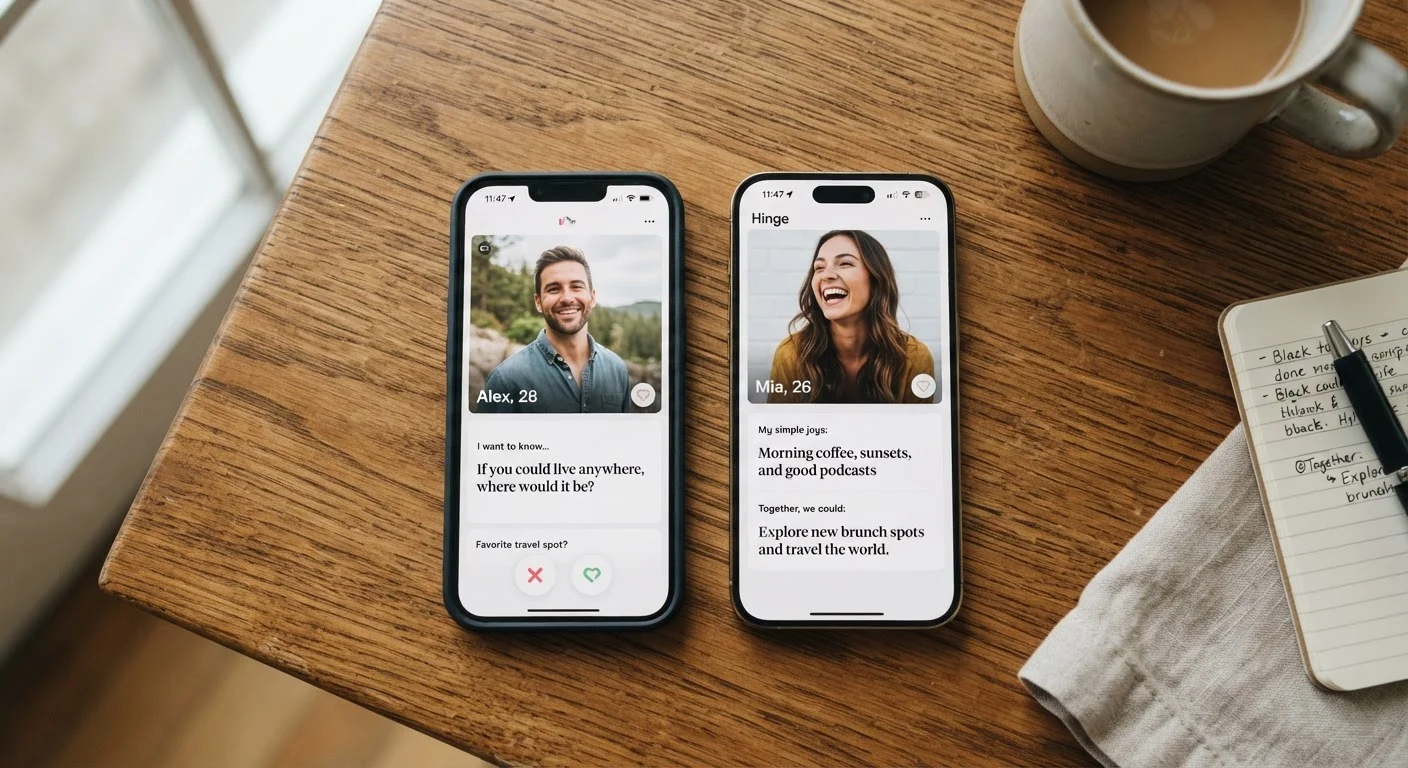
Key Takeaways
- Tinder prioritizes volume and speed, while Hinge emphasizes depth and intentionality.
- Hinge's prompt-based profiles give you more ways to express personality beyond photos.
- Both apps offer free tiers, but premium features vary significantly in cost and utility.
- Tinder's user base is larger globally; Hinge tends to attract users seeking relationships.
- Your best choice depends on what you're looking for — and how you prefer to communicate.
Option A
Tinder
The fast-paced, wide-net approach to modern dating.
Best for: Singles who want a large pool of matches and enjoy a casual, low-pressure swiping experience.
Option B
Hinge
The intention-driven app designed to get you off the app.
Best for: People seeking meaningful connections who prefer structured conversation starters over snap judgments.
If you want to browse a large pool quickly with minimal effort
Tinder
Tinder's swipe interface is fast and intuitive, letting you cover a lot of ground without much setup. It suits singles who enjoy exploring options before deciding.
If you're looking for a relationship and want conversations that actually go somewhere
Hinge
Hinge's prompt-and-comment system encourages more substantive first messages, which research suggests leads to higher-quality connections over time.
If you're new to dating apps and want a gentler learning curve
Hinge
Hinge's structured profiles make it easier to present yourself authentically without feeling overwhelmed by the blank-slate pressure of pure photo swiping.
If you're dating in a smaller city or rural area where pool size matters
Tinder
Tinder's significantly larger global user base means you're more likely to find matches in areas where dating app adoption is lower.
If budget is a top concern and you want solid free-tier functionality
Hinge
Hinge's free tier allows you to send likes with comments on specific prompts, which can spark genuine conversations without spending anything.
How Each App Is Built — and Why It Matters
At their core, Tinder and Hinge are built around different philosophies about how people connect. Tinder, launched in 2012, popularized the swipe mechanic: you see a photo, maybe a short bio, and make a split-second left-or-right decision. It's designed for speed and volume. Hinge, by contrast, positions itself as an app that encourages you to engage with something specific — a photo, a written prompt, or a voice note — before you can express interest.
That structural difference shapes everything from how you build your profile to how your first conversation begins. On Tinder, matches land in your inbox with no context — you and your match have to generate conversation from scratch. On Hinge, your opening message is already tied to something your match shared, which lowers the anxiety of that first message significantly.
For budget-conscious singles, this also affects how far the free tier gets you. Both apps limit certain features behind paywalls, but the type of limitation matters. Understanding those differences is the first step to picking the right tool. You can also learn more about how platform algorithms shape your visibility in our guide to what dating app algorithms actually prioritise.
Profile Setup: Photos vs. Prompts
Tinder profiles are photo-first, full stop. You can add a bio (up to 500 characters) and connect Spotify or Instagram, but the visual impression drives almost every swipe decision. If photography isn't your strong suit, that can feel limiting.
Hinge gives you six photos and three written prompts chosen from a curated library of questions — things like "The most spontaneous thing I've ever done" or "A non-negotiable in my life." You can also add voice notes and video prompts. The result is a profile that tells a small story rather than presenting a gallery. Research in interpersonal attraction consistently points to personality cues as strong drivers of sustained interest, which is an argument in Hinge's favor for people who feel their personality outshines their profile pictures.
| Criterion | Tinder | Hinge |
|---|---|---|
| Core mechanic | Swipe left or right | Like or comment on profile elements |
| Profile format | Photos + short bio | Photos + written/voice prompts |
| Daily match volume | Large, fast-moving queue | Smaller, curated daily stack |
| First message context | No built-in context | Tied to a liked prompt or photo |
| User base size | Very large globally | Smaller but growing |
| Free tier usefulness | Limited daily likes | Commented likes included free |
| Stated purpose | Meet people (casual to serious) | "Designed to be deleted" — relationships |
If you're just getting started, our complete first-week walkthrough for new dating app users covers profile-building tips that apply to both platforms.
Matching, Messaging, and Day-to-Day Experience
On Tinder, two people must both swipe right before a conversation can open — the classic mutual match model. The swipe queue is essentially endless, which can feel exhilarating or exhausting depending on your temperament. Free users get a limited number of daily likes (Tinder restricts these without a paid plan), and you have no control over who sees your profile.
Hinge shows you a curated "stack" of profiles each day — typically a smaller, more tailored set than Tinder's feed. You can like or comment on a specific element of someone's profile, and that person sees your comment before deciding whether to match. This means conversations on Hinge often start with a reference point rather than a generic opener, which many users find reduces ghosting and dead-end chats.
57%
Hinge users seeking a relationship
According to Hinge's own user surveys, a majority of its users identify as looking for a committed relationship rather than casual dates.
75M+
Estimated monthly Tinder users globally
Tinder has consistently reported tens of millions of active users worldwide, giving it one of the largest pools of any dating app.
3x
More likely to share phone number on Hinge
Internal Hinge data has suggested users are significantly more likely to exchange contact details compared to typical swipe-based app interactions.
That said, Tinder's sheer scale is hard to ignore. Its user base is substantially larger than Hinge's globally, which matters most in smaller cities or for users with very specific demographic preferences. If long-distance connection is part of your dating picture, see how apps perform in that context in our piece on long-distance dating in the app era.
Cost, Free Tiers, and What You Actually Get
Neither app requires a paid subscription to get started, but both monetize through premium tiers that unlock features like unlimited likes, seeing who liked you, and advanced filters. Tinder's premium plans (Tinder Gold and Platinum) tend to be priced higher than Hinge's equivalent (Hinge+), though pricing varies by age, location, and promotional offers — so it's worth checking current rates directly on each app.
For free users, Hinge arguably offers more functional value: you can still send commented likes and receive matches without hitting a hard daily limit as quickly. Tinder's free tier has grown more restrictive over time as the company has expanded its subscription offerings. If you're dating on a tight budget, testing both free tiers before committing to a subscription is a sensible approach. For a broader perspective on navigating modern dating, our complete guide to modern dating covers everything from profile basics to handling rejection.
This article is for informational purposes only. Dating app features, pricing, and availability change frequently — always verify current details directly with each platform.