

Key Takeaways
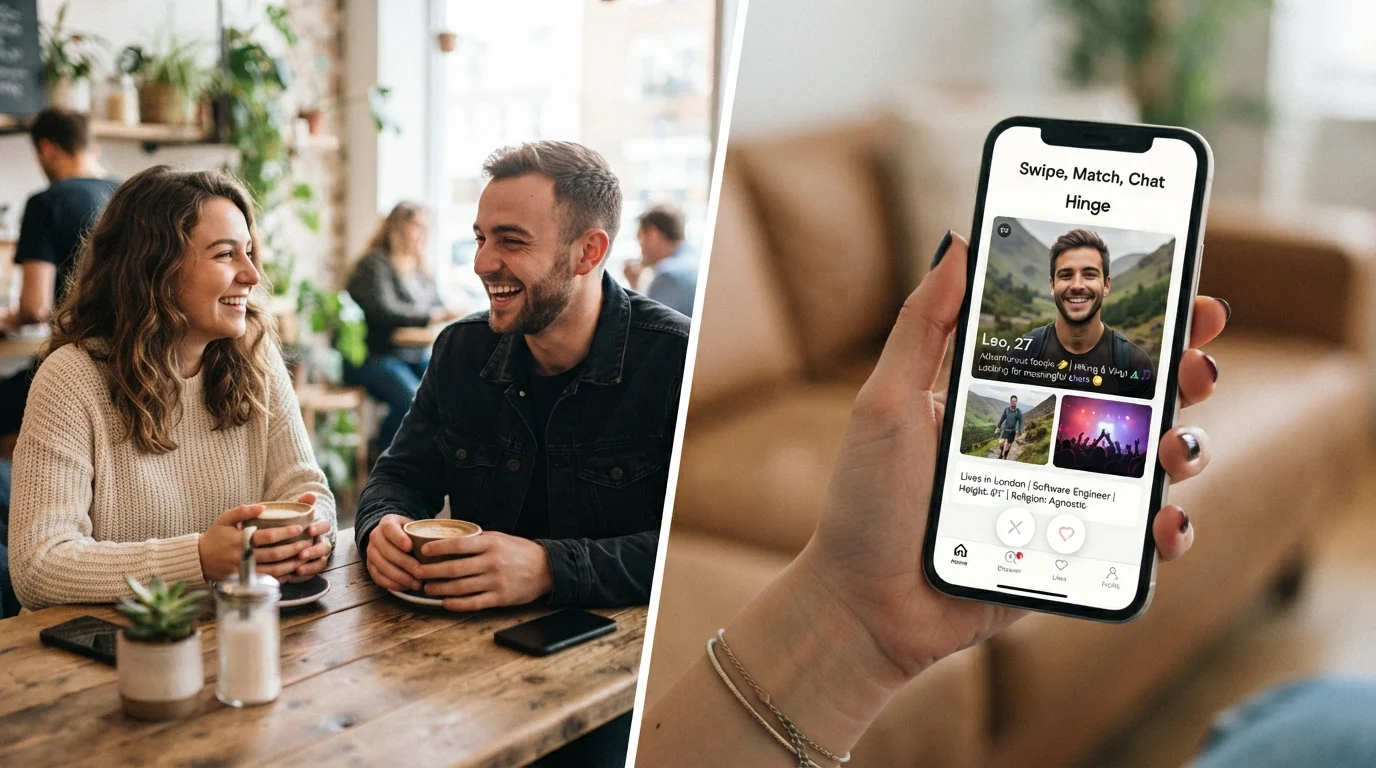
- Old-school dating builds context organically, while app dating compresses early impressions into profiles and photos.
- Apps expand your reach significantly but introduce a selection paradox that can fuel decision fatigue.
- Meeting organically often carries built-in social proof, which can lower initial anxiety for both parties.
- Neither approach guarantees a better match — your communication style matters more than the method.
- Combining both strategies tends to yield the widest, most realistic pool of potential partners.
Our Verdict
Old-school and app dating each have genuine strengths that suit different personalities, circumstances, and goals. Rather than declaring a winner, the most useful frame is understanding what each method costs you in time, energy, and emotional bandwidth — and choosing accordingly.
| Best for | Recommended |
|---|---|
| Those who find digital interactions draining or artificial | Old-School Dating |
| Singles in smaller social circles or rural areas wanting more options | App Dating |
| Budget-conscious daters who want to minimize time spent on incompatible matches | App Dating |
| People who prefer natural chemistry before committing to a formal date | Old-School Dating |
The Core Difference: How Context Shapes Connection
When you meet someone at a friend's gathering, a class, or through a shared hobby, you're already embedded in a shared context. That context does real work — it provides conversation hooks, mutual social accountability, and an early window into how someone actually behaves around others. This is what makes organic, or "old-school," dating feel more intuitive to many people.
App dating flips the sequence. You encounter a curated snapshot — photos, a short bio, maybe a few conversation prompts — before any real-world interaction. That's not inherently worse, but it does mean you're forming impressions from a tightly edited presentation rather than unfiltered behavior. Understanding this difference helps set realistic expectations for both paths. For more on how apps shape those first impressions algorithmically, see how dating app algorithms actually work.
Reach, Speed, and the Paradox of Choice
One of the most concrete advantages of app dating is scale. Within a few hours of creating a profile, you can potentially connect with dozens of people you'd never cross paths with organically. For singles in smaller towns, niche communities, or demanding careers, this access genuinely matters.
But expanded reach comes with a real cognitive cost. Research in decision science — including work associated with psychologist Barry Schwartz's concept of the "paradox of choice" — suggests that too many options can lead to less satisfaction, not more. When every match feels replaceable, it can become harder to invest meaningfully in any single connection.
Old-school dating is slower and more constrained by geography and social overlap, but that friction has a hidden upside: it tends to produce fewer, more considered connections. You're less likely to ghost someone you met through a mutual friend.
| Old-School Dating | App Dating | |
|---|---|---|
| Initial context | Rich — shared environment, mutual contacts | Minimal — photos and a short bio |
| Pool size | Limited by geography and social overlap | Large, often citywide or broader |
| Speed to first contact | Slower, naturally paced | Fast — can match within minutes |
| Authenticity of impression | High — behavior observed in real context | Variable — curated self-presentation |
| Clarity of intentions | Often implicit, requires more conversation | Often explicit — prompted by app design |
| Rejection frequency | Lower volume, higher social stakes | Higher volume, lower individual stakes |
| Typical cost | Social activities, events | Subscription fees, time investment |
Authenticity and the Profile Problem
Profiles are edited selves. Most people choose their most flattering photos, polish their bios, and present an idealized version of their personality. This isn't dishonesty so much as it's the nature of any self-presentation — but it does mean that app-based first impressions can diverge significantly from the in-person reality, creating a jarring experience for both parties on that first date.
Organic meetings sidestep this somewhat. You see someone laugh, watch how they treat a server, hear how they talk about their friends — all before you've consciously decided whether you're interested. That unfiltered information is valuable, and it's genuinely hard to replicate through a screen.
That said, app dating can actually encourage more explicit honesty about intentions early on. Many apps prompt users to state what they're looking for, which can reduce ambiguity. If that kind of clarity appeals to you, our guide on communicating intentions early in dating is worth a read.
Try a Hybrid Approach
You don't have to choose one method exclusively. Many people find that apps help them practice articulating what they want, while organic social settings help them reconnect with how attraction actually develops in real life. Using both keeps your skills sharp and your options open without over-relying on either.
Cost, Effort, and Emotional Energy
For budget-conscious singles, both approaches carry costs — just different ones. App dating often involves subscription fees for premium features, and the sheer volume of low-quality interactions can be emotionally exhausting. Old-school dating requires showing up consistently in social spaces, which costs time and sometimes money (classes, events, social outings).
Emotionally, app dating tends to involve more frequent, lower-stakes rejection, while organic dating involves less rejection overall but higher stakes when it does happen — because there's usually a social network involved.
Neither path is objectively easier. The right one depends on your personality, your schedule, and honestly, where you are emotionally right now. For a broader look at how to navigate all of this, the complete guide to modern dating covers the full landscape. And if you're new to apps specifically, your first week on a dating app is a solid starting point.