

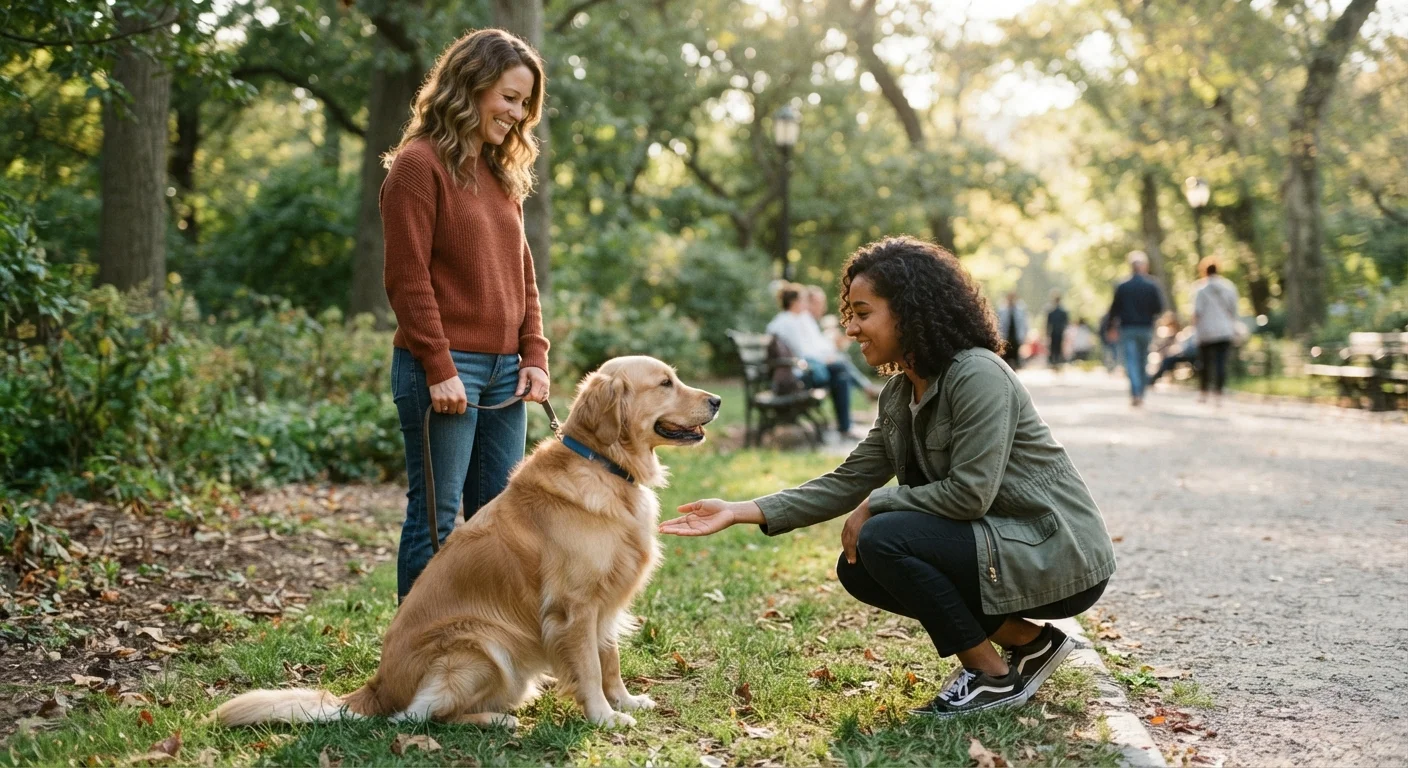
Key Takeaways
- Consistent, short training sessions work better than infrequent long ones for this skill.
- Dogs that react to strangers are often anxious, not aggressive — read the difference carefully.
- Desensitization means starting far from the trigger and gradually closing the distance over days or weeks.
- Asking strangers to ignore the dog initially reduces pressure and speeds up calm behavior.
- Every calm interaction with a new person is a deposit into your dog's confidence bank.
What you will need
Why Dogs React to Strangers
When a dog barks, lunges, or bounces uncontrollably around new people, it's easy to label the behavior as bad manners. In most cases, though, the dog is communicating something real — either excitement it hasn't learned to manage, or anxiety about an unpredictable situation. Before you begin training, it helps to understand which one you're working with.
An excited dog typically has loose, wiggly body language: a wagging tail, soft eyes, and a dog that recovers quickly once the stranger moves away. An anxious dog may show stiffer posture, tucked tail, lip licking, yawning, or attempts to create distance. If you're unsure, our guide on signs your pet is stressed, not stubborn can help you read those signals accurately.
Both types of reactivity respond to the same foundational approach — controlled exposure, clear rewards, and patience — but anxious dogs generally need a slower pace and more distance from strangers during early sessions.
What you will need
Setting Up for Success
Training works best when the environment is predictable. Before involving strangers at all, make sure your dog has a solid foundation in two skills: sit and focus (making eye contact with you on cue). These give you something to ask for when a new person appears, and they give your dog a job to do instead of reacting.
If you have a rescue dog or one with an unknown history, read our guide on building trust before you build commands before beginning stranger-focused work. Dogs who haven't yet established safety with their owner will struggle to generalize calm behavior to new people.
High-value training treats
Used to reward calm behavior immediately — small, soft, and highly motivating to your specific dog.
Standard 4–6 foot leash
Keeps your dog at a manageable distance and prevents rehearsal of reactive behaviors during early training.
Treat pouch or bait bag
Keeps rewards accessible so you can mark and reward calm behavior quickly without fumbling.
Willing training helper
Acts as the 'stranger' during controlled sessions, following your instructions to remain calm and neutral.
Step-by-Step Training Process
Follow the steps below in order. Progress only when your dog is consistently calm at the current level — there's no fixed timeline, and rushing is the most common reason this training stalls.
Establish a distance where your dog stays calm
Identify how close a stranger can be before your dog begins to react. This is your starting distance. In a park or quiet street, position yourself at that distance — or slightly beyond it — while a helper walks by without engaging. Reward your dog with a treat the moment it notices the person but stays relaxed.
Practice the 'watch me' focus cue
Once your dog is noticing strangers without reacting, add a focus cue. Say your dog's name or use 'watch me' to redirect its attention to you. Reward the moment it makes eye contact. Repeat until it looks at you reliably when it sees a new person at that distance.
Gradually reduce the distance over multiple sessions
Over several sessions — not all in one day — reduce the distance between your dog and the passing stranger by small increments. Each session should end before your dog reacts. If your dog goes over threshold (barks, lunges, freezes), calmly move away and note the distance as your reset point for next time.
Introduce a stationary stranger at close range
Once your dog can walk past strangers calmly, have a helper stand still nearby. Ask your dog to sit or focus, then reward for staying settled. The helper should avoid eye contact and remain neutral. This is a meaningful jump in difficulty — go back to a comfortable distance if your dog struggles.
Allow the dog to approach on its own terms
If your dog is curious and relaxed, you can now allow it to approach the stranger at its own pace. The stranger should remain passive — no reaching out, no sudden movements. If the dog sniffs and walks away, that's a success. Reward calm behavior throughout with quiet praise or a treat from your hand, not from the stranger's.
Generalize across different people and settings
Practice with a variety of helpers — different heights, clothing, hats, or voices — and in different locations. A dog that's calm around one familiar helper hasn't necessarily generalized the skill. Short, frequent sessions in varied settings build a dog that handles real-world strangers with genuine confidence.
Common Mistakes and How to Avoid Them
The most frequent error owners make is flooding — putting the dog in a high-exposure situation before it's ready, hoping it will simply adjust. This typically increases anxiety rather than reducing it. Always start below your dog's threshold: the distance or intensity at which it first notices but doesn't react to a stranger.
A second common mistake is allowing strangers to immediately approach, reach over, or pet the dog. Well-meaning guests who rush a greeting can undo weeks of progress. Brief them in advance: ignore the dog, no direct eye contact, and let the dog approach on its own terms if it wants to.
It's also worth noting that early-life socialization plays a major role in how easily adult dogs accept new people. Our article on socialization windows and early development explains why some dogs need more support than others — and that's never a reason for blame, just a reason for patience.
Short Sessions Outperform Long Ones
Five to ten minutes of focused training is more effective than a 45-minute marathon, especially for anxious or excitable dogs. End every session before your dog reaches its limit — a calm finish reinforces that new people predict good things. You can do two or three short sessions per day.
This article provides general training guidance and is not a substitute for advice from a certified professional dog trainer or veterinary behaviorist, particularly for dogs showing fear-based aggression or significant anxiety.