

Key Takeaways
- A crate is a management tool and a safe space — never a punishment.
- The right crate size gives a puppy room to stand, turn, and lie down — not more.
- Gradual introduction with positive associations is the foundation of successful crate training.
- Puppies should not be crated longer than their age in months plus one hour at a time.
- Whining and pawing signal the puppy needs more slow, positive steps — not stricter enforcement.
Start here
What a Crate Actually Is (and Isn't)
Next
Choosing the Right Crate Size
Then
How to Introduce the Crate Step by Step
Check progress
Signs Your Puppy Is Comfortable — and Signs They're Not
Refine
Common Mistakes to Avoid
What a Crate Actually Is (and Isn't)
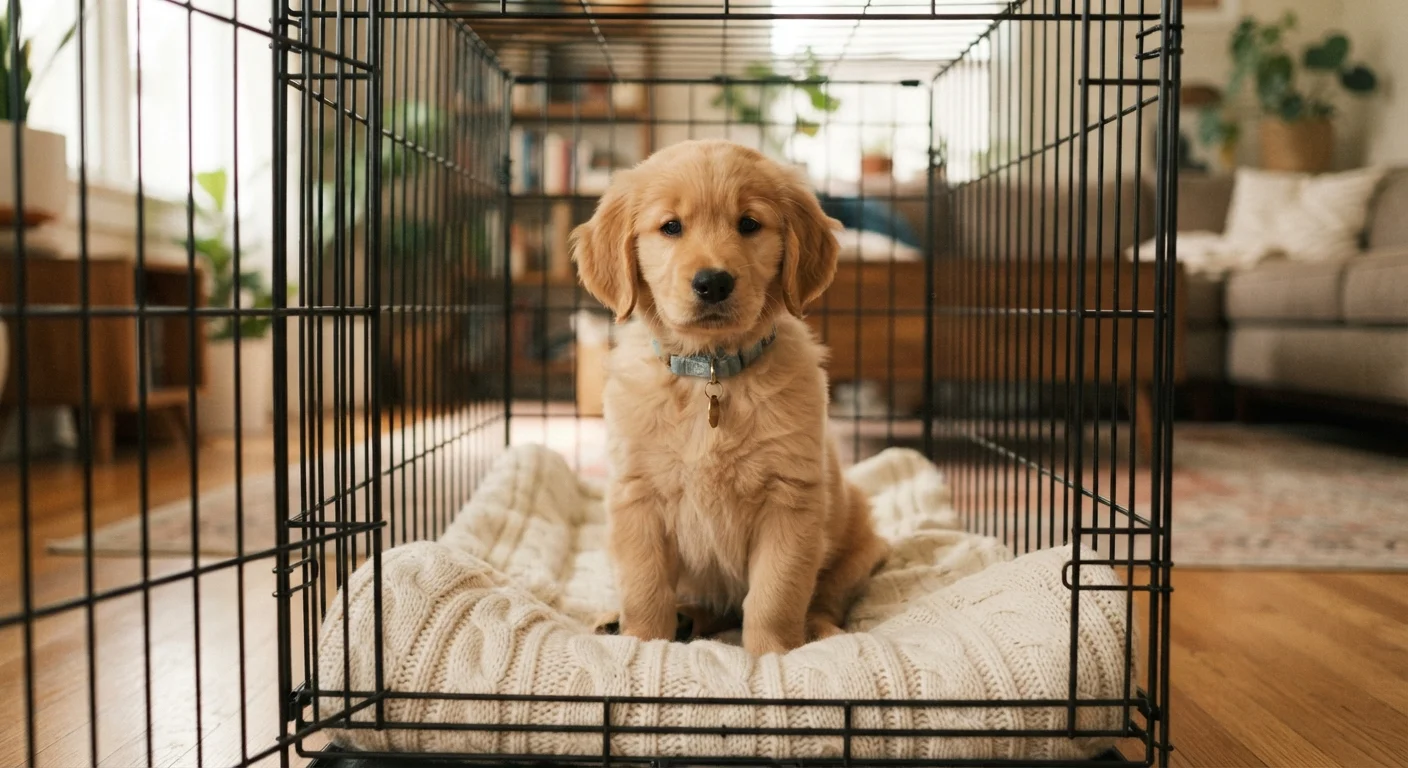
A crate is simply an enclosed space — wire, plastic, or fabric — sized for your dog. Used well, it functions as a secure resting den: somewhere your puppy can decompress, sleep safely, and stay out of trouble when you can't supervise directly. It's also one of the most reliable tools for house-training, because puppies instinctively avoid soiling where they sleep.
What a crate is not: a babysitter, a storage unit for a bored dog, or a consequence for bad behavior. Locking a puppy inside after a scolding teaches them the crate means something went wrong. That association makes every future crating session harder. The moment a crate becomes punishment, it stops being a safe space.
Think of it less as a cage and more like a puppy's bedroom — a spot that belongs to them. Before you start, it helps to check our guide to bringing a pet home for the first time to make sure the rest of your environment is set up for success too.
Crate
An enclosed kennel or den-like space used to give a dog a safe, contained area for rest or short supervised absences.
Positive reinforcement
A training approach that rewards desired behavior — typically with treats, praise, or play — to make that behavior more likely to happen again.
House-training
Teaching a puppy to toilet outside (or in a designated indoor spot) by managing their environment and rewarding appropriate elimination.
Divider panel
An adjustable insert included with many wire crates that lets you reduce the usable space inside, keeping it appropriately sized as a puppy grows.
Desensitization
Gradually exposing a dog to something that causes stress — like a closed crate door — at very low intensity until they no longer react with anxiety.
Choosing the Right Crate Size
Sizing matters more than most new owners realize. Your puppy's crate should be large enough for them to stand up without crouching, turn around comfortably, and lie fully stretched out. That's it. A crate that's too large actually undermines house-training: extra floor space gives a puppy room to toilet in one corner and sleep in another.
If you're buying a crate sized for your dog's adult weight — which is more economical — look for a model that includes a divider panel. You can block off the back section while your puppy is small and slide the divider back as they grow.
- Wire crates: Good airflow, easy to clean, and most include a divider. The folding design makes storage straightforward.
- Plastic travel crates: Cozier and more den-like; a good choice for puppies who seem anxious in open spaces.
- Soft fabric crates: Lightweight but not escape-proof. Better for calm, already-trained dogs than active young puppies.
How to Introduce the Crate Step by Step
Rushing the introduction is the single most common reason crate training stalls. The goal is for your puppy to choose to go in — not be coaxed or pushed. Work through these stages at your puppy's pace, not a fixed schedule.
- Let them investigate freely. Place the crate in a busy room with the door open. Toss a few small treats just inside the entrance and let your puppy sniff around without pressure. Don't close the door yet.
- Feed meals near, then inside, the crate. Move the food bowl progressively closer to the crate entrance each meal, then just inside the door, then further back over several sessions.
- Practice short door closures. Once your puppy is eating comfortably inside, close the door briefly while they finish eating, then open it immediately. Gradually extend this to a minute, then five minutes, building on calm behavior.
- Build up to short absences. Use a cue word like "crate" or "bed," reward your puppy for going in, and leave the room for a few minutes. Return calmly before they become distressed.
- Introduce overnight crating. Keep the crate in or near your bedroom at first. Most puppies need a toilet break during the night — plan for it rather than hoping they'll hold on.
Pairing verbal cues with rewards is a foundational skill. If you'd like to understand why reward timing shapes behavior so effectively, our clicker training guide explains the mechanics clearly.
Make the Crate Part of the Room
Placing the crate in a living area where your family spends time — not an isolated laundry room — helps puppies associate it with the comfort of being near you. Cover three sides with a blanket to create a cozier, den-like feel, especially for puppies who seem nervous in open-sided wire crates.
Signs Your Puppy Is Comfortable — and Signs They're Not
Reading your puppy's body language honestly is more useful than following a rigid timeline. Comfortable crate behavior looks like: settling down without prolonged fussing, relaxed posture, and voluntarily entering the crate between sessions. Some puppies even start taking naps in there with the door open — a reliable sign the training is working.
Signs that your puppy needs more gradual work include:
- Persistent whining or barking that doesn't settle within a few minutes
- Frantic scratching, pawing at the door, or attempts to escape
- Panting, drooling, or trembling when the door is closed
- Refusing food or treats they'd normally take eagerly
These responses don't mean the training has failed — they mean you've moved too fast. Return to an earlier step where your puppy was relaxed and rebuild from there. Forcing through distress won't create comfort; it creates a dog who associates the crate with feeling trapped.
Never Use the Crate as Punishment
Putting a puppy in the crate immediately after a scolding — or with an angry voice — creates a negative association that can be difficult to reverse. Even if you need to manage your puppy during a chaotic moment, use a calm, neutral tone and a treat when directing them inside. The crate should always feel like their space, not a consequence.
Common Mistakes to Avoid
Even well-meaning owners run into predictable pitfalls. Knowing them ahead of time saves a lot of backtracking.
- Crating for too long
- Puppies have limited bladder control and high energy needs. Extended crating leads to accidents, frustration, and anxiety — none of which help training.
- Letting the puppy out when they cry
- If you open the door every time your puppy fusses, you teach them that crying works. Wait for a brief pause in the noise, then open the door — so calm behavior is what earns release.
- Using the crate only when you leave
- If crating only happens right before you go out, your puppy learns to associate it with your departure. Practice crating while you're home so it's not a reliable signal that you're leaving.
- Skipping the gradual steps
- There's no shortcut to a puppy who trusts their crate. Skipping steps to save time almost always means more time spent repairing anxiety later.
For a broader look at training habits that can slow progress, see our piece on common pet training myths. And if you're also preparing for your first formal training session, the readiness checklist for new pet owners is a practical next step.