

Key Takeaways
- The clicker's value comes from its consistency — it always sounds the same, unlike your voice.
- Timing is everything: the click must happen at the precise moment the desired behavior occurs.
- You must "charge" the clicker first so your pet learns the sound predicts a reward.
- Clicker training works across species — dogs, cats, birds, and even rabbits can learn with it.
- Short, frequent sessions produce better results than long, infrequent ones.
- Age is not a barrier — older pets can learn clicker-based behaviors just as effectively.
Clicker Training
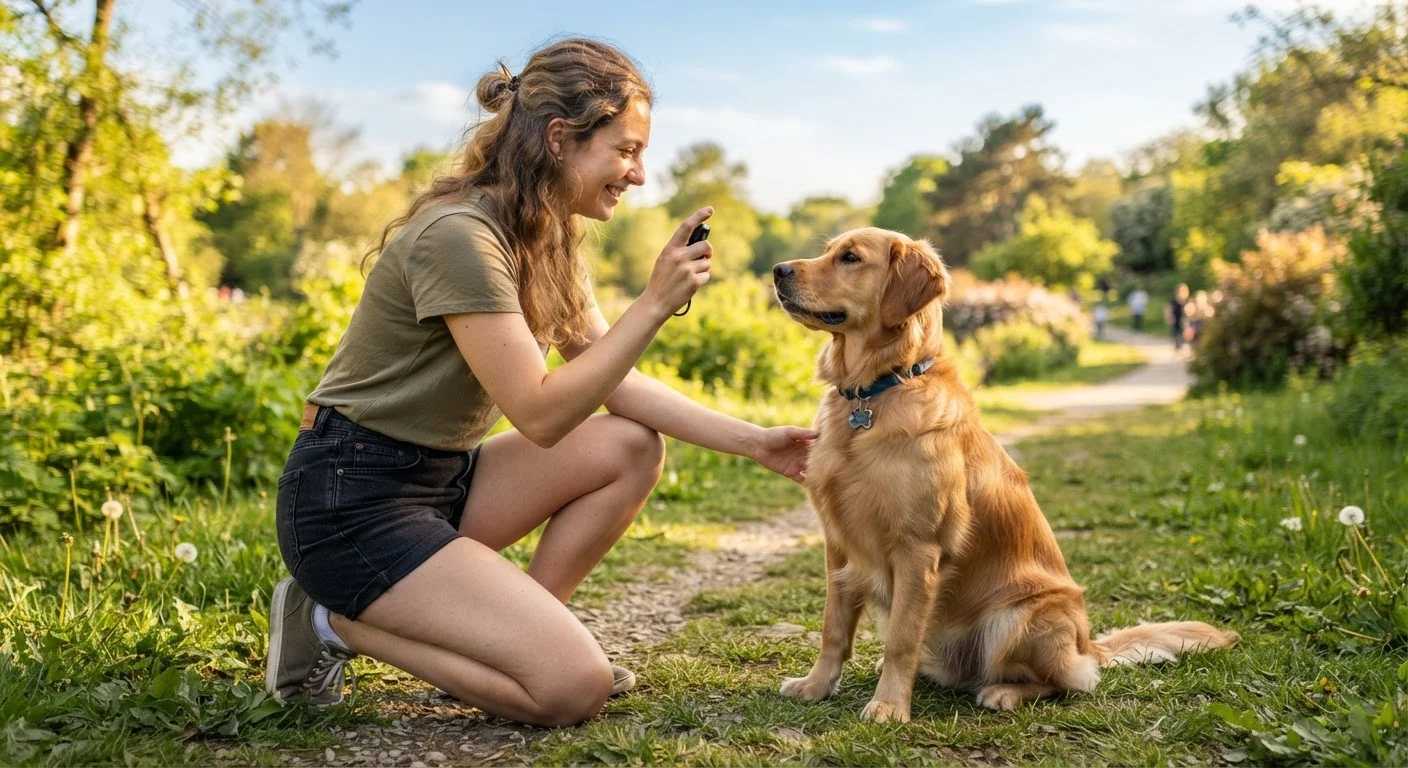
Clicker training is a method of teaching animals using a small handheld device that makes a distinct clicking sound. The click is used to mark the exact moment a pet does something you want to reinforce, and is immediately followed by a treat or reward. Over time, the animal learns that the click signals they did the right thing, making communication between owner and pet clearer and faster.
Clicker training is grounded in operant conditioning — specifically positive reinforcement — where a conditioned reinforcer (the click) bridges the gap between a behavior and its reward, a technique developed from B.F. Skinner's foundational work in behavioral science.
Why a Click Works Better Than a Word
When you say "good dog," your tone changes depending on your mood, the situation, and how tired you are. A clicker does not have that problem. Every click is identical — same pitch, same duration, same speed — which gives your pet a crystal-clear, reliable signal that cuts through ambient noise and emotional variation.
This consistency is the foundation of why clicker training is effective. Animals learn through patterns. When the same sound reliably predicts a reward, its meaning becomes fixed in the animal's mind faster than a word ever could. The click becomes what trainers call a conditioned reinforcer: a neutral sound that has been linked, through repetition, to something the animal genuinely wants.
For a deeper look at how pets process and respond to signals, see The Complete Picture on Pet Behaviour, which covers the full arc of how animals learn from instinct through to trained behavior.
“The clicker gives you precision. You're not rewarding the whole animal — you're rewarding a specific moment in time. That specificity is what makes the behavior stick.”
— Karen Pryor, Behavioral biologist and pioneer of clicker training methodology
The Three Phases of Getting Started
Phase 1: Charge the Clicker
Before your pet can benefit from the click, they need to understand what it means. This is called charging the clicker. Click once, then immediately give a treat. Repeat this 10–15 times across a short session. You are not asking for any behavior yet — you are simply building the association between sound and reward.
Phase 2: Mark the Behavior
Once your pet looks toward you expectantly after a click, you know the charging worked. Now you can begin marking real behaviors. Ask for something simple — like a sit — and click the instant your pet's rear touches the ground. Not after. Not two seconds later. Timing is the single most important skill in clicker training.
Phase 3: Build and Fade
Repeat the marked behavior across multiple short sessions (three to five minutes works well for most pets). As the behavior becomes reliable, begin asking for it in different environments to generalize it. Eventually, you can fade the clicker and maintain the behavior with intermittent verbal praise or treats.
Keep Sessions Short and End on a Win
Three to five minutes per session is enough for most pets, especially early on. Always aim to end each session with a behavior your pet can do successfully — this leaves both of you on a positive note and keeps motivation high for the next session.
If you want to make sure your training environment is set up for success before you begin, this readiness checklist for new pet owners covers what to have in place before your first session.
Common Misconceptions About Clicker Training
Many pet owners assume clicker training is only for dogs, only for puppies, or requires professional-level skill. None of that is accurate. The method has been used successfully with cats, parrots, horses, rabbits, and even fish. Age is equally not a barrier — the brain's ability to form associations through reward does not shut off as an animal gets older.
Another frequent misunderstanding is that the clicker is a remote control — that pointing it at a pet triggers obedience. In reality, the clicker is a communication tool. It tells your pet what earned the reward, which helps them repeat the behavior more deliberately next time.
< 1 sec
Ideal click-to-behavior timing window
Animal learning researchers generally agree that a marker signal should follow the desired behavior within approximately one second to be effective — delays reduce the behavior-reward connection.
3–5 min
Recommended session length for most pets
Short, focused training sessions are widely recommended by professional animal trainers and veterinary behaviorists to prevent mental fatigue and maintain motivation.
10–15
Repetitions needed to charge a clicker
Most pets form a reliable association between the click sound and a pending reward within a single short charging session of 10 to 15 click-and-treat pairings.
It is also worth noting that clicker training is not a stand-alone magic solution. It works within the broader framework of positive reinforcement. If you have encountered conflicting advice about training approaches, common pet training myths examined is worth reading alongside this guide. And for a direct comparison of training philosophies, see Positive Reinforcement vs. Punishment-Based Training.
The Clicker Is a Tool, Not a Trick
Clicker training is most effective when paired with a clear understanding of what behavior you actually want to reinforce. Decide on the target behavior before you start a session and keep your criteria consistent. Changing what you reward mid-session can confuse even an experienced animal learner.