

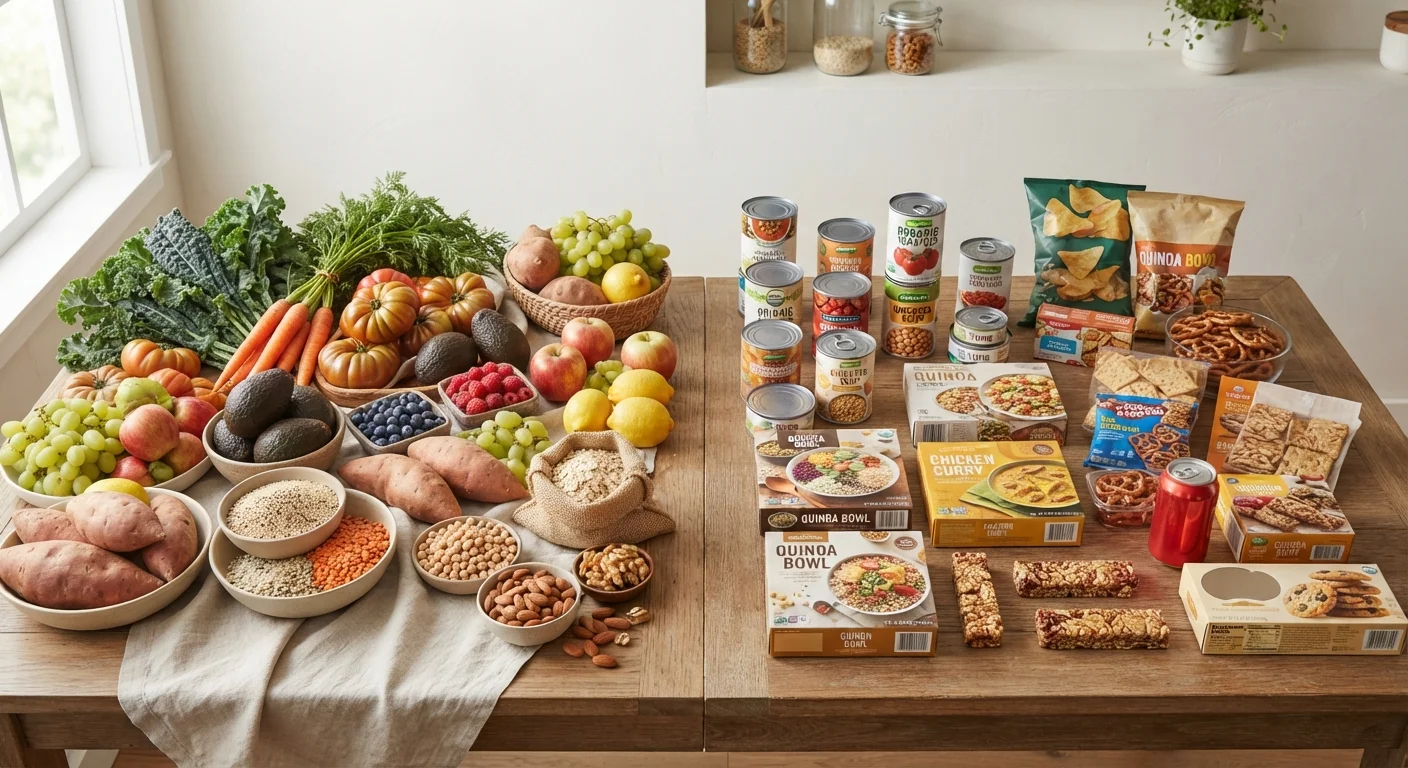
Key Takeaways
- "Processed" covers a wide spectrum — from canned beans to fast-food meals — not a single category.
- Ultra-processed foods, not all processed foods, are most consistently linked to poorer health outcomes.
- Whole foods generally offer more fiber, vitamins, and minerals with fewer additives per calorie.
- Minimally processed staples like frozen vegetables and canned tomatoes are nutritionally sound budget options.
- A practical diet blends whole foods with selectively chosen processed items based on ingredient quality.
- Reading nutrition labels helps you navigate the processed food spectrum with confidence.
Option A
Whole Foods
The minimally altered, nutrient-dense foundation of most healthy diets.
Best for: People prioritizing nutrient density and looking to build meals around ingredients in their natural or near-natural state.
Option B
Processed Foods
A broad, misunderstood category that spans the nutritional spectrum.
Best for: Anyone who wants to understand which packaged or prepared items fit into a balanced diet and which are worth limiting.
If you want the most nutrient-dense calories per dollar
Whole Foods
Whole grains, legumes, produce, and eggs deliver fiber, vitamins, and minerals with little to no added sugar or sodium — often at a lower cost per serving than convenience foods.
If you need fast, affordable meal components on a tight schedule
Processed Foods
Minimally processed items like canned fish, frozen vegetables, and plain rolled oats are nutritious, inexpensive, and require minimal preparation time.
If your goal is reducing ultra-processed food intake gradually
Whole Foods
Swapping just one or two ultra-processed staples for whole-food alternatives can meaningfully shift your overall nutrient intake without requiring a complete diet overhaul.
If you want balanced nutrition without cooking every meal from scratch
Processed Foods
Thoughtfully chosen processed items — those with short ingredient lists and recognizable components — can fill gaps when time or resources are limited.
What 'Processed' Actually Means
The word "processed" triggers an almost automatic negative reaction in nutrition conversations — but it's worth pausing on the definition. A food is technically processed any time it's altered from its original state. By that standard, pasteurized milk, bagged spinach, and canned chickpeas are all processed.
The more useful framework is a spectrum. Nutrition researchers commonly use the NOVA classification, which groups foods into four categories based on the extent and purpose of processing:
- Group 1 – Unprocessed or minimally processed: Fresh fruit, vegetables, plain meat, eggs, plain nuts, dried legumes.
- Group 2 – Processed culinary ingredients: Olive oil, flour, salt, vinegar — items used in cooking, rarely eaten alone.
- Group 3 – Processed foods: Canned vegetables, cheese, cured meats, plain bread. These have added salt, sugar, or preservatives but retain recognizable food structure.
- Group 4 – Ultra-processed foods (UPF): Soft drinks, packaged snacks, fast food, flavored instant noodles. These are industrially formulated with multiple additives, flavoring agents, and emulsifiers that don't appear in a home kitchen.
The distinction that matters nutritionally is primarily between Group 1–3 and Group 4. Much of the health research pointing to harm from "processed" food is specifically about ultra-processed foods in Group 4. For a deeper look at reading labels on packaged items, see how to read a nutrition label.
| Criterion | Whole Foods | Ultra-Processed Foods |
|---|---|---|
| Fiber content | Generally high | Often low or absent |
| Added sugar | Minimal to none | Frequently elevated |
| Sodium | Naturally low | Often high |
| Micronutrient density | High | Variable; often low |
| Ingredient list | Single or few ingredients | Long, includes additives |
| Shelf life | Shorter (perishable) | Extended |
| Prep time | Varies; some require cooking | Minimal; ready-to-eat |
| Cost per serving | Low to moderate | Low to high |
How Whole Foods and Ultra-Processed Foods Differ in Practice
Whole foods — produce, legumes, whole grains, plain dairy, eggs, and unprocessed meat — tend to share a common set of nutritional traits. They're higher in fiber, micronutrients, and phytonutrients, and lower in added sodium and sugar. Fiber in particular plays a meaningful role in digestion, blood sugar regulation, and satiety. Understanding how fiber and sugar differ helps clarify why carbohydrate quality matters as much as quantity.
Ultra-processed foods, on the other hand, are engineered for palatability and long shelf life. Additives like emulsifiers, flavor enhancers, and colorants make these products taste consistent and appealing — but the combination of high caloric density, low fiber, and elevated sodium or sugar can make it easy to consume more than intended without feeling full.
This doesn't mean every packaged item is nutritionally empty. Frozen peas are nutritionally comparable to fresh. Plain canned tomatoes are a practical source of lycopene and vitamin C. The key question isn't "is it processed?" but rather: What's in it, and how does it fit into the overall pattern of what I eat?
57%
Share of US calories from ultra-processed foods
Research published in BMJ Open estimated that ultra-processed foods account for roughly 57% of daily caloric intake for average US adults.
~28g
Daily fiber recommended for most US adults
The 2020–2025 Dietary Guidelines for Americans identifies fiber as a nutrient of public health concern due to widespread under-consumption.
4 groups
NOVA food processing classification tiers
The NOVA system, developed by Brazilian nutrition researchers, categorizes foods by extent of industrial processing rather than nutrient composition alone.
All-or-nothing thinking about food often does more harm than the foods themselves. A diet built primarily on whole foods, with selectively used processed items, is both realistic and evidence-aligned for most people.
Making the Distinction Work for Your Budget
Budget constraints are real, and whole food eating doesn't require organic produce or specialty grocery stores. Some of the most nutrient-dense foods available — dried lentils, oats, eggs, frozen vegetables, canned beans — are also among the least expensive per serving. These minimally processed staples sit comfortably at the nutritious end of the spectrum without straining a grocery budget.
A practical approach:
- Anchor meals in whole or minimally processed foods. Build a plate around a whole grain, a legume or lean protein, and vegetables — fresh, frozen, or canned all count.
- Audit the ultra-processed items you buy regularly. Not to eliminate them, but to identify one or two where a simpler swap is easy and affordable.
- Use the ingredient list, not just the label claims. "Natural" and "wholesome" on a package front mean little. A shorter ingredient list with recognizable components is a more reliable signal of minimal processing.
Eating well on a budget is more about pattern than perfection. Explore practical budget eating strategies for actionable guidance tailored to everyday grocery decisions. The whole foods vs. processed foods distinction is a tool for making better choices — not a pass/fail test.
This article is for general informational and educational purposes only and is not a substitute for personalized medical or nutritional advice. Consult a qualified healthcare professional or registered dietitian for guidance specific to your health needs.
Minimally Processed ≠ Unhealthy
Frozen vegetables, canned legumes, plain yogurt, and pasteurized milk are all technically processed — but they retain the nutritional profile of their whole-food origins. Freezing and canning preserve most vitamins and minerals effectively. When whole food isn't accessible or affordable, these items are a sound nutritional alternative, not a compromise.