
Electric Vehicles and Running Costs: What New Drivers Should Know Before Switching

Key Takeaways
- Home charging typically delivers the biggest cost advantage over public fast-charging networks.
- EVs generally have lower maintenance costs but higher upfront purchase prices than equivalent gas vehicles.
- Battery degradation affects real-world range over time — understand warranty terms before you buy.
- Insurance premiums for EVs often run higher than for comparable gas-powered vehicles.
- Your daily mileage and parking situation are the strongest predictors of whether an EV saves you money.
Start here
What Makes EV Running Costs Different
Next
Charging: Where the Savings Live (or Disappear)
Then
Battery Health and Long-Term Value
Also consider
Insurance, Registration, and Hidden Costs
Finally
Is Switching Worth It for Your Situation?
What Makes EV Running Costs Different
Electric vehicles operate on a fundamentally different cost structure than gas-powered cars. The upfront price is typically higher, but several ongoing expenses are lower — and understanding which ones matter most for your situation is the real starting point.
With a gas vehicle, you're continuously paying for fuel, oil changes, and a longer list of wear parts: spark plugs, transmission fluid, exhaust components. An EV strips many of those out. There's no combustion engine to service, no oil to change, and the drivetrain is considerably simpler. For a broader view of all the costs that stack up annually, see the true annual cost of running a car.
Level 2 charger
A 240-volt home or public charging unit that charges an EV significantly faster than a standard household outlet, typically adding 20–30 miles of range per hour.
DC fast charger
A high-power public charging station (Level 3) that can charge most EVs to 80% in under an hour. These are common along highways but typically cost more per charge than home charging.
Regenerative braking
A system that recovers kinetic energy during braking and converts it back into electricity to top up the battery, extending range and reducing brake pad wear.
Battery degradation
The gradual loss of a battery's ability to hold a full charge over time and through repeated charge cycles, which reduces the maximum driving range available.
kWh (kilowatt-hour)
The unit used to measure electricity consumption and battery capacity. It's the EV equivalent of a gallon of gas — how much energy you're using or storing.
Range anxiety
The concern that an EV's battery will run out of charge before reaching a destination or charging station, a common worry for drivers new to electric vehicles.
What remains are electricity costs, tire replacement (EVs are heavier and can wear tires faster), cabin air filter service, brake fluid, and eventual battery considerations. The weight difference that affects tires also means that driving habits — acceleration style, load, speed — have a measurable effect on how far your costs stretch.
Charging: Where the Savings Live (or Disappear)
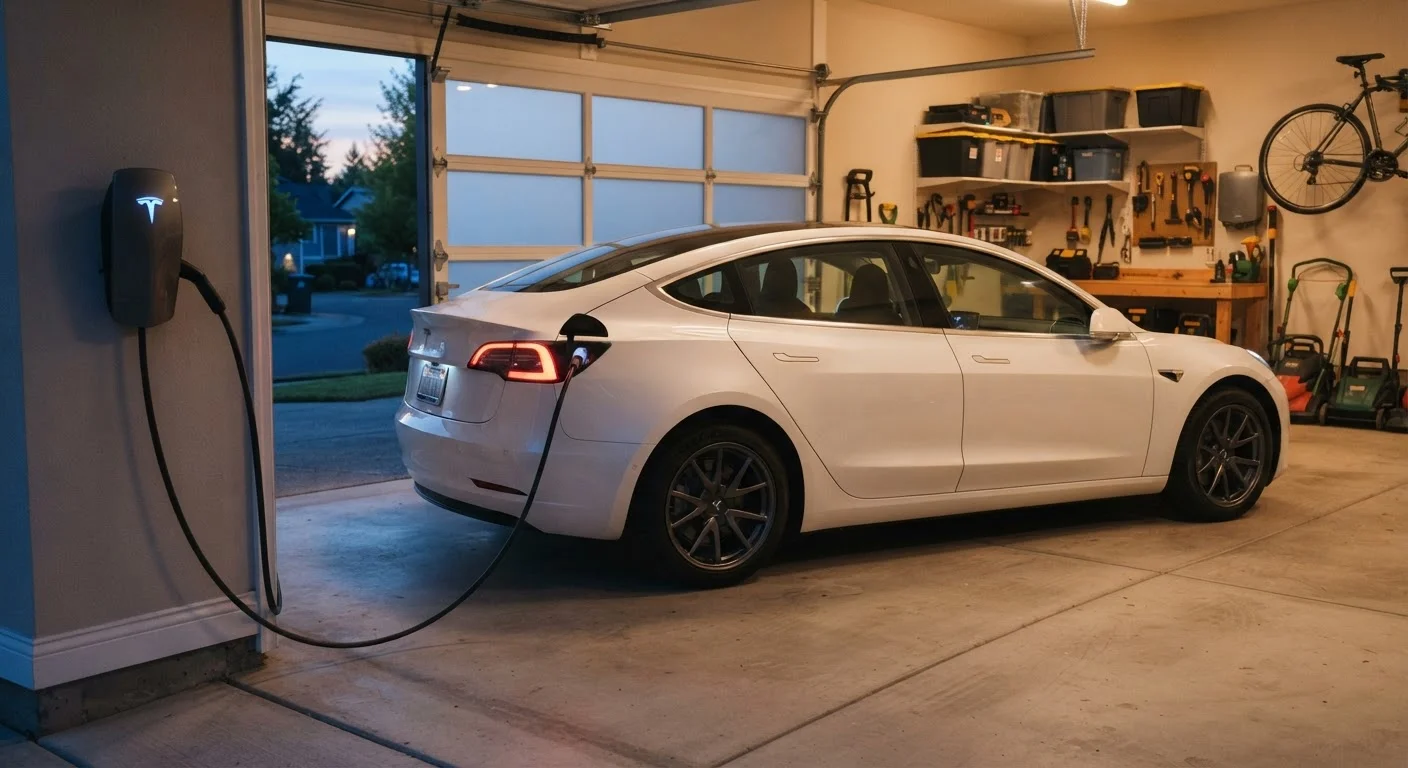
The single biggest variable in EV economics is how and where you charge. Home charging — plugging into a Level 2 charger (240V) installed in your garage or carport — is where most drivers realize real savings. You're essentially buying electricity at your residential rate, typically during off-peak hours, which is far cheaper per mile than pump prices in most US regions.
Public fast-charging networks (DC fast chargers, often called Level 3) are convenient for road trips but priced at a premium. Some networks charge per minute, others per kilowatt-hour. Frequent reliance on public fast charging can substantially reduce or eliminate the cost advantage over gas. If you live in an apartment without dedicated parking or reliable access to a home outlet, factor that in carefully before assuming the savings will materialize.
Make Home Charging Work Harder for You
If your utility offers time-of-use rates, schedule overnight charging during off-peak hours when electricity is cheapest. Even modest rate differences compound significantly over tens of thousands of miles. A simple timer setting through your EV's app or charging unit is usually all it takes.
Short, frequent trips also behave differently in an EV than in a gas car. While EVs avoid the cold-engine fuel penalty described in our guide on short trips and running costs, repeated short runs can affect charging efficiency and battery cycle counts if you're topping up constantly from low charge states.
Battery Health and Long-Term Value
The battery pack is the most expensive component in any EV, and its long-term health affects both your running costs and the vehicle's resale value. Battery capacity gradually declines over years and charge cycles — meaning the range you get on a full charge slowly decreases. This is normal and expected, but the rate varies by model, climate, and charging behavior.
Consistently charging to 100% and frequently using DC fast charging both accelerate degradation faster than charging to 80–90% on a Level 2 charger at home. Most manufacturers recommend keeping the battery between roughly 20% and 80–90% for daily use, reserving full charges for long trips.
Battery Warranty Terms Vary by Manufacturer
While 8 years/100,000 miles is a common benchmark, the specific terms — including what constitutes a warranted failure versus normal degradation — differ across manufacturers. Some warrant against capacity falling below a specific threshold (e.g., 70%). Read the warranty document for any EV you're seriously considering, not just the headline numbers.
When shopping for a used EV, battery health becomes a critical due-diligence item. Ask about the remaining warranty — most manufacturers warrant EV batteries for 8 years or around 100,000 miles. A battery health report from a dealer or independent diagnostic tool can reveal how much capacity has already been lost.
Insurance, Registration, and Hidden Costs
Insurance is one area where EVs frequently surprise new owners. Average premiums for electric vehicles tend to run higher than for comparable gas models, primarily because repair costs are higher — specialized technicians, proprietary parts, and the cost of battery-related repairs all factor in. This doesn't mean EV insurance is always dramatically more expensive, but it's worth getting actual quotes for the specific model you're considering rather than assuming parity.
Registration fees vary by state. Some states charge EV-specific fees to offset the loss of gas-tax revenue that funds road maintenance — these can range from modest to several hundred dollars annually depending on where you live. Check your state's DMV schedule before finalizing your cost calculations.
For a broader comparison of how EVs stack up against conventional ownership costs, our look at petrol vs. diesel running costs provides useful context on how fuel-type economics play out over ownership periods. Also consider ownership vs. long-term renting if you're still deciding whether to own at all.
Is Switching Worth It for Your Situation?
There's no universal answer. The drivers who benefit most from switching to an EV tend to share a few common traits: they have home charging access, drive moderate to high annual mileage (giving them more miles over which to recover the higher purchase price), and live in areas with reasonable electricity rates.
If your daily driving is mostly short errands and you park on the street without charging access, the math often doesn't favor an EV — at least not yet. Routine maintenance practices still matter regardless of powertrain; small checks like tyre pressure and air filters keep any vehicle running efficiently and cost-effectively.
Run your own numbers using your actual electricity rate, estimated annual mileage, and realistic charging access. Compare that against your current fuel and maintenance spend. That calculation — not the marketing — is what should drive the decision.
This article provides general information about electric vehicle ownership costs and is not financial or purchasing advice. Costs, incentives, and regulations vary by location and change over time. Verify current figures with your state DMV, utility provider, and a qualified automotive professional before making a purchase decision.