
America's Desert Landscapes: Distinguishing the Mojave, Sonoran, and Chihuahuan

| Smallest U.S. hot desert | Mojave (~25,000 sq mi) (U.S. Geological Survey) |
| Most biodiverse North American desert | Sonoran (Sonoran Desert Conservation Plan, Pima County) |
| Largest North American desert | Chihuahuan (~175,000 sq mi total) (Chihuahuan Desert Research Institute) |
| Mojave annual rainfall | Under 5 inches (National Park Service) |
| Sonoran rainy seasons | Two (winter rains + summer monsoon) (USDA Forest Service) |
| Chihuahuan's most visited U.S. park | Big Bend National Park, TX (National Park Service) |
Why These Three Deserts Are Not Interchangeable
Ask most people to picture an American desert and they'll conjure a single image — endless sand, scorching sun, maybe a cactus. In reality, the three major U.S. hot deserts are ecologically, climatically, and visually distinct from one another. Mixing them up means choosing the wrong season, packing the wrong gear, or missing the landscape feature you actually came to see.
Whether you're plotting a Southwest road trip or zeroing in on one national park, knowing which desert you're entering is step one of smart trip planning. Here's a quick-reference breakdown of each.
| Smallest U.S. hot desert | Mojave (~25,000 sq mi) (U.S. Geological Survey) |
| Most biodiverse North American desert | Sonoran (Sonoran Desert Conservation Plan, Pima County) |
| Largest North American desert | Chihuahuan (~175,000 sq mi total) (Chihuahuan Desert Research Institute) |
| Mojave annual rainfall | Under 5 inches (National Park Service) |
| Sonoran rainy seasons | Two (winter rains + summer monsoon) (USDA Forest Service) |
| Chihuahuan's most visited U.S. park | Big Bend National Park, TX (National Park Service) |
The Mojave: America's Driest, Highest Hot Desert
Straddling southern California, Nevada, and small corners of Utah and Arizona, the Mojave Desert is the smallest and most arid of the three. It sits at higher elevations than its neighbors — generally 2,000 to 5,000 feet — which gives it cooler winters and occasional snowfall that surprises first-time visitors.
Its defining plant is the Joshua tree (Yucca brevifolia), a spiky, otherworldly tree-form succulent that grows nowhere else on Earth in significant numbers. Joshua Tree National Park, located where the Mojave meets the Sonoran, is the most accessible entry point. The Mojave receives under 5 inches of rainfall annually, mostly in winter, making spring the prime visiting window before summer temperatures regularly exceed 100°F.
Budget travelers will appreciate that much of the Mojave's most dramatic scenery — dunes, volcanic craters, dry lake beds — sits within free or low-cost public lands managed by the Bureau of Land Management (BLM). See our guide to visiting national parks on a budget for entrance fee strategies that apply here.
Rain shadow desert
A desert that forms on the leeward side of a mountain range, where air loses its moisture as it rises over the peaks, leaving the far side dry. The Chihuahuan Desert is a classic example.
Monsoon
A seasonal shift in wind patterns that brings concentrated summer rainfall to parts of the Southwest, typically July through September. Both the Sonoran and Chihuahuan deserts experience summer monsoons.
Succulent
A plant adapted to store water in thick leaves, stems, or roots. Cacti are the most recognizable succulents in American deserts, but the category includes agaves, yuccas, and others.
BLM land
Public land managed by the federal Bureau of Land Management, often accessible for free or low-cost camping and recreation outside designated national parks. Large portions of the Mojave Desert fall under BLM administration.
Elevation desert
A desert located at notably higher altitude than surrounding lowlands, which moderates extreme heat and can produce winter frost or snow. Both the Mojave and Chihuahuan qualify as higher-elevation deserts relative to the Sonoran.
The Sonoran: Lush, Biodiverse, and Surprisingly Green
Spanning southern Arizona, a sliver of southeastern California, and extending deep into Mexico's Sonora state, the Sonoran Desert is the most biologically rich desert in North America. That richness has a simple explanation: the Sonoran receives two distinct rainy seasons — a gentle winter rain and a dramatic summer monsoon — giving it enough moisture to support an extraordinary variety of life.
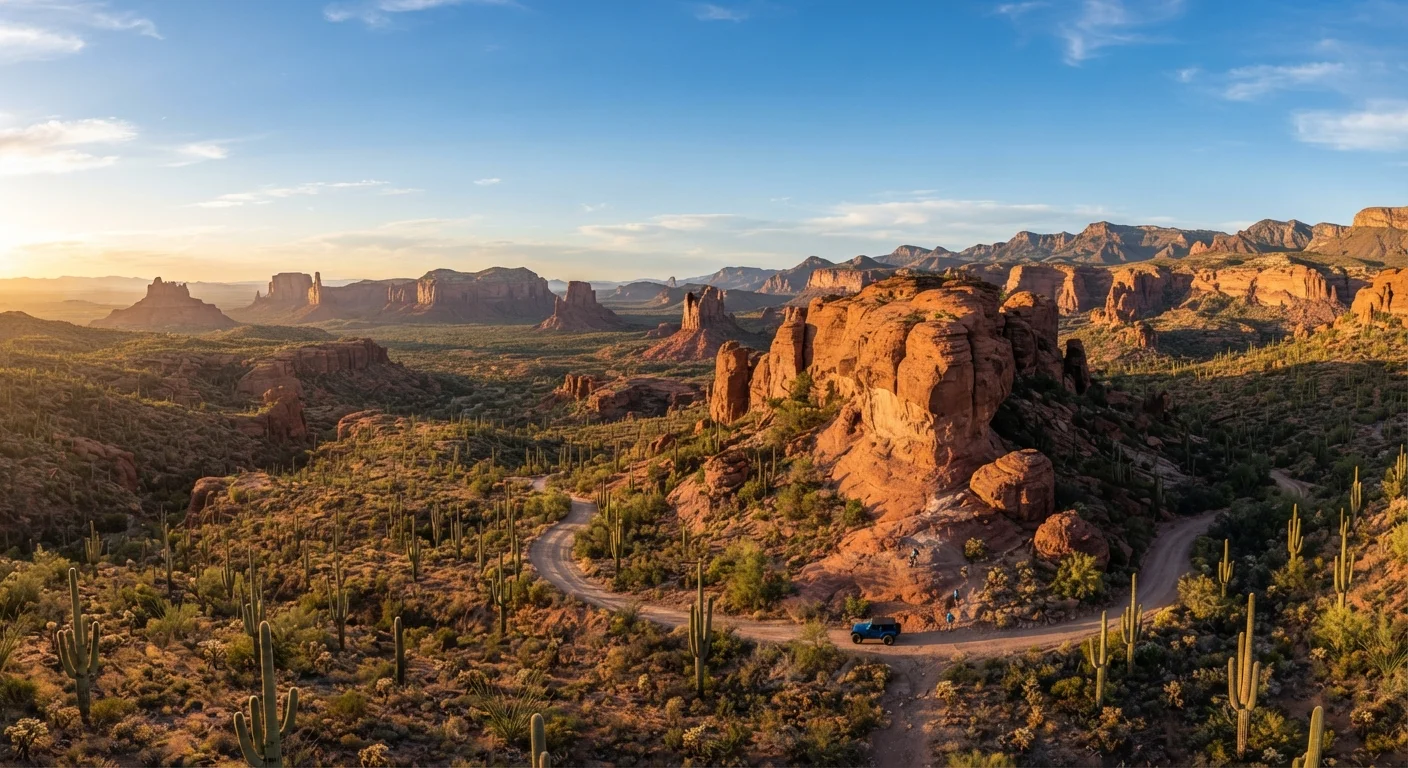
The iconic saguaro cactus (Carnegiea gigantea) grows only in the Sonoran, making it the postcard image most people associate with the American Southwest. Saguaro National Park (split between two districts near Tucson) and Organ Pipe Cactus National Monument are the marquee destinations. Summer monsoon season runs roughly July through September — spectacular to witness but demanding in terms of heat and flash flood risk. October through April is generally the most comfortable window for visitors.
Entry-level camping and day-use fees at Sonoran-area parks tend to be modest. Planning ahead for permits and reservations is especially important during the peak spring wildflower season when campsites fill quickly.
The Chihuahuan: The Overlooked Giant
The Chihuahuan Desert is the largest North American desert by area, yet it remains the least visited by U.S. travelers — largely because most of it lies in Mexico, with only the northern reaches extending into New Mexico, Texas, and a corner of Arizona. That relative obscurity makes it a genuine find for travelers seeking crowd-free landscapes.
The Chihuahuan is a rain shadow desert, shielded from Pacific moisture by multiple mountain ranges. It receives most of its rain during summer monsoons and sits at higher elevations than the Sonoran, producing cooler average temperatures and an ecology dominated by lechuguilla agave, various yucca species, and ocotillo.
White Sands National Park — home to the world's largest gypsum dune field — and Big Bend National Park are the premier U.S. destinations within Chihuahuan territory. Big Bend alone spans over 800,000 acres and sees a fraction of the visitation of better-known parks, meaning trail solitude is genuinely attainable. Winter and spring are the most comfortable seasons for visiting the U.S. portion of this desert.
Border Region Travel: Check Official Advisories
Big Bend National Park and other Chihuahuan Desert destinations sit near the U.S.-Mexico border. Entry requirements, safety conditions, and border crossing rules can change. Always consult the U.S. State Department and the National Park Service for current advisories before you travel — do not rely solely on third-party sources or older trip reports.
Side-by-Side: Key Differences at a Glance
Choosing between these deserts ultimately comes down to what kind of experience you're after. The Mojave delivers stark, surreal minimalism. The Sonoran rewards visitors with dense life and dramatic summer storms. The Chihuahuan offers scale, solitude, and landscapes that feel genuinely off the beaten path.
| Desert | Signature Plant | Best Season | Top U.S. Destination |
|---|---|---|---|
| Mojave | Joshua tree | Feb – Apr | Joshua Tree NP |
| Sonoran | Saguaro cactus | Oct – Apr | Saguaro NP |
| Chihuahuan | Lechuguilla agave | Nov – Mar | Big Bend NP |
All three deserts sit along potential Southwest road trip routes, and a well-planned loop can pass through more than one. Just be prepared for each to surprise you.
800,000+
Acres in Big Bend National Park
Big Bend is one of the least visited large national parks in the lower 48, according to National Park Service annual visitation data.
~200
Species of birds in the Sonoran Desert
The Sonoran Desert's dual rainy seasons support extraordinary biodiversity, including migratory and resident bird species tracked by the Arizona-Sonora Desert Museum.
275 sq mi
Area of White Sands gypsum dune field
White Sands National Park, New Mexico, contains the world's largest gypsum dune field, per the National Park Service.