

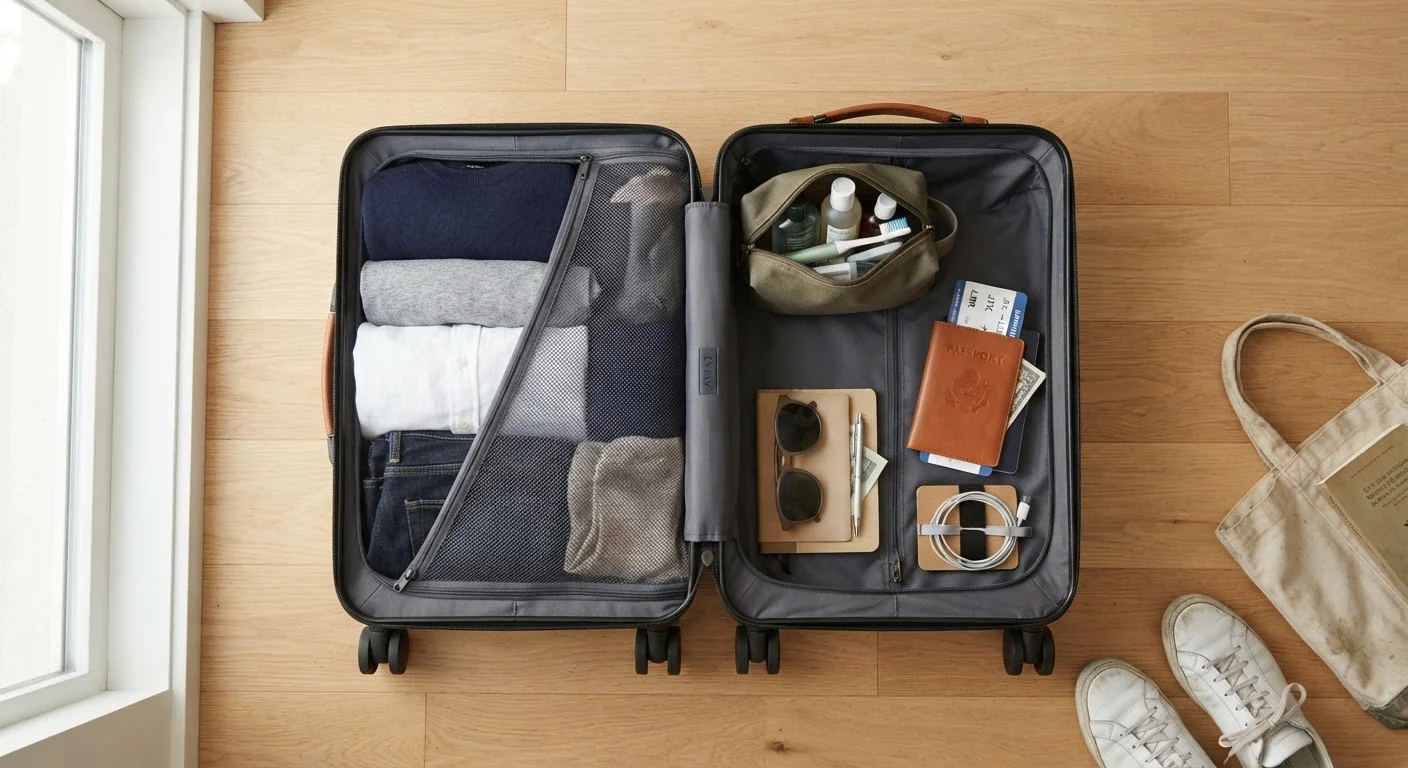
Key Takeaways
- Carry-on-only travel can save $50–$150 or more in checked bag fees per round trip.
- Packing light means real constraints on clothing, gear, and trip length.
- Airline size and weight limits vary significantly and can catch travelers off guard.
- Carry-on travel works brilliantly for short city trips and less well for outdoor or formal-occasion travel.
- The strategy pays off most when paired with a broader budget approach.
Eliminates checked bag fees on every flight
Bag fees on U.S. carriers typically run $35–$70 per bag each way, so a carry-on-only approach can save a solo traveler $70–$140 per round trip — and significantly more for families.
Skip baggage claim entirely
Walking straight off the plane and out the door saves 20–45 minutes per arrival and removes the risk of delayed or lost luggage, which affects roughly 5 in 1,000 checked bags according to DOT data.
Greater flexibility for connections and rebooking
Without a checked bag tying you to a specific flight, you can switch to an earlier or later departure more easily, which is valuable when delays or cancellations cascade.
Opens access to ultra-low-cost carriers
Airlines that bundle fares with only a personal item become genuinely usable when you can pack into carry-on dimensions, unlocking lower base fares that checked-bag travelers can't practically access.
Builds intentional, lighter travel habits
Packing only what you need reduces decision fatigue on the road and often leads travelers to rediscover that they needed far less than they assumed.
Strict size and weight limits vary by airline
Carry-on allowances differ across carriers — some international airlines cap bags at 15 lbs or require smaller dimensions than U.S. domestic standards. A bag that passes on one leg may be flagged on another.
Difficult for trips longer than two weeks
Managing clothing and toiletries for extended travel in a single carry-on usually requires mid-trip laundry, which adds time, cost, and planning complexity to the itinerary.
Specialty gear often doesn't fit
Skis, snorkeling equipment, hiking poles, formal attire, and camera rigs are either prohibited or practically impossible to fit in standard carry-on dimensions, limiting trip types significantly.
Overhead bin space isn't guaranteed
On full flights, bins fill before boarding is complete, and airlines may gate-check your bag — removing the time advantage you planned around, sometimes with no advance warning.
Cold or multi-climate trips strain packing limits
Bulky jackets, layering systems, and waterproof footwear consume space rapidly; multi-climate itineraries often require clothing volume that a standard carry-on simply can't accommodate.
Our Verdict
Carry-on-only travel is a genuinely powerful tool for budget-conscious travelers — but it's not a universal solution. The savings are real, and so are the constraints. When the trip type, duration, and packing demands align, going baggage-fee-free is hard to beat. When they don't, forcing it creates friction that can erode the experience.
Best suited to travelers taking shorter trips — typically one to two weeks — who visit urban destinations, don't require specialty gear, and are willing to plan their packing carefully in advance.
Where the Real Savings Come From
The financial case for carry-on-only travel is straightforward. Major U.S. carriers charge anywhere from $35 to $70 per checked bag each way, meaning a round trip for two travelers can cost $140 to $280 before you've even boarded. Over multiple trips a year, those fees compound quickly.
Beyond direct bag fees, traveling light unlocks other savings. You can book on ultra-low-cost carriers that include a personal item but charge steeply for checked luggage. You avoid baggage claim entirely, which means no waiting, no risk of delayed bags, and the flexibility to take earlier or later connecting flights. For budget travelers trying to stretch every dollar, that added mobility has real value. See how bag fees fit into the bigger picture of hidden flight costs before booking.
Eliminates checked bag fees on every flight
Bag fees on U.S. carriers typically run $35–$70 per bag each way, so a carry-on-only approach can save a solo traveler $70–$140 per round trip — and significantly more for families.
Skip baggage claim entirely
Walking straight off the plane and out the door saves 20–45 minutes per arrival and removes the risk of delayed or lost luggage, which affects roughly 5 in 1,000 checked bags according to DOT data.
Greater flexibility for connections and rebooking
Without a checked bag tying you to a specific flight, you can switch to an earlier or later departure more easily, which is valuable when delays or cancellations cascade.
Opens access to ultra-low-cost carriers
Airlines that bundle fares with only a personal item become genuinely usable when you can pack into carry-on dimensions, unlocking lower base fares that checked-bag travelers can't practically access.
Builds intentional, lighter travel habits
Packing only what you need reduces decision fatigue on the road and often leads travelers to rediscover that they needed far less than they assumed.
The Genuine Limits of Packing Light
Here's what travel content often glosses over: carry-on-only travel requires genuine trade-offs, not just clever folding. A standard carry-on — typically around 22 x 14 x 9 inches — holds less than most people initially assume, and airline enforcement of size and weight limits varies unpredictably.
Trips longer than 10 to 14 days become increasingly difficult to manage without either doing laundry mid-trip or wearing the same items repeatedly. Specialty travel — ski trips, beach vacations requiring snorkeling gear, weddings requiring formal attire, or backcountry hiking — can make carry-on-only practically unworkable. Cold-weather destinations compound the problem; bulky layers eat space fast.
There's also a stress variable many travelers underestimate. Overhead bin space fills quickly on full flights, and airlines increasingly gate-check carry-ons at no charge — but that removes the time advantage you were counting on. And if you've packed to the absolute limit, a strict gate agent can send you to the ticket counter with an oversize fee that wipes out your savings entirely.
Strict size and weight limits vary by airline
Carry-on allowances differ across carriers — some international airlines cap bags at 15 lbs or require smaller dimensions than U.S. domestic standards. A bag that passes on one leg may be flagged on another.
Difficult for trips longer than two weeks
Managing clothing and toiletries for extended travel in a single carry-on usually requires mid-trip laundry, which adds time, cost, and planning complexity to the itinerary.
Specialty gear often doesn't fit
Skis, snorkeling equipment, hiking poles, formal attire, and camera rigs are either prohibited or practically impossible to fit in standard carry-on dimensions, limiting trip types significantly.
Overhead bin space isn't guaranteed
On full flights, bins fill before boarding is complete, and airlines may gate-check your bag — removing the time advantage you planned around, sometimes with no advance warning.
Cold or multi-climate trips strain packing limits
Bulky jackets, layering systems, and waterproof footwear consume space rapidly; multi-climate itineraries often require clothing volume that a standard carry-on simply can't accommodate.
When Carry-On-Only Is the Right Call
Certain trip profiles are nearly ideal for carry-on travel. Short urban getaways — long weekends in cities with easy transit access — are the sweet spot. You're not hauling gear, you're dressing for similar conditions each day, and laundry isn't a concern. Business travel fits well here too, since a few interchangeable professional outfits pack compactly.
Travelers who've built a deliberate packing system — a curated wardrobe of versatile, quick-dry fabrics and a disciplined toiletries kit under 3.4 oz per item — report that the discipline becomes second nature. The key is committing to the system before the trip, not improvising at the last minute.
Airline Limits Vary More Than You'd Expect
U.S. domestic carry-on standards are relatively consistent, but international carriers — including budget carriers operating transatlantic or transpacific routes — often impose stricter size and weight rules. A bag that fits in a U.S. overhead bin may exceed the allowance for your international leg. Always verify carry-on dimensions and weight limits directly with each airline on your itinerary before you pack.
Pairing carry-on-only travel with smart on-the-ground choices — like using public transit instead of taxis — amplifies your overall savings. Our guide on ground transportation abroad covers how to move efficiently once you arrive.
When You Should Check a Bag — and Own That Choice
The goal isn't to carry on at all costs — it's to travel efficiently and affordably. For trips of three or more weeks, adventure travel requiring specific gear, or multi-climate itineraries where conditions shift dramatically, a checked bag is often the more rational choice. Forcing an undersized bag when the trip demands more creates daily friction: shopping for items you forgot, wearing uncomfortable clothes, or stressing about fitting into overhead bins.
The smarter move is to factor checked bag fees into your trip budget from the start rather than treating them as a failure. That framing — bag fee as a known cost, not a penalty — helps you make the decision clearly. Our trip budgeting guide offers a practical framework for accounting for exactly these kinds of costs before you book.
$70–$140
Round-trip bag fee savings per solo traveler
Based on typical U.S. carrier one-way checked bag fees of $35–$70 per bag, applied to a single round trip.
20–45 min
Time saved skipping baggage claim
Average baggage claim wait times at U.S. airports range from 20 to 45 minutes depending on airport size and staffing.
Ultimately, carry-on-only travel is a tool, not a travel philosophy. Used in the right context, it's one of the most effective ways to stretch a travel budget without sacrificing the quality of the experience.