

| Typical Foreign Transaction Fee Range | 1%–3% per purchase (General industry range; varies by card issuer) |
| Common International ATM Fee (Home Bank) | $3–$7 flat per withdrawal (General industry range; varies by bank) |
| Airport Kiosk Rate Premium | Often 8–15% above interbank rate (General traveler guidance; rates vary by location) |
| DCC Rate Disadvantage | Typically 3–7% worse than card rate (General consumer finance guidance) |
| Cards That Waive Foreign Transaction Fees | Many travel-oriented cards (Verify with your specific card issuer) |
Why Currency Costs Matter Before You Land
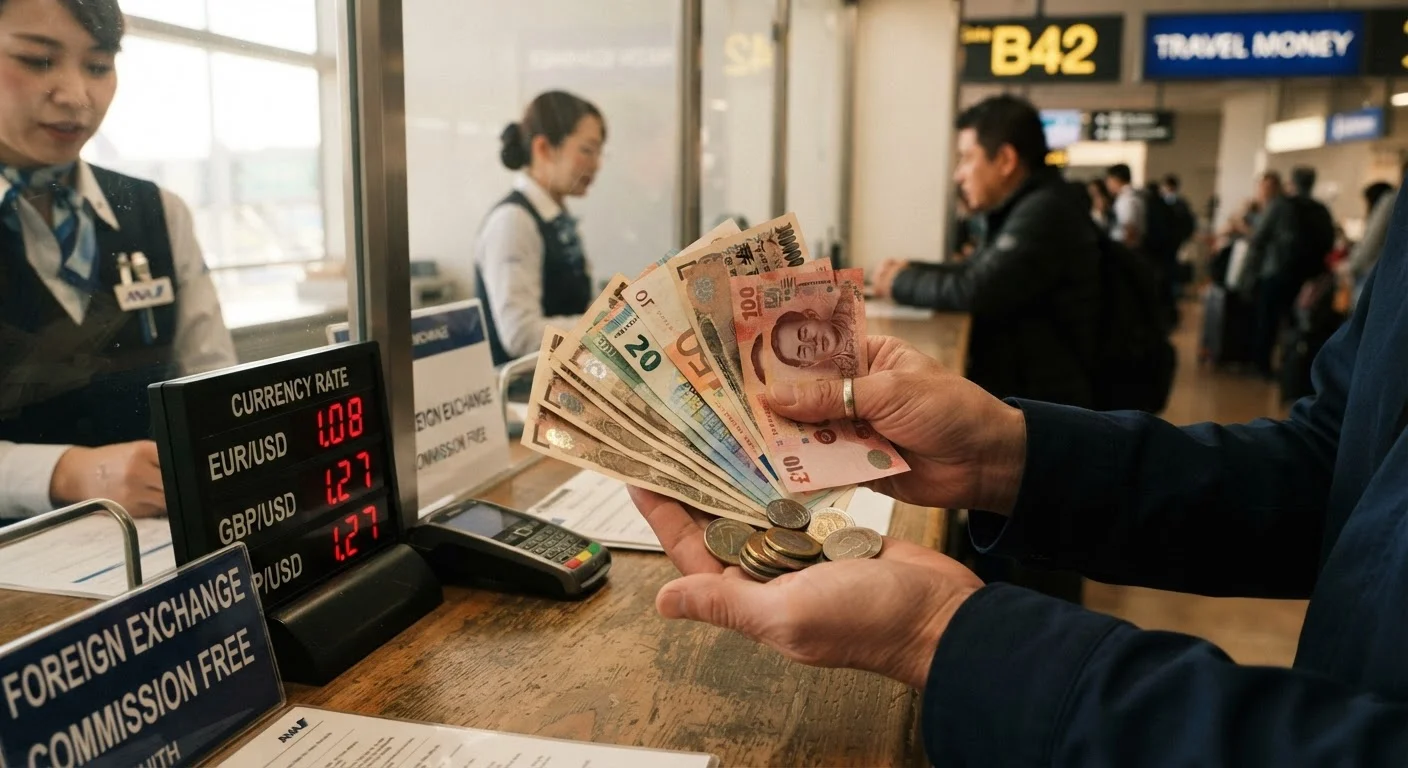
The moment your dollars become euros, pesos, or baht, a quiet tax kicks in — one most travelers never see itemized. Spread across ATM withdrawals, card swipes, and airport kiosks, currency conversion costs can quietly consume 5–10% of your travel budget before you've paid for a single meal. Understanding the terminology puts you in control.
This reference covers the key terms, fee structures, and tradeoffs every international traveler should know. It pairs naturally with the Budget Traveler's Pre-Trip Preparation Checklist — handle your currency planning before you leave, not after you land.
Interbank Rate
The exchange rate that major banks use when trading currency with each other. It's the most favorable rate available and serves as the benchmark against which all consumer rates are compared — consumers almost never receive this rate directly.
Foreign Transaction Fee
A fee charged by your card issuer — typically 1–3% — on purchases made in a foreign currency or processed through a foreign bank. It appears as a separate line item on your statement.
Dynamic Currency Conversion (DCC)
A service offered at foreign ATMs and point-of-sale terminals that lets you pay in your home currency instead of the local one. Rates are set by the merchant or ATM operator and are almost always less favorable than your card issuer's rate.
Spread
The difference between the rate at which a currency is bought and the rate at which it is sold. A wider spread means higher implicit cost to the consumer, even when no explicit fee is listed.
Currency Conversion Fee
A charge embedded in the exchange rate applied to your transaction, distinct from a foreign transaction fee. It may not appear as a line item but is built into the rate you receive.
ATM Operator Fee
A fee charged by the owner of the foreign ATM machine itself, separate from any fee your home bank charges. Both can apply on a single withdrawal.
The Core Fee Types, Explained
Currency costs don't come from one place — they stack. Here's what each layer actually means:
| Typical Foreign Transaction Fee Range | 1%–3% per purchase (General industry range; varies by card issuer) |
| Common International ATM Fee (Home Bank) | $3–$7 flat per withdrawal (General industry range; varies by bank) |
| Airport Kiosk Rate Premium | Often 8–15% above interbank rate (General traveler guidance; rates vary by location) |
| DCC Rate Disadvantage | Typically 3–7% worse than card rate (General consumer finance guidance) |
| Cards That Waive Foreign Transaction Fees | Many travel-oriented cards (Verify with your specific card issuer) |
Foreign transaction fees typically range from 1% to 3% of each purchase and are charged by your card issuer, not the merchant. Many travel-oriented cards waive this fee entirely — check your cardholder agreement before departure.
Currency conversion fees are different. These are built into the exchange rate itself, not listed as a line item. A provider might advertise "no fees" while quietly widening the spread between the interbank rate (what banks charge each other) and the rate offered to you.
ATM fees can be two-sided: your home bank may charge a flat international withdrawal fee ($3–$7 is common), and the foreign ATM operator may charge its own fee on top. Some banks reimburse ATM fees globally — again, worth confirming before you travel.
Dynamic Currency Conversion (DCC) is a trap worth knowing. When a foreign merchant or ATM offers to charge you in your home currency "for convenience," they're applying their own exchange rate — typically worse than your card issuer's rate. Always choose to pay in the local currency.
Where You Exchange Matters as Much as How
Not all exchange channels are equal. Here's a practical comparison:
- Airport kiosks and hotel desks are the most expensive options. Convenience commands a premium — rates are often 8–15% worse than the interbank rate.
- Local ATMs abroad typically offer rates close to the interbank rate. Fees come from your bank and possibly the ATM operator, but the base rate is generally the strongest you'll find without a brokerage account.
- Your home bank or credit union may offer currency orders in advance, often at better rates than airport exchanges, though you'll carry cash before you leave.
- Currency exchange bureaus in city centers vary widely. Rates in major tourist hubs tend to be worse; bureaus in less-trafficked neighborhoods or used by locals often perform better.
These same principles apply whether you're navigating a European rail corridor or paying for ground transport in Southeast Asia — see Ground Transportation Abroad for how payment norms differ by region.
Verify Conditions Before You Travel
Exchange rates, ATM fee policies, and card terms change. Always confirm your card's current fee structure directly with your issuer, and check whether the ATM networks at your destination charge operator fees. Government travel sites and your bank's international services page are the most reliable sources before departure.
Building a Simple Currency Strategy
A practical approach for most travelers: carry a modest amount of local cash for small vendors and taxis, and rely on a no-foreign-transaction-fee card for larger purchases. Withdraw cash in larger, less-frequent amounts to minimize per-transaction ATM fees — making four withdrawals of $200 is cheaper than eight of $100 if a flat fee applies each time.
Notify your bank of travel dates before departure to avoid fraud freezes. Understand your card's fee structure in writing — not from memory. And as you budget your overall trip spending, remember that currency costs are part of the total picture, just like airfare surprises covered in why cheap flights sometimes cost more.
None of this requires a finance degree — just a few minutes of research before you leave. That's time well spent.