

Key Takeaways
- Mindfulness meditation means paying deliberate, non-judgmental attention to your present experience.
- You do not need to clear your mind — noticing thoughts and returning focus is the actual practice.
- Even five minutes a day can be a meaningful starting point for most beginners.
- Research suggests regular practice may support stress reduction and emotional regulation, though results vary.
- No app, cushion, class, or retreat is required to begin.
Start here
What Mindfulness Meditation Actually Is
Clear the confusion
What It Is Not
Try it today
How to Start a Basic Practice
Understand the evidence
What the Research Generally Shows
Stick with it
Common Obstacles and How to Work With Them
What Mindfulness Meditation Actually Is
Mindfulness meditation is the practice of deliberately paying attention to what is happening right now — your breath, your body sensations, sounds around you, or the thoughts passing through your mind — without judging any of it as good or bad. That's the whole idea at its core.
Mindfulness
Intentional, present-moment awareness — paying attention to what is happening right now, internally or externally, without judging it.
Breath awareness
A foundational meditation technique where you focus attention on the physical sensations of breathing as an anchor for the present moment.
Mind wandering
The very normal tendency of the mind to drift away from its intended focus into thoughts, memories, or planning. In meditation, noticing this and returning focus is the core activity.
MBSR
Mindfulness-Based Stress Reduction — a structured eight-week program developed in clinical settings that uses mindfulness practices to help people manage stress and related concerns.
Non-judgmental awareness
Observing your thoughts, feelings, or sensations without labeling them as good or bad — simply noticing them as they are.
The word mindfulness itself simply means intentional awareness of the present moment. Meditation, in this context, is the structured time you set aside to exercise that awareness, much like setting aside time to go for a walk exercises your body. You do not need a quiet room, a special cushion, or any prior experience to begin.
What It Is Not
A lot of people avoid mindfulness meditation because they assume they are doing it wrong before they even try. Two ideas are worth clearing up immediately.
- It is not about clearing your mind. Thoughts will appear — that is what minds do. The practice is noticing a thought has pulled your attention away, and then calmly returning focus to whatever you were attending to. That return is the repetition that builds the skill.
- It is not reserved for a particular type of person. You do not need to be calm, spiritual, flexible, or free of stress to meditate. The practice is specifically designed for ordinary, busy, distracted human beings.
Mindfulness is also distinct from relaxation techniques, though relaxation can be a side effect. If you want tools for an anxious moment right now, the grounding techniques in this companion article can complement a regular meditation habit well.
How to Start a Basic Practice
Below is a simple breath-awareness practice you can try today. No equipment needed.
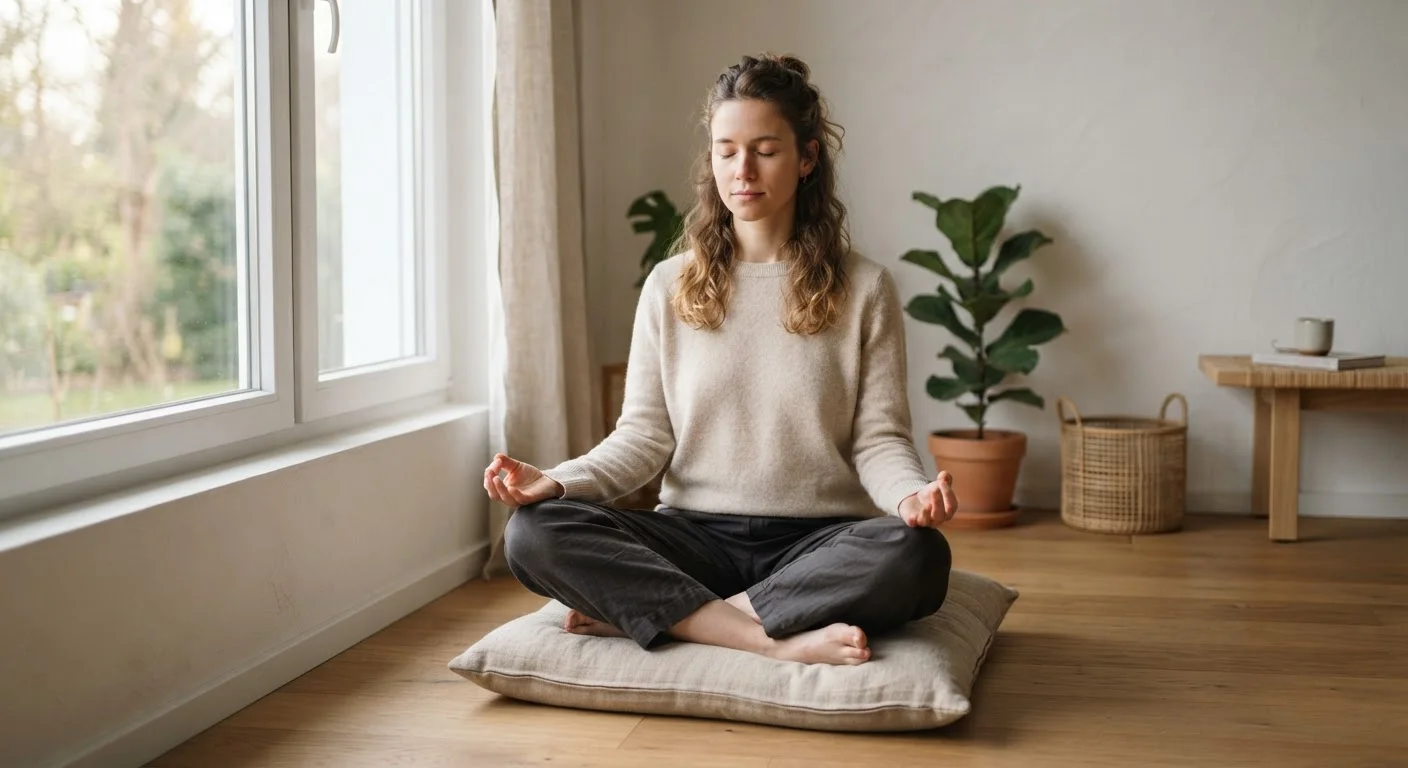
- Find a comfortable position. Sit in a chair, on the floor, or even lie down — whichever keeps you alert rather than sleepy.
- Set a short timer. Five minutes is enough to start. Knowing the timer will signal the end removes the urge to check the clock.
- Close your eyes or soften your gaze downward. Take a few natural breaths without trying to control them.
- Settle attention on the physical sensation of breathing. Notice where you feel it most clearly — the rise of your chest, air at your nostrils, or your belly expanding. Stay there.
- When your mind wanders, gently return. No criticism needed. Noticing the wander is the skill. Return your focus without drama.
- When the timer ends, take a moment before moving. Notice how you feel before resuming your day.
Make It Easier With Habit Stacking
Attach your meditation practice to something you already do every day — like making coffee or sitting down after lunch. This "habit stacking" approach reduces the effort required to remember and follow through. Even a consistent five-minute practice done daily is more beneficial than longer sessions done sporadically.
Pairing meditation with another daily habit — morning coffee, brushing your teeth, or a lunch break — can make it easier to maintain. Writers and health researchers alike note that habit stacking, attaching a new behavior to an existing one, improves follow-through. If you enjoy written reflection alongside quiet practice, starting a simple journaling habit can reinforce what you notice during meditation.
What the Research Generally Shows
A substantial body of peer-reviewed research has examined mindfulness-based interventions. The evidence, while not uniform across every population or outcome, broadly suggests that regular mindfulness practice is associated with reductions in perceived stress, improvements in emotional regulation, and some support for attention and focus. Programs like Mindfulness-Based Stress Reduction (MBSR), developed in clinical settings, have been studied for decades.
It is worth being honest about the limits, too. Effect sizes vary, many studies are small, and research quality is uneven. Mindfulness is not a cure for any condition, and it works differently for different people. Think of it as one evidence-informed tool among many — useful, low-cost, and widely accessible, but not a replacement for professional mental health care when that is what someone needs. For a broader look at structured psychological approaches, see our overview of how Cognitive Behavioral Therapy works.
Common Obstacles and How to Work With Them
Most beginners run into the same few difficulties. Here is how to think about each one.
- "I don't have time."
- Five minutes is enough to begin building the habit. Meditation does not need to be a long ritual to be useful.
- "My mind won't stop."
- This is not a failure — it is just what minds do. Every time you notice your mind has wandered and bring it back, you have completed one successful repetition of the practice.
- "I feel restless or bored."
- Restlessness and boredom are experiences you can observe, just like breath. Noticing "I feel restless right now" is itself a mindful moment.
- "I fell asleep."
- Try meditating earlier in the day, sitting rather than lying down, or opening your eyes slightly. Sleepiness is common and not a sign you are doing it wrong.
The simplest path forward is consistency over perfection. Starting small, showing up regularly, and treating every session — including the awkward ones — as useful practice is how the skill develops over time.
This article is for general informational and educational purposes only and is not a substitute for professional medical or mental health advice. If you are experiencing significant stress, anxiety, or any mental health concern, please speak with a qualified healthcare provider.