

Key Takeaways
- ABS prevents wheel lock-up but does not shorten stopping distances on all surfaces.
- Traction control limits wheelspin — it cannot prevent all skids or compensate for excessive speed.
- Electronic Stability Control reduces the risk of rollovers and spinouts but has hard physical limits.
- These systems work best when paired with correct tire pressure, proper tires, and sensible driving speeds.
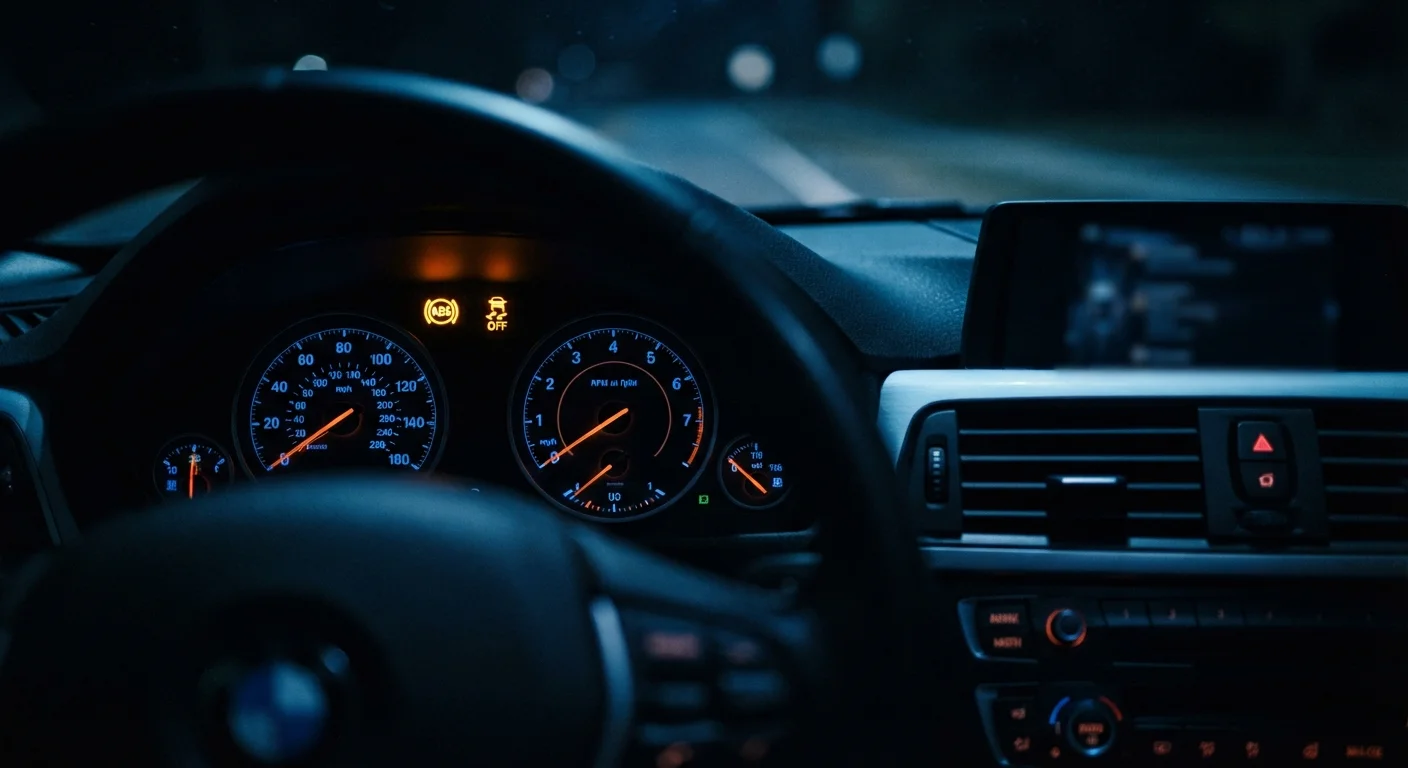
- A warning light for any of these systems means reduced protection — get it checked promptly.
Why Misunderstanding These Systems Is a Real Safety Risk
Most drivers know their car has ABS, traction control, and electronic stability control. Far fewer understand what each system actually does — and more importantly, what it cannot do. That gap between perceived protection and real protection is where accidents happen.
The technology is genuinely useful. But it was designed to assist skilled, attentive driving, not to compensate for speed that is too high for conditions or following distances that are too short. When drivers treat these features as a substitute for good habits rather than a supplement to them, the systems get asked to do things they were never built for.
Myth
ABS helps you stop faster, so you can follow closer and brake later than you would in an older car.
Fact
ABS maintains steering control during hard braking but does not always reduce stopping distance — on loose gravel or snow, it can actually increase it.
Anti-lock Braking System (ABS) works by rapidly pulsing brake pressure to prevent the wheels from locking up completely. This is critical because locked wheels cause the car to slide straight ahead and eliminate your ability to steer around an obstacle.
However, the trade-off on loose surfaces is real. On dry pavement, ABS typically delivers stopping distances similar to a skilled driver's threshold braking. On gravel, sand, or deep snow, a locked wheel can actually build up a wedge of material in front of the tire that shortens the stop — something ABS interrupts. The real benefit of ABS is directional control, not a shorter distance number on every surface.
Myth
Traction control stops you from skidding, so you can safely accelerate through slippery corners.
Fact
Traction control only manages wheelspin during acceleration — it does nothing to control a skid caused by oversteering or entering a corner too fast.
Traction control (TCS) monitors wheel speed sensors and reduces engine power or applies individual brakes when it detects a driven wheel spinning faster than the others. It is specifically designed to prevent wheelspin when pulling away or accelerating on a slippery surface.
What it cannot do is catch a car that is already sliding because the driver cornered too aggressively. That scenario — where the car's momentum exceeds available grip — is outside traction control's scope entirely. Drivers who feel confident because traction control is active often take corners faster than the situation warrants, which is precisely when it offers no help at all.
Myth
Electronic Stability Control (ESC) will always catch a slide before you lose control.
Fact
ESC can correct minor to moderate instability, but it operates within physical limits — extreme speed or abrupt inputs can exceed what the system can recover.
Electronic Stability Control (ESC) uses sensors to compare the direction the driver is steering with the direction the vehicle is actually moving. When it detects a mismatch — an oversteer or understeer condition — it applies individual brakes and may reduce engine torque to bring the car back in line.
ESC has been mandatory on all new US passenger vehicles since 2012, and research from the Insurance Institute for Highway Safety suggests it meaningfully reduces single-vehicle crash risk. But the system needs time, grip, and reasonable inputs to work. At very high speeds or on black ice, the available traction may simply not be enough for any electronic system to restore control. ESC is most effective when the driver hasn't already overwhelmed the car's limits.
For more on how to handle the moments when control does break down, see our article on handling skids and brake failures.
Myth
These systems work the same regardless of tire condition or inflation level.
Fact
All three systems depend entirely on tire grip — worn tires or incorrect pressure directly undermine what ABS, traction control, and ESC can achieve.
ABS, traction control, and ESC are sensor-and-software systems, but they have no way to create traction that the tires themselves cannot provide. A tire with worn tread, a sidewall bulge, or significantly wrong inflation pressure delivers less grip than a tire in good condition — and that reduced grip ceiling applies equally to the safety systems riding on top of it.
This means a driver with bald tires and active ESC is not as protected as a driver with quality tires and no electronic aids at all. Checking your tire pressure regularly and monitoring tread depth are among the simplest and most cost-effective things you can do for safety. Our guide on tire pressure and safety covers the exact numbers to look for.
Myth
If ESC or traction control kicks in occasionally, everything is probably fine — it's just doing its job.
Fact
Frequent system interventions are a sign that you are driving beyond conditions, not a sign the car is handling the situation comfortably.
When ESC or traction control activates, it typically signals with a flashing dashboard light. An occasional flash on a wet ramp or a steep uphill is normal. But if the systems are intervening repeatedly during routine driving, that is a signal worth paying attention to — either road conditions are worse than they appear, or driving speed and inputs need adjusting.
Frequent intervention also adds heat cycles to brakes and can, in sustained use, reduce their effectiveness temporarily. The better response is to treat system activation as a cue to slow down and reassess rather than as confirmation the car is coping fine. For wet, icy, or foggy conditions specifically, our article on adjusting your driving for weather conditions explains what changes to make.
What All Three Systems Share — and Where They All Fall Short
ABS, traction control, and ESC are distinct systems, but they share a common dependency: the tires. Every intervention these systems make — modulating brake pressure, cutting engine power, applying a single caliper — only works through the contact patch between tire and road. If that contact patch is compromised by worn tread, incorrect pressure, or a tire that is simply the wrong type for the conditions, the electronics have less to work with.
~49%
Reduction in single-vehicle crash risk from ESC
The Insurance Institute for Highway Safety (IIHS) has reported that ESC reduces single-vehicle crash risk for passenger cars by roughly 49% compared to vehicles without the system.
2012
Year ESC became mandatory on US new cars
The National Highway Traffic Safety Administration (NHTSA) required ESC as standard equipment on all new US passenger vehicles and light trucks from model year 2012 onward.
This is why proper tire maintenance is not separate from electronic safety systems — it is the foundation they operate on. A car with functioning ESC but underinflated tires is not as safe as one where both are in good condition. Keeping up with routine maintenance checks matters for reasons that go well beyond engine health.
Dashboard Lights Signal Reduced Protection
If your ABS, traction control, or ESC warning light stays on while driving, the corresponding system may be partially or fully disabled. Don't assume everything is fine because the car drives normally. Get the fault diagnosed — these systems are your last line of defense in an emergency. See our guide on what dashboard warning lights mean for more detail.
The bottom line is straightforward: use these systems as the backup they are intended to be. Adjust your speed for weather and road surface, maintain adequate following distance, and keep your tires in good shape. The electronics will handle the rest — within their limits.