

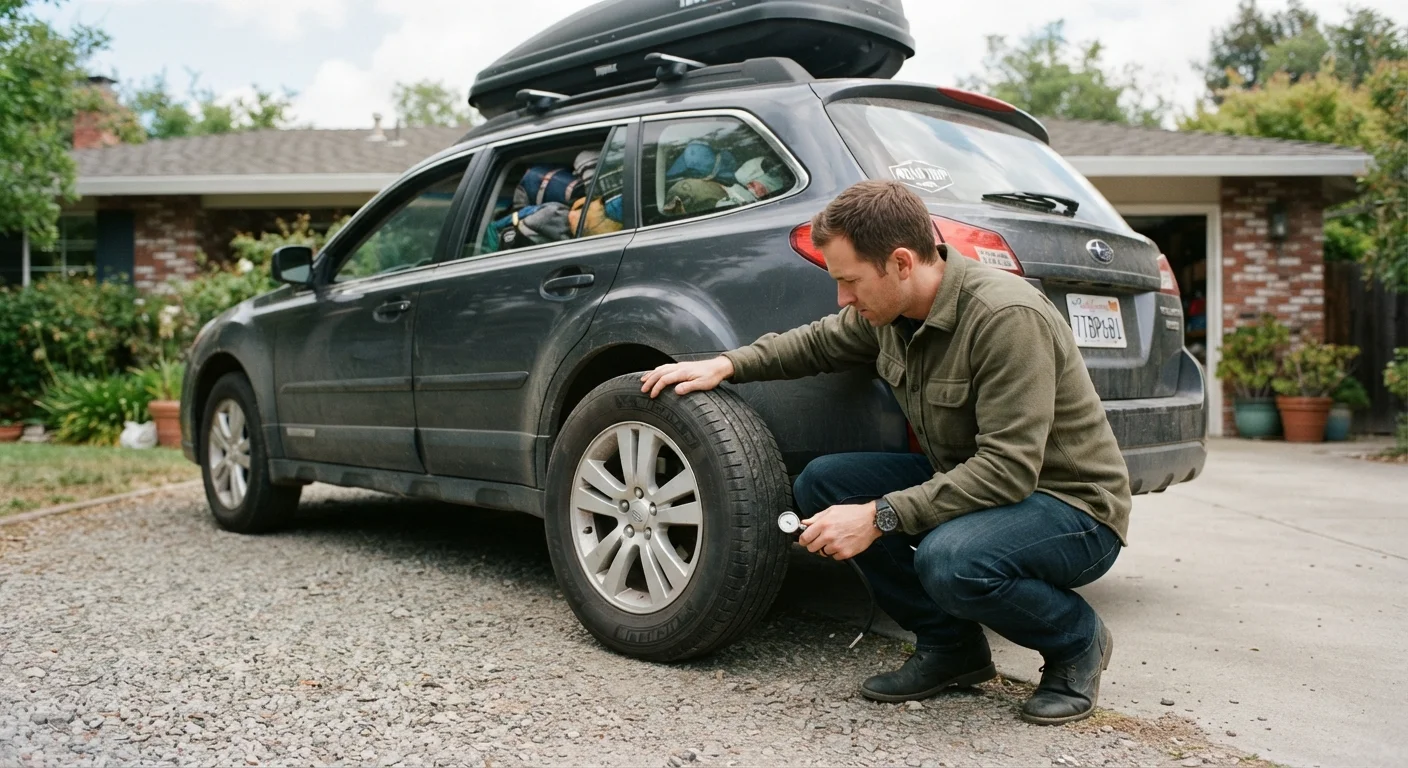
Key Takeaways
- Most pre-trip safety checks can be completed at home with no tools or mechanical training.
- Tire pressure, fluid levels, and lights are the three most commonly overlooked items before long drives.
- Catching a small problem before departure is far less disruptive and expensive than a roadside breakdown.
- An emergency kit in the trunk can limit damage when something does go wrong on the road.
- This checklist applies to any vehicle and takes under 40 minutes from start to finish.
Summary
22 items · 20–40 minutes
Why a Walk-Around Before a Long Drive Is Worth Your Time
Most roadside breakdowns aren't random bad luck. According to industry data, a large share of them involve problems — low tire pressure, dead batteries, empty washer fluid — that a driver could have spotted in the driveway. The trouble is that most of us skip the check entirely because it feels like something only mechanics need to do.
It isn't. You don't need tools, a lift, or any automotive experience to run through the items on this checklist. You need about half an hour and a willingness to look carefully at your own car before you pull out of the driveway.
This matters even more on longer trips. At highway speeds, a problem that would be minor in town — a slow tire leak, a cracked wiper blade — can turn dangerous quickly. If you're heading into a road trip, pairing this vehicle check with broader trip preparation helps you cover both the car and the journey itself.
The checklist below is organized into four logical groups. Work through them in order — it takes less time than stopping at a gas station and costs nothing.
Tires
Fluids
Lights and Visibility
Emergency Readiness
What You'll Need Before You Start
Everything on this list is either free or something most households already own. You don't need a full tool kit — just a few basics to make the inspection accurate rather than approximate.
Tire pressure gauge
Accurately measures PSI in each tire so you can inflate or deflate to the correct level.
Flashlight or work light
Lets you inspect fluid levels, check under the car, and examine tires in shaded areas or early-morning darkness.
Clean rag or paper towels
Used to wipe the oil dipstick clean for an accurate reading and to spot fluid leaks.
Penny (for tread test)
A simple, no-cost tool for checking whether your tire tread meets the minimum safe depth.
Portable jump starter
Allows you to restart a dead battery without needing another vehicle — particularly useful on remote routes.
If your vehicle hasn't had its seasonal systems checked recently, it's also worth reviewing what changes between summer and winter maintenance. Extreme temperatures affect tire pressure, battery performance, and fluid viscosity in ways that this quick check alone won't address.
Never Check Coolant on a Hot Engine
Opening the coolant reservoir or radiator cap when the engine is still hot can cause pressurized fluid to spray, resulting in serious burns. Always let the engine cool completely — at least 30 minutes after shutting it off — before inspecting coolant levels. If the temperature gauge shows the engine is warm, wait.
After the Check: Know Your Limits
This checklist is designed to catch obvious problems you can see and address yourself. It is not a substitute for scheduled maintenance or a professional inspection. If you notice something during your walk-around that you don't understand — an unusual smell, a fluid you can't identify, a warning light that wasn't there yesterday — have a qualified mechanic look at it before you leave.
Driving on a known problem because you're eager to get on the road is one of the most common reasons trips end early. Road trips can unravel for many reasons, but a preventable mechanical failure is one of the most frustrating. Give yourself enough time before departure to act on anything this checklist turns up.
For ongoing vehicle health beyond single-trip prep, the car maintenance hub covers a wider range of routine tasks that keep repair bills manageable over time.
Warning Lights Are Not Optional to Investigate
If your dashboard shows a check engine light, tire pressure warning, or any other warning indicator, do not simply plan to deal with it after the trip. Some warning lights indicate conditions that can cause sudden failures at highway speed. Have the vehicle inspected by a qualified mechanic before departure if you're uncertain what a warning light means.